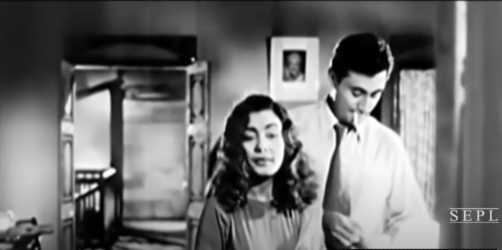
Sara Akash (1969)

When Basu Chatterji passed away in 2020, I wanted to pay a tribute to him, because he was one of my favourite directors from the 70s and 80s (and he directed Byomkesh Bakshi, a television series I love). But given that I restrict my blog to films from before the 70s, there was only one film that would fit: Sara Akash, Chatterji’s first film, which was released in 1969.

This was in June 2020, at the peak of the lockdown. The situation was dire. We were getting news of people we knew who were ill with Covid, even a few who had succumbed. Close family were suffering the fallouts of the lockdown. I tried watching Sara Akash, but couldn’t sit beyond the first five minutes. Perhaps I was not in the right frame of mind.

But now I was tempted to give it another try, because I’d been reading about the film in Anirudha Bhattacharjee’s Basu Chatterji and Middle-of-the-Road Cinema (my review here).

Continue reading

Aadhi Raat ke Baad (1965)

I dithered over this film for a long time after I’d finished watching it. Should I review it? Should I not? It wasn’t a great film, but it wasn’t terrible, either. It wasn’t as if a review was needed to warn potential viewers off it. Or vice-versa, to alert people to a film they must see.

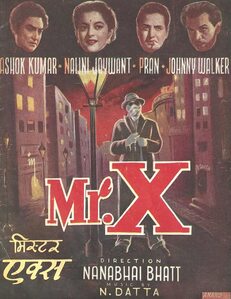
Eventually, I decided that at least a brief review was in order, because this film had an interesting connect to another film I’ve wanted to watch for a while: Mr X.

In 1957, Nanabhai Bhatt had directed a science fiction film (borrowing from HG Wells’s novel The Invisible Man) that starred Ashok Kumar and Nalini Jaywant. According to this web page on Mike Barnum’s blog, the film is about a man who ingests a drug that makes him invisible; he uses this invisibility to go on a Robin Hood-esque spree, helping the poor by robbing the rich. The cops, baffled by the invisible man, dub him Mr X.

I’ve long wanted to watch Mr X, mostly because it features one of my favourite N Dutta songs, Laal-laal gaal. The film isn’t available online, at least, or even on DVD, from what I can tell; perhaps there are carefully guarded prints deep in some archive…

Continue reading

Ten of my favourite spooky songs

Some days back, I watched A Shamshir’s Woh Koi Aur Hoga (1967), starring Mumtaz, Feroz Khan, and Sohrab Modi. It turned out to be one of the most incoherent and illogical films I’d ever seen: Sohrab Modi’s character, a professor, is drugged (by Asit Sen in yellowface, a Chinese villain pretending to be the professor’s Indian servant) and made to do the dirty work of the Chinese: that is, inject hapless victims with something that will drain the blood from their bodies. The corpses are then covered with wax and sold off as mannequins to the wealthy gullible who want realistic-looking statues in their homes (and are possibly not averse to the frightful stench).

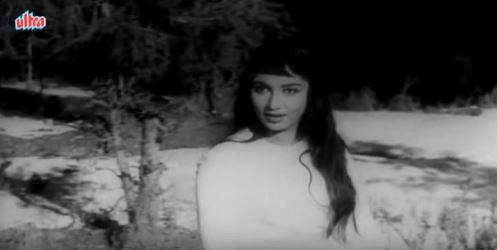
But, digressions aside: there was also, in the film, Mumtaz. Wearing a shimmery white dress and roaming about the hills at night, singing a sad song. Repeatedly.

Watching Ae raat ke andhere mujhko gale lagaa le, I was reminded of many other songs with a similar premise: a ghostly figure (invariably female), wandering about in the night and singing a signature spooky song. There is often an echo, sometimes other props, something else perhaps to suggest darkness, mystery, ghosts.

Continue reading

Mr India (1961)

A simple-hearted—even outright simple, really—man turns out to be the look-alike of a much-wanted criminal. As a result, the police train him to impersonate the criminal so that they can get enough evidence to crack down on a web of crime.

I have no idea if Don (1978) was inspired by Mr India. Don is in many ways a very different film (the criminal, for one, dies fairly early on in the proceedings; for another, it’s a much more complex plot): but there is that fleeting resemblance.

Mr India begins by introducing us to Gullu (IS Johar), naïve and simple, as he goes about job-hunting, and getting rejected at every office because he doesn’t fit the regional profiles demanded by the parochial employers of these places. Gullu gets briefly hired by someone who wants to rig a ‘Mr India’ weight-lifting competition, with Gullu pretending to hoist what is actually wooden dumbbells rather than iron.

Continue reading

Arpan (1957)

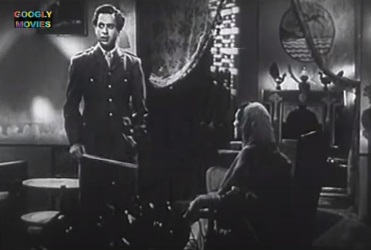
When I was going through Chetan Anand’s filmography last year (to commemorate his birth centenary), I stumbled across a Chetan Anand film in which he starred, besides directing it: a film, too, which immediately struck me as unusual, just given its length: a mere one hour. For a Hindi film, rare indeed. Though I didn’t watch Arpan back then, I bookmarked it and decided I’d watch it sometime later.

And it is an unusual film. Not just short, but also somewhat surreal in places. Hauntingly beautiful at times, outright odd at others.

Arpan is set, we are told, 2,500 years ago. A famine is ravaging the land, and people are starving left, right and centre. In this situation, the royalty, of course, is expected to set an example, and thus Princess Madhavi (Sheila Ramani) is going about, a large entourage with her, distributing food to her father’s subjects.

Continue reading

Nagina (1951)

This Gothic mystery story has an interesting claim to fame: it was the film Nutan wasn’t permitted to watch at the premiere, even though she starred in it.

Nutan had debuted in the film Hamari Beti (1950; it was directed by her mother, Shobhna Samarth) when she was all of fourteen. The following year, after having spent the intervening period at a finishing school in Switzerland, she was cast as the female lead in Ravindra Dave’s Nagina, which starred Dilip Kumar’s brother Nasir Khan. Nagina was released under an A certificate because it was considered too frightening for children; Nutan, then not even sixteen years old, was escorted to the premiere of the film by family friend Shammi Kapoor, but was not allowed in because she was underage.

The story begins [rather choppily; I wonder if this is the modern-day slash-and-burn style of video editing that’s reflected here, rather than the original film’s editing] with Srinath (Nasir Khan) having a conversation with his wheelchair-bound mother (Anwari Bai). As it later emerges from the story, Srinath’s father, a jeweller named Shyamlal, has been missing these last twelve years, ever since he was accused of having murdered the wife of a zamindar, Raiji, over a valuable gemstone (a ‘nagina’) set in a ring.

Continue reading

Naya Daur (1957)

Happy 100th birthday, Dilip Kumar!

It was on this day that Mohammad Yusuf Khan, who was to go on to become one of India’s most-loved and finest actors, was born in Peshawar’s Qissa Khwani Bazaar.

In a career spanning several decades, and some sixty-odd films, Dilip Kumar attained a status all his own. He was one of the first to win a Filmfare Award, and went on to win the most Best Actor Awards (until the record was equalled— though not yet surpassed). His scenes have been copied and re-done, his dialogues have become familiar to fans of cinema, his films and his acting closely dissected.

Continue reading

Kangan (1959)

In which Iftekhar, playing against type, acts the part of a lecherous villain. And Chitragupta, composing against type, proves he was no one-trick pony.

But, to begin at the beginning (and Kangan gets into action right at the start, not dilly-dallying about with incidental stuff). Karuna (Nirupa Roy) is about to get married, and her widowed father (?) is giving her his blessings and wishing her mother were still around. Just then, Kamla (Purnima) comes in; she is not just Karuna’s bridegroom’s sister, but also a good friend of Karuna’s. Karuna’s father leaves the two women together and goes off.

Continue reading

The ‘Not-Naachnewaali’ Gaanewaali: Ten Songs

I have been watching Hindi cinema for most of my life. And for most of my life, too, I have been happily swallowing all the many outlandish tropes and elements that are part of this realm. Not the least the many obscurities and questions that surround songs: how do people think up a tune and words at the drop of a hat, with no rehearsals whatsoever? How do two people who are not even within earshot of each other, manage to sing—perfectly—a duet? Where does the music come from? And how do people who are dancing about energetically manage to sing at the same time?

The naachne-gaanewaali so derided by the ‘shareef’ of Hindi cinema is, in essence, an unlikely character. The Vyjyanthimala of Sadhana, who dances with so much energy, or even the Meena Kumari of Pakeezah, her dance often more sedate, but a dance nevertheless… or the many, many other onscreen naachne-gaanewaalis, from Minoo Mumtaz in Saaqiya aaj mujhe neend nahin aayegi to Kumkum in Dekh idhar o jaadugar: they must be having Olympic athlete-standard fitness levels to be able to dance so vigorously and sing so well at the same time.

But there is the occasional naachne-gaanewaali who doesn’t dance. She only sits, or, at the most, stands up a bit and languidly moves about. No proper dancing. Not, I think, because she realizes that it’s well-nigh impossible to do both at the same time or that she’s conserving her energy, but perhaps because that’s the filmmaker’s way of showing that she is relatively pure. This invariably happens in cases where the heroine is the naachnewaali, sitting in a kotha or other similar house of ill-repute and forced to use her beautiful voice to earn her living. Only her voice, mind you. No more.

Continue reading

Insaaf ka Mandir (1969)

Insaaf ka Mandir is a relatively little-known film which I’d seen many years back, but had forgotten most of. It was fellow blogger Jitendra Mathur who reminded me of this, and my memories of the film were pleasant enough for me to want me to rewatch and review this.

The story begins with Sunil (Sanjeev Kumar), a student who’s just completed his law studies at college when he receives an urgent telegram: his father is very ill, Sunil should head home immediately. A classmate of Sunil’s, Sunita (Snehlata), comes by and, in a brief conversation, confesses to Sunil of her love for him; Sunil, embarrassed, tells her that he will not do anything against his father’s wishes.

Continue reading