Chaar Darvesh (1964)

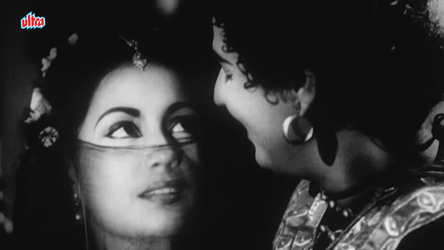
YouTube suggested this film to me, and for a few days, I was torn. Should I watch it (Feroz Khan is not a favourite of mine, though I don’t find him as irritating as some others), or should I not? Sayeeda Khan, after all, is someone I’ve wanted to watch, mostly because I was intrigued—she was married to film director/producer Brij Sadanah, and was murdered by him on their son’s eleventh birthday party (Sadanah also shot and killed their daughter, before committing suicide). Yes, macabre (not to mention tragic), but that’s how it is.

Eventually, it was the music—by the very talented but vastly underrated GS Kohli—that tipped the scales in favour of my watching Chaar Darvesh. Kohli, who did a lot of work as assistant to OP Nayyar (and it shows, in the rhythms and styles of much of his work), composed music on his own for several B-grade films, of which among the best-known are Shikari (1963; easily his magnum opus, with one great song after another) and Chaar Darvesh. Even if just for the music, I wanted to watch this film.

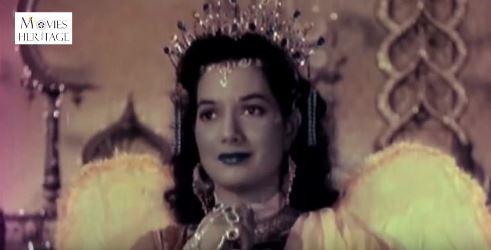
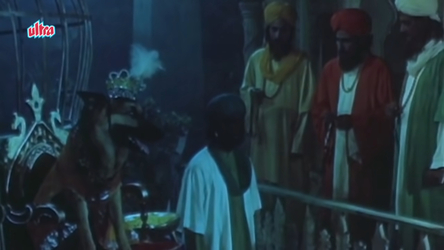
The story is set in some fictitious fantasy kingdom somewhere in the Middle East. At a shrine, three bearded darveshes, clad in flowing robes, have gathered to pray for boons. One is seeking a treasure [that sounds a little shallow, for a darvesh]; another is searching for his sweetheart, who’s gone missing.

These three men have learnt, though, that their wishes will only be granted once they have been joined by a fourth darvesh… who, thank heavens, arrives soon after. This is Qamar (Feroz Khan in blackface), and he proceeds to tell them his tale of woe and to explain how he happens to have turned so black.
Continue reading

Aladdin aur Jaadui Chiraagh (1952)

Some weeks back, when I reviewed Police (1958), the thought that had stayed in my mind regarding Madhubala’s character—and her acting—in that film and otherwise, in the larger context of her career, was that she got sadly stereotyped. Too many people, film-makers most of all, ended up slotting her as the ravishingly beautiful woman who need only be cast for the fact that she could light up a screen like few others could. Her acting ability (which was actually very good) got overlooked far too often.

Something similar, though in a different way, happened to Meena Kumari. In Meena Kumari’s case, the ‘Tragedy Queen’ label got affixed fairly early in the actress’s career and branded her forever as the Main Chup Rahoongi type: the weepy, self-sacrificing, stoic Bhartiya naari. Despite films like Kohinoor, Azaad, Majhli Didi, Tamasha and Bandish, most people today associate Meena Kumari with ‘serious’ roles.

So, this film, which starred Meena Kumari in one of her lighter roles.

Continue reading

Suvarna Sundari (1958)

If you’ve been reading this blog for a while, you probably know that I cannot resist good music; so much so that there are plenty of films I’ve watched just because they happened to have one song which I like a lot. Many of these films have turned out to be complete duds, not at all worthy of the wonderful song which drew me to it—but I do not, in this case, subscribe to the ‘once burnt, twice shy’ philosophy. I go on doing it, often with painful results.

Suvarna Sundari, which I watched for Kuhu kuhu bole koyaliya, will however remain one of the exceptions. A stellar song, but also a very entertaining film.

The story begins in a gurukul, where Prince Jayant of Malwa (Akkineni Nageshwara Rao, ‘ANR’) is about to graduate and go back to Malwa to be declared crown prince. At the prospect of Jayant’s departure, his guru’s daughter (?) gets all het up and confesses her love for him. Jayant, being a good and upright man who knows his guru’s daughter is out of bounds for him, sternly refuses…

Continue reading

Maya Bazaar (1957)

When I did a post on food songs as part of Food and Food Movie Month on Dustedoff last year, blog reader magi posted a link to a very interesting song Vivaaha bhojanambu and told me about the film it was from. Maya Bazaar, which several others also praised as being a very entertaining mythological.

Continue reading

Hatim Tai (1956)

RIP, Shakila.

Yes, this post is a little late as a tribute to one of Hindi cinema’s loveliest actresses—Shakila passed away, aged 82, on September 21—but that was because I was travelling. I heard the news, was saddened and upset, and vowed that as soon as I got back, I’d post something about Shakila. Not a songs list, because I’d already done that. A review of one of her more popular films, then, I decided.

Continue reading

Pathala Bhairavi (1951)

When I’d decided to dedicate this month to regional Indian cinema, I’d also decided that I wouldn’t restrict myself to only the grim, stark ‘real’ films that win awards (Chemmeen, as you will see over the next few films, was an exception rather than the norm). After all, it’s not only the films which win awards that are remembered and loved. There are also films that may not be award-winning material, but are enjoyable and prove to be hugely popular.

Pathala Bhairavi—originally in Telugu, also dubbed in Hindi and Tamil—was one of these.  Although the research I’ve done doesn’t seem to indicate any awards won, this film was a superhit, which ran to packed houses for weeks on end. It was also the only South Indian film to be selected for screening at the first International Film Festival in Bombay in 1952. And—this was what made me want to see it—it was a fantasy film, one of my favourite genres.

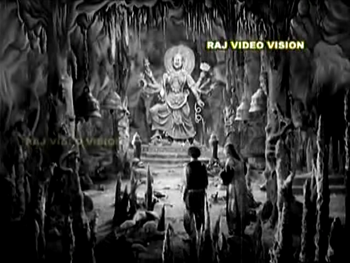
The cave of Pathala Bhairavi

Continue reading

The 7th Voyage of Sinbad (1958)

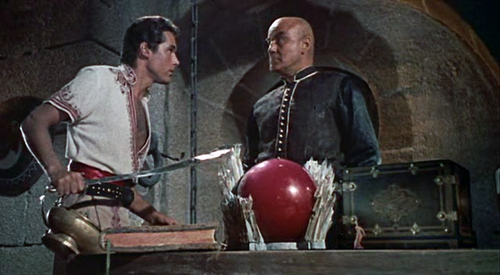
Ever since I began this blog, I’ve maintained one annual tradition: on my birthday, I post a review of a film featuring a film personality who shares my birthday. I’ve reviewed Ittefaq (starring Nanda); Wild in the Country (starring Elvis Presley) and Baghdad ka Jaadoo (with Fearless Nadia). This time, it’s back to Baghdad – with Kerwin Matthews, who, like me, was born on the 8th of January. The 7th Voyage of Sinbad is typical Kerwin Matthews fare: he gets to swing a sword, battle an array of fearsome (sometimes unintentionally hilarious) monsters, and generally be the man who wins the day for the good guys.


So here’s remembering Mr Matthews. Happy birthday, and RIP.

Continue reading

Abe-Hayat (1955)

I’ve been very busy the last couple of days, and the busy-ness doesn’t look like it’ll come to an end soon. My husband, therefore (and what a model of husbandly devotion!) offered to write the review of Abe-Hayat for me. This, mind you, without having seen the film, just on the basis of a very sketchy gist I’d narrated of the first half while we were on our evening walk. Tarun said he’d do a 3-sentence review:
Once there was an evil jaadugar named Saamri. There was a prince, and a princess. The prince killed Saamri, and then he and the princess lived happily ever after.

Continue reading

Ek Sapera Ek Lutera (1965)

And besides that ‘one snake charmer, one bandit’ (and not a single snake, mind you)—there’s also one pretty lady, a nasty patricidal king, a ghost (who appears for all of one very short scene) and a trio of comic courtiers who go bananas trying to differentiate between their crown prince and an impostor. There’s also, to add to the fun, a variety of disguises. And a decent enough score by Usha Khanna, including the depressing hit song Hum tumse judaa hoke.

Continue reading