Pote tin Kyriaki (1960)

Or, in English, Never on Sunday.

In one telling little scene in Pote tin Kyriaki, Greek prostitute Ilia (Melina Mercouri) tells earnest American Grecophile Homer Thrace (Jules Dassin, who also wrote and directed the film) that she is very, very fond of Greek tragedies. In fact, the next performance she’s eager to watch—of Medea—will be the fifteenth time she’ll be watching that particular play. Thrace is surprised, but impressed, too.

… until Ilia, on being invited by her innumerable male friends to tell them the story of Medea, launches forth on a version so garbled and wildly inaccurate that Thrace is left shocked. Not to worry, says a mutual friend, the Captain (Mitsos Ligizos). Ilia likes to be happy; so her interpretation of Medea is tailored to be a happy story, with everybody living happily ever after and going off to the seashore (which is Ilia’s concept of being happy).

Ilia tells the story of Medea

Continue reading

A Christmas Carol (1938)

Merry Christmas!
It’s that time of the year again—and time for a tradition I’ve kept up on this blog ever since its inception. Time for a Christmas movie.

This time, wondering which film I should review, I came across this one, and it appealed to me at once, because I remembered Dickens’s classic story of an asocial and curmudgeonly miser whose life changes one Christmas. I had seen an animated version of A Christmas Carol ages ago on TV, I’d just read the novella that Dickens wrote to help tide him over during a hard spell when money was short. High time (and appropriate time) to watch the film.

A Christmas Carol begins on Christmas Eve in London. As crowds hustle and bustle through streets covered in snow, people rushing briskly about from one gaily decorated shop to another, a young man (Barry Mackay) goes sliding merrily down a little slope of snow. In the process, he makes friends with Tim Cratchitt ‘Tiny Tim’ (Terry Kilburn), who can’t indulge in such treats because he’s lame—and so Fred happily takes Tiny Tim on his shoulders and allows him a taste of the joy of sliding down a slope.

Fred gives Tiny Tim a ride

Continue reading

Kab? Kyon? Aur Kahaan? (1970)

If you’ve been reading this blog for a while, you’ve probably realized by now that I’m a sucker for suspense films. And that I have a soft spot for Dharmendra. And Helen. And Pran. Bring all of those together, and I’m pretty much willing to give it a try. Kab? Kyon? Aur Kahaan? is a film I’d watched many years ago, and liked, so I decided it was time for a rewatch [especially since I’d forgotten pretty much everything of it except for one very taut and tense section]. As it turned out, this was one of those films that make me realize how much more forgiving I was in my younger days. I’d forgotten, for instance, how Babita’s eyebrows managed to give Dharmendra’s a run for their money in the bushiness department.

Babita and Dharmendra in Kab? Kyon? Aur Kahaan?

Continue reading

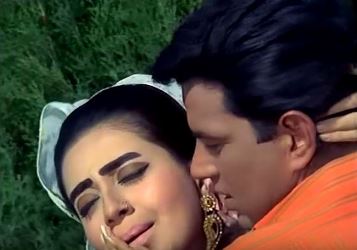
Jhuk Gaya Aasmaan (1968)

Rajendra Kumar is one of those actors whom I’ve repeatedly mentioned as ‘not being one of my favourites’. Saira Banu, beyond her first few films (notably, Junglee and Shaadi), I find too shrill for my liking. Despite the fact that these two star in Jhuk Gaya Aasmaan, it remains one film I like a good deal—because it has such an unusual story.

A story to which there’s a brief nod in the first scene. Sanjay (Rajendra Kumar) and Priya (Saira Banu) meet in what looks like an obviously ‘indoor set’ representation of a cliff. There’s a little banter, she insisting that he’s irritating her with his wooing, he professing his love for her and asserting that he could do anything for her—even give up his life. Priya eggs him on: yes, please. Go ahead. Show us.

Priya begs Sanjay to jump off Continue reading

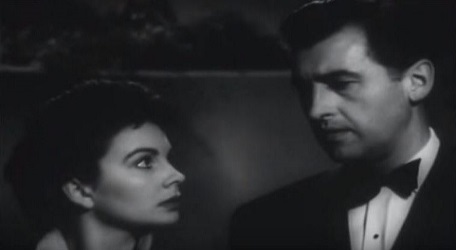
Adam and Evelyne (1949)

This film has been on my to-watch list for years, one major reason being that it stars one of my favourite actors, the very attractive Stewart Granger. It also stars, opposite Granger, the beautiful Jean Simmons, whom he was to go on to marry the year after Adam and Evelyne was released. Plus, what I’d read of this film sounded enticing—romantic, somewhat Daddy Long-Legs style, just the sort of film that would appeal to me.

Stewart Granger and Jean Simmons in Adam and Evelyne

Continue reading

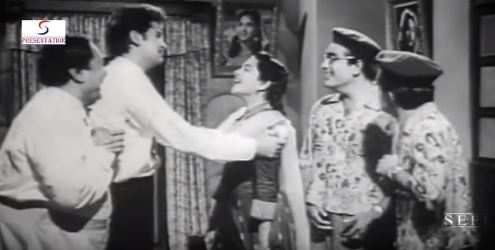
Hum Sab Chor Hain (1956)

I have to admit that I watched this film against all advice. Anu had watched it a couple of years back (and had written up a review of it); but I—remembering a long-ago viewing of Hum Sab Chor Hain, which I’d enjoyed immensely—decided to give it a try anyway.

And, it seems the version I got to watch, while as incoherent in the second half as the one that Anu saw, at least had some more parts intact. The main problem, from what I could see, was that—possibly in transferring the film from celluloid to digital—the reels got mixed up, with one of the reels that should’ve come early in the film ending up later, thus making things very confusing. Despite that (and despite some shameful editing in the last half-hour by the video production company), this evoked one reaction in me: If only this could’ve been available in the original version. Because, if you try to fit the pieces together and imagine what might have been in the bits so summarily chopped off, you can see the outline of what must have been a pretty funny and entertaining film.

Ram Avtar, Shammi Kapoor, Nalini Jaywant, Rajendranath in Hum Sab Chor Hain

Continue reading

New Delhi (1956)

Over the years, I have heard and read much praise for this relatively little-known film. Its songs, which various people have introduced to me over the years, are good, and Anu—whose taste and opinion usually match my own—had good things to say about New Delhi in her review of the film. I decided it was time to watch it for myself.

New Delhi is set, of course, in New Delhi (though a bit of Old Delhi intrudes now and then, even as it does in everyday life in Delhi today). The film begins outside New Delhi Railway Station, where Anand Kumar (Kishore Kumar) has just arrived from Jalandhar, to study radio engineering. Anand hails a passing taxi at the same time that Janaki (Vyjyantimala), who is standing a few steps further along the road, does too. One taxi draws up; both Anand and Janaki get into it, and then start arguing over whose taxi this is.

Anand meets Janaki in a taxi

Continue reading

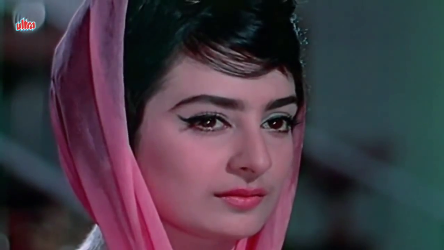
Yeh Zindagi Kitni Haseen Hai (1966)

Every now and then [with distressing frequency], I come across a film that, just by looking at its cast and crew, sounds mouthwatering enough. This was one of those. Saira Banu, when she still looked pretty. Joy Mukherji, still at the height of his career. Ashok Kumar. Motilal. Ravi as the composer. RK Nayyar as the director. Europe.

Sounds good?

Saira Banu in Yeh Zindagi Kitni Haseen Hai

Continue reading

The Woman in Question (1950)

Aka (in the US) Five Angles to Murder.

The last English-language film I reviewed on my blog was Anatomy of a Murder, which, while not strictly a multiple narrative film, was one of those that peeled back layers of a character and a story as the film progressed.

Then, last weekend, I finished Ngaio Marsh’s Died in the Wool, where the detective arrives on the scene of a gruesome murder a year after it’s been committed. He ends up learning all about the victim from those around her—and there are some very conflicting opinions there. Was she a saint, a saviour? An opportunist, a neglectful wife, what?

A few hours after I finished Died in the Wool (since it was Sunday night), I decided it was time to watch something on Youtube. I was looking for nothing more specific than ‘50s suspense films’, and The Woman in Question was among the search results. I began watching it simply because it starred Dirk Bogarde (whom I like a lot)—and then suddenly it took an interesting turn, and there I was, faced with multiple narratives, multiple perspectives, all over again.

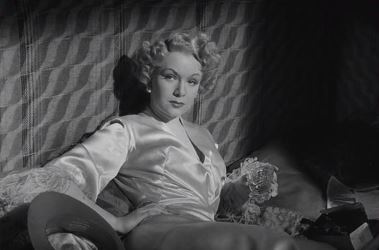
Jean Kent in and as The Woman in Question

Continue reading

Anatomy of a Murder (1959)

A couple of months back, I was invited to an interesting series of sessions focusing on building creativity. This was part of a venture by an organization where I once worked, and the creativity-building exercises take unconventional routes to help employees think out of the box: by watching films and analyzing them, for instance. One of the sessions I attended was presented by a team which used the theme of ‘multiple narratives’ to examine four films. The classic Kurosawa film Rashomon was (of course) on the list; so was the excellent South Korean film, Memories of Murder. The other two films—which I hadn’t seen, though I’d heard of them—were Talwar and Anatomy of a Murder.

The description and brief discussion of Anatomy of a Murder that followed got me interested, and I made a mental note to get the DVD. Then, a week or so back, friend and ex-fellow blogger Harvey recommended the film to me, too, so I decided it was high time I watched it. And what a film it turned out to be.

A scene from Anatomy of a Murder

Continue reading