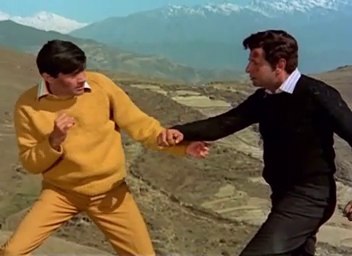
Mohabbat Zindagi Hai (1966)

Considering ‘arranged marriages’ were—and still are—so common in India, the fact that old Hindi cinema tended to focus mostly on ‘love marriages’ seems rather odd to me. It’s more romantic, I suppose, to imagine that one will fall in love and end up, after various trials and tribulations and having encountered sundry obstacles, married to one’s sweetheart.

There were exceptions, though, the occasional film about people getting married first, and falling in love later. There was Ghoonghat, Saanjh aur Savera, Blackmail, or those examples of child marriages, Chhoti si Mulaqat and Ji Chaahta Hai. Most of them about people who are forced—because of their own submissiveness, and because they can’t pluck up the courage to say no to bossy elders—into getting married to near or complete strangers.

Unlike this one. Mohabbat Zindagi Hai is one of the few examples (Mr & Mrs 55 was another) of someone getting married for a very mercenary reason. And, as in Mr & Mrs 55, the heroine here is an heiress who needs to get married in a hurry in order to inherit. No husband, no money. But, unlike Mr & Mrs 55, the heroine here doesn’t marry because she thinks she can easily divorce her unwanted husband soon after; she marries him because he’s on death row. He won’t be alive three days after their wedding.

Dharmendra and Rajshree in Mohabba Zindagi Hai Continue reading

Godaan (1963)

I am not a one to make New Year’s resolutions; more often than not, it’s just something I silently tell myself I should attempt to do over the course of the coming year. At the start of 2014, I decided I should read more classic fiction this year—and, importantly, more fiction that wasn’t originally in English. Since the only two languages I am fluent in are English and Hindi, it meant that the only untranslated works I could read would be in either of those two languages. So, after many years (if I remember correctly, I last read a Munshi Premchand novel in school), I decided to read his landmark novel, Godaan.

…and didn’t even know, till a couple of months back, that it had been adapted into a film. When I discovered Godaan on Youtube, I bookmarked it immediately (noting, though, with trepidation, that it starred two people I’m not especially fond of: Raj Kumar and Kamini Kaushal). And I vowed to watch it as soon as possible, at least while the novel was still fresh in my mind.

Raj Kumar and Kamini Kaushal in Godaan Continue reading

The Last Time I Saw Paris (1954)

Looking through the blog posts I’ve published over the past few months, I realized what a long time it’s been since I reviewed one of those Hollywood classics, the type of film that people tend to recognize the name of, even if they’ve never seen it, or even if the film didn’t win any awards. Or wasn’t, eventually, as in this case, all that great after all. But I wanted to watch The Last Time I Saw Paris for two reasons: one, it stars Elizabeth Taylor, one of the most mesmerizing faces in 50s’ Hollywood.

Elizabeth Taylor in The Last Time I Saw Paris Continue reading

Flower Drum Song (1961)

A very belated tribute to an actor I’ve actually seen only in a couple of films, but whom I like a lot: James Shigeta. The Hawaiian-born Shigeta passed away on July 28 this year, and it came to me as a shock a couple of days ago when I discovered that he was gone—and that no newspaper and none of the sites I occasionally visit—mentioned it. The news, however, made me remember the first film in which I saw James Shigeta: Flower Drum Song, one of his earliest films. Very different from his debut film (the superb The Crimson Kimono, one of my favourite noirs), but enjoyable in its own way—and an interesting commentary, both deliberate and unwitting, on immigrants in the US.

James Shigeta and Miyoshi Umeki in Flower Drum Song Continue reading

Johny Mera Naam (1970)

One day in August, I checked my blog roll and discovered that not one, but two, of my favourite bloggers had posted reviews of films based (even if only in spirit) on The Arabian Nights. Anu had reviewed Ali Baba aur 40 Chor, and Ira (aka Bollyviewer) had reviewed The Thief of Baghdad. Coincidence? Planned? If the latter, then why hadn’t I, the third of the three soul sisters, been included in the plan?
It turned out to have been sheer coincidence, but Anu, Ira and I decided it would be a good idea to actually do a themed set of posts. And what better theme than the one Ira suggested: long-lost siblings, such a favourite trope in Hindi cinema.

So here goes. Head over to Anu’s blog to read her review of the delightful Yaadon ki Baaraat (singularly appropriate, considering the link between Anu and me) and to Ira’s blog to read her take on another extremely popular (and superb!) lost-and-found-siblings film, Seeta aur Geeta. And here, of course, is mine: a review of a film which just manages to make the cut for my blog when it comes to time period. A classic story of long-separated brothers who grow up, unknown to each other, on opposite sides of the law.

Dev Anand and Pran in Johny Mera Naam Continue reading

Mamta (1966)

While watching Pakeezah some months back (and reading Meghnad Desai’s book about the film), I was struck by how fond old Hindi cinema used to be of the motif of the ‘chaste tawaif’. A paradox, seemingly, because how could a woman be a tawaif – a prostitute, to put it bluntly – and be chaste? But films like Pakeezah and Adalat did just that: they portrayed women who lived in kothas, sang (in Adalat) and danced (in Pakeezah) but were ‘good’ women, chaste and pure, women who may have been lusted after by bad men, but who – thanks to fate, good friends and relatives, kind strangers (both human and animal) – were always able to avoid the fate worse than death: of yielding their chastity to a man they were not married to, or weren’t going to eventually marry, even if only in secret.

Suchitra Sen as Devyani/Panna Bai in Mamta Continue reading

Lilies of the Field (1963)

And why take ye thought for raiment? Consider the lilies of the field, how they grow; they toil not, neither do they spin:
And yet I say unto you, That even Solomon in all his glory was not arrayed like one of these.

-Matthew 6: 28-29, King James Version

I am very familiar with this passage from the Bible (part of the Sermon on the Mount, this passage is part of one of my favourites—a beautiful little piece of scripture on how futile it is to worry), but when I first heard of the name of this film, the relevance of its title didn’t strike me. When I started watching it, I realized: yes, the lilies of the field are impermanent, evanescent, depending on no-one and yet not even doing anything very visible to keep themselves alive. But they—like all the flowers of this world, especially the wild ones, with no-one to care for them—are amongst the most beautiful of God’s creations.

Not an exact parallel with the protagonists of this heart-warming and sweet little tale, but close. And with some subtly-put messages about being content with one’s lot, yet pushing on, working hard.

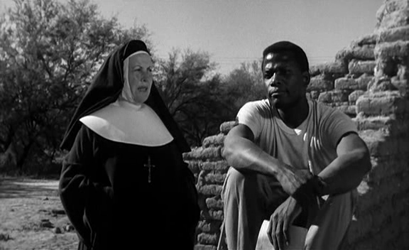
Sidney Poitier and Lilia Skala in Lilies of the Field Continue reading

Ghazal (1964)

Those who frequent this blog have probably figured out by now that I have a soft spot (a very soft spot) for Muslim socials. So much so that I will watch just about any Muslim social out there, even if it features people who aren’t among my favourites. Even if it has a fairly regressive theme, and even if I end up not agreeing with half the things in the film. So, when I come across a Muslim social that stars some of my favourite actors (Sunil Dutt? Meena Kumari? Rehman? Prithviraj Kapoor? Rajendra Nath? Check, check, check), has lyrics by my favourite lyricist (Sahir Ludhianvi), and had its songs composed by one of my favourite music directors (Madan Mohan—and how appropriate, too, for a film called Ghazal to be scored by the Ghazalon ka Shahzaada): to not watch this would be a crime, I thought.

Meena Kumari and Sunil Dutt in Ghazal Continue reading

Only the Valiant (1951)

Someone once told me “I don’t watch Westerns and war movies. Too much blood and gore, too little character development, and no message to take home. Nothing but guts and glory.”

True, if (and this is a very big, very emphatic if) the only war films or Westerns you’ve ever seen are the straightforward action types (and even among those, old films tend to be far less gory than their newer counterparts—modern Westerns and war films like The Thin Red Line, Saving Private Ryan, True Grit, etc are, on the whole, far more graphic than their predecessors). But there’s nothing to stop a film—irrespective of genre—from also being well-written, from having good characterisation and character development, and from being something more than a battle of “let’s see who’s braver”. Some of the best films—in fact, even the films that I’ve found affirming virtues like humanity, peace, equality, and so on—I’ve seen have been war films or Westerns: Paths of Glory, La Grande Guerra, The Searchers

My point being, there are films out there that may seem, at first glance, deceptively run-of-the-mill genre film. Then, at closer inspection, they turn out to be something more.

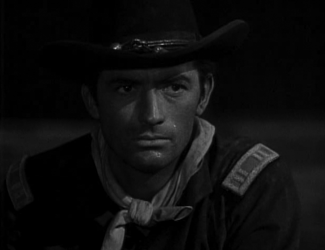
Gregory Peck in Only the Valiant Continue reading