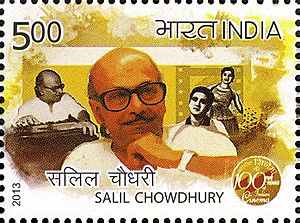
In the 17 years this blog has been in existence, I’ve created song lists for a large number of music directors: OP Nayyar, Madan Mohan, Naushad, Ravi, SD Burman… but somehow, I had never got around to creating a Salil Chowdhury song list. I realized this lacuna some years back, but then, realizing that Salil’s birth centenary was in 2025, I told myself I’d plan a list to mark that. I could not ignore Salil, who has long been one of my favourite music directors.
Continue readingTag Archives: Salil Choudhary
Biraj Bahu (1954)
I have to admit I have never watched this film in all my years of watching and blogging about old Hindi cinema. Part of the reason is, I suppose, that this film—directed by Bimal Roy—somehow always tends to get sidelined in all the praise that’s showered on his better-known works: Do Bigha Zameen, Bandini, Devdas, Parakh, Sujata, Madhumati… then, too, there’s the fact that Kamini Kaushal has never been one of my favourite actresses. I’ve always found her a little affected, her diction and expressions too exaggeratedly innocent.
Continue readingSapan Suhaane (1961)
Starring Balraj Sahni and Geeta Bali. With music by Salil Choudhary.
How could I—with a well-established reputation for watching films based on a single name I like among the crew and cast—pass up this one? Balraj Sahni is a favourite, as is Geeta Bali. And Salil Choudhary is one of those rare music directors for whom I’ll watch a film (even if I could just as well just listen to a playlist of the songs online).
These three were the reason I watched Sapan Suhaane, and I’ll admit that till more than midway through the film, I was congratulating myself on having stumbled on a hidden gem. Or, if not strictly a ‘gem’, at least a film that was watchable enough. After that…
But to start at the very beginning, when we are introduced to Shankar (Balraj Sahni) and his younger brother Dilip (Chandrashekhar). Shankar and Dilip are stepbrothers, but deeply devoted to each other. Shankar has given up his own comfort, his own prospects, in order to work so that he can finance Dilip’s studies.
Continue readingSara Akash (1969)
When Basu Chatterji passed away in 2020, I wanted to pay a tribute to him, because he was one of my favourite directors from the 70s and 80s (and he directed Byomkesh Bakshi, a television series I love). But given that I restrict my blog to films from before the 70s, there was only one film that would fit: Sara Akash, Chatterji’s first film, which was released in 1969.
This was in June 2020, at the peak of the lockdown. The situation was dire. We were getting news of people we knew who were ill with Covid, even a few who had succumbed. Close family were suffering the fallouts of the lockdown. I tried watching Sara Akash, but couldn’t sit beyond the first five minutes. Perhaps I was not in the right frame of mind.
But now I was tempted to give it another try, because I’d been reading about the film in Anirudha Bhattacharjee’s Basu Chatterji and Middle-of-the-Road Cinema (my review here).
Continue readingMem-Didi (1961)
Today marks hundred years of the birth of one of Hindi cinema’s finest directors: Hrishikesh Mukherjee was born on September 30, 1922, in Calcutta. Beginning in the late 1940s, Mukherjee worked as a film editor in Calcutta, before moving on to Bombay, where too he continued as editor, gradually moving on to direction as well. Mukherjee’s first film as director was Musafir (1957), and while it didn’t fare too well, it set the tone for a lot of Mukherjee’s later works: films about everyday people, with everyday triumphs and everyday sorrows. His were not the masala films that have always tended to dominate Hindi cinema, and yet—whether he was making classic comedies like Chupke-Chupke or Golmaal, or more nuanced, sensitive films like Majhli Didi, Satyakam, or Abhimaan, Hrishikesh Mukherjee made films that were hard to fault. He is one of the rare directors for whom I will watch a film just because it’s been made by this person.
Continue readingApradhi Kaun (1957)
The world of Hindi cinema is peppered with names that anyone familiar with the industry (at least the industry of the 50s and 60s) can quickly slot into categories. Star. Villain. Comedian. Character actor. There are many, many names that automatically fall into (almost exclusively) one of these categories. Those that have shifted from one category to another—like Pran, for instance, once the quintessential villain but in later years the more interesting ‘good man’, or Ajit and Premnath, both initially hero and later villain—have again usually not done too many shifts.
Abhi Bhattacharya is one of those relatively rare individuals who seem to have appeared in a wide variety of roles, a wide variety of films. He was the idealistic school teacher of Jagriti, the ‘other man’ of Anuradha. The kind-hearted, principled example of the bhadralok in films like Amar Prem, and the straying older brother of Dev Anand in Love Marriage. He played Krishna and Arjun and Vishnu (the latter in a slew of mythologicals). He even played the villain, in the Vinod Khanna-Yogita Bali starrer, Memsaab.
This year marks the birth centenary of Abhi Bhattacharya (as far as I’ve been able to find out, he was born in 1921, though I’ve not been able to discover exactly when in 1921). To commemorate his career, I wanted to watch a Bhattacharya film, but a dilemma presented itself: which one? Hindi or Bengali? (since Bhattacharya had what seems to have been a very successful career in Bengali cinema as well). Eventually, I homed in on this film, a rare whodunit in Hindi cinema that’s pretty well made too.
Continue readingNaukri (1954)
I have a confession to make: I am not especially fond of Kishore Kumar as an actor. He’s a brilliant singer, and he can be pretty funny in films like Chalti ka Naam Gaadi or Pyaar Kiye Jaa or Padosan—but that, as far as I am concerned, is about it. Asha, Rangoli, Naughty Boy, Half Ticket, Jhumroo, Ek Raaz, Naya Andaaz, Bandi, Manmauji: I have lost count of the number of films I’ve seen because of good songs, or a cast that appeals to me, but have ended up regretting because Kishore Kumar’s antics were so very over the top as to be unfunny.
But then there are films like New Delhi and Naukri, where there isn’t a concerted effort to make Kishore’s a comic character. Films about young men who are like most other young men: trying to go from being boys to men, facing trials and tribulations, trying to laugh through them when they can, caving in occasionally. Not heroes, not comedians, just normal men.
Poonam ki Raat (1965)
One style of mystery story popular in the early 60s (though there was the odd film even earlier, like Mahal) was the one where the suspense includes a seemingly supernatural element. A woman in white, singing a ghostly song of eternal yearning as she wanders half-seen (or unseen) through the gloom. Woh Kaun Thi?, Yeh Raat Phir Na Aayegi, Bees Saal Baad, Gumnaam, Raaz: all of them used this trope to the hilt.
As did this relatively lesser-known film [and you’ll probably realize, by the end of this post, why it’s little-known]. Poonam ki Raat was made by actor/writer/director Kishore Sahu, who played an important role in this film, the star of which was Manoj Kumar, quite a veteran of these suspense thrillers.
Ek Gaon ki Kahaani (1957)
What is it about Bengali directors—Bimal Roy, for instance, or Hrishikesh Mukherjee, or (if one steps out of the realm of just Hindi cinema, Satyajit Ray)—that they manage to bring so vividly to life the everyday happenings in the lives of everyday people? Not the escapist fare that most people tend to equate Hindi cinema with, but stories about real people, people one can relate to? Films like Majhli Didi, Parivaar, Parakh, Sujata, Anand: not larger than life, not without a shred of reality. Not art films, not angst-riddled, songless films about the search for the meaning of life, but everyday stories. Songs and all, still very much commercial cinema, but easy to relate to.
Add to that list Dulal Guha, who while he also went on to make films like Mere Humsafar, began his career as a director in Hindi cinema with this charming little film about a sleepy village named Chandangaon, that’s jolted by the arrival of a new doctor…
Parivaar (1956)
Serendipity isn’t something I encounter too frequently while watching Hindi cinema. More often than not, it’s the other way round: I watch a film because I liked the cast, or because the story sounds appealing, or (and this happens with appalling frequency) because the music is wonderful. That I should watch a film about which I know next to nothing—on a whim, so to say—and find that it’s not just watchable but actually quite enjoyable is something to be grateful about. Which is why this review. Seriously speaking, I hadn’t expected much of Parivaar (the name itself conjures up one of those extremely melodramatic social dramas AVM used to specialise in).
Worse, I had my memories (I wish I could rid myself of them) of having watched the utterly execrable Nanda-Jeetendra starrer Parivaar, one of the worst films from the 60s I’ve ever wasted three hours upon. But, back to this Parivaar, which brought a smile of pleased anticipation to my face as soon as the credits began to roll. Directed by Asit Sen and produced by Bimal Roy, Parivaar is set completely within the large haveli of the Choudhary brothers, where all of them, with the exception of one brother, live as a joint family. Over the first hour or so of the film, we are introduced to these men, their families, and their servants.
Continue reading