Chanda aur Bijli (1969)

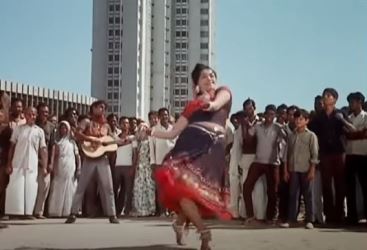
Chanda aur Bijli is one of those films I’ve known about for a long time—because of a family anecdote that is centred around a song from this film. My sister, a toddler when Chanda aur Bijli was released, quickly fell in love with Bijli hoon main toh bijli. Her version of it, though, was somewhat different (and suggests a mind that dwelt rather heavily on food):

Bijli hoon main toh bijli
Bun khaake jab bhi nikli
Logon ke dil mein machhli
(And here she’d add a little line completely off her own bat: ‘Wohi machhli jo Baby ne khaayi thhi!’)

For those who don’t understand Hindi, that means:

Lightning; I am lightning,
When I went out after eating a bun,
There was a fish in people’s hearts
That same fish that Baby ate!

The original, of course, is a rather more predictable Hindi film song:

Bijli hoon main toh bijli
Bal khaake jab bhi nikli
Logon ke dil mein machli

(Lightning; I am lightning,
Every time I went out, tripping along,
I made people’s hearts trip)
Continue reading

Raat ke Raahi (1959)

What a dreadful year this is turning out to be. As if the communal violence at the start of the year wasn’t bad enough, we were then hit by coronavirus. And as I struggle to cope, trying to keep my spirits high in the face of failing economies, loss of income, and of course the threat of a lethal disease—the last thing I needed was the passing of two of my favourite actors. Irrfan Khan and Rishi Kapoor, both very good actors, immensely watchable and with a charisma hard to match, died within 24 hours of each other.

This blog is not about cinema after 1970, so there will not be a separate tribute piece for these two brilliant actors, but yes: I did want to put it out there, my sorrow at their passing, a blow that oddly enough (given that I never even met either of them) hit really hard.

What this is, though, is a tribute to another actor, someone whose birth centenary it is today. Achla Sachdev.

Continue reading

Dragonwyck (1946)

A poor and impressionable young woman arrives at a grand mansion and is blown away by its magnificence—and by the attractive man who is master of the manor. Except that the manor (and the man himself) may have secrets to hide…

Dragonwyck begins at the Wells farm in Connecticut. The Wells are stolid peasant stock: hard-working, sensible, god-fearing. One of their two daughters, Miranda (Gene Tierney) is somewhat less stolid than her parents—especially her father Ephraim (Walter Huston)—would like her to be. At the start of the film, Miranda comes racing into the farmhouse, bearing a letter for her mother Abigail (Anne Revere). The fine envelope and the grand address from which it’s come—Dragonwyck—are enough to convince Miranda that this is a letter of some worth.

Continue reading

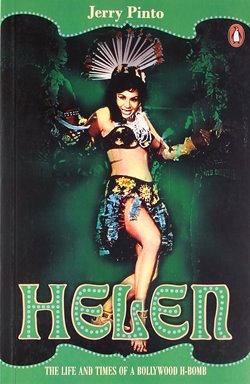
Book Review: Jerry Pinto’s ‘Helen: The Life and Times of a Bollywood H-Bomb’

I won’t go so far as to say that Helen was the first Hindi film actress I remember seeing (that would be Shakila, since CID was the first Hindi film I remember watching). But I distinctly remember being about 10 years old, watching Chitrahaar, and being very excited because an old favourite of mine, a song I had till then only heard and never seen, was going to come on (in Chitrahaar, there would always be a sort of intertitle between songs, a single frame in which the name of the next song, the film it was from, and the names of the music director, the lyricist, and the singer(s) would be listed).

This song was Mera naam Chin Chin Choo, and my feet were already tapping when it began. All that frenetic movement, those men in sailor suits dancing about. The energy, so electric that it even seemed to transmit itself to the musicians. The infectiousness of it all.

And Helen.

Continue reading

Street Singer (1938)

Look what I found!

Considering some of you might not understand the reason for all the fuss and excitement, I ought to back up and provide some context. 

I must admit that till fairly recently, I’d never been a huge fan of 1930s Hindi film music. My first brush with the decade was when I watched Main ban ki chidiya banke as a teenager—it was showing on Chitrahaar—and was in splits because it was so funny. Ashok Kumar was so awkward, the singing was so nasal, the entire song was so far removed from what I liked (the songs of the 50s and 60s), that I couldn’t bring myself to regard the song with anything but mirth. 

I still know very little about the songs of the 30s, and would be hard put to it to name even ten songs from the decade. But if asked to name just one song from the decade, the song that I would name without even stopping to think would be the utterly brilliant Baabul mora naihar chhooto (I actually went out on a limb and named this song as my pick for the 30s in this article I wrote to commemorate hundred years of Indian cinema).

Continue reading

Lockdown Lyrics: Songs for Covid-19 Times

What a horrid year this has turned out to be (and we’re barely past the first quarter, even). First we had all that communal violence, and then—just as we were wondering how much worse it could get—we were side-swiped by … Continue reading

Akahige (1965)

Or, in English, Red Beard.

Today is the birth centenary of one of my favourite actors, the Japanese star Toshiro Mifune. Born in Tsingtao (China) to Japanese parents on April 1, 1920, Mifune  first appeared in Japanese cinema in 1947. A year later, having met director Akira Kurosawa, Mifune was cast in his first Kurosawa film, Drunken Angel. Over the next eighteen years, Kurosawa and Mifune worked together on sixteen films, including several classics like The Seven Samurai, Rashomon, High and Low, and The Hidden Fortress. Alongside, Mifune continued to work with other directors, both Japanese and foreign (one of the more unusual Mifune films I’ve reviewed is Animas Trujano, a Mexican film). Mifune also starred in several Hollywood productions, and set up his own film production company in Japan.

Trying to decide on a Mifune film to review by way of celebration of his hundredth birthday was a tough task: should I go with an early one, like Drunken Angel or Stray Dog? Or one of the many samurai-period films that became almost synonymous with the Kurosawa-Mifune collaboration? Eventually, I settled on this one. Akahige or Red Beard, the last film this great actor and this equally great director made together. Kurosawa and Mifune fell apart during the making of Akahige, and parted ways—but the film itself displays none of that. On the contrary, it’s a well-made, very memorable film about humanity and humaneness.

Continue reading

Ten of my favourite Nimmi songs

RIP, Nimmi.

It has been a nerve-wracking past few months. And just as I thought things couldn’t get much worse—what with the violence in Delhi, coming on the heels of increasingly acrimonious and violent disputes regarding CAA/NRC/NPR—coronavirus struck, and we, as a country, have ended up in lockdown.

And now, this news came. Nimmi, 88 years old, passed away on March 25.

Continue reading

Wuthering Heights (1939)

Since I watched Dil Diya Dard Liya (the Hindi adaptation of Wuthering Heights), I decided it was about time I watched the 1939 film version of the book, too. I’ve seen several English-language adaptations of Emily Brontë’s dark classic (including some TV series), but had never got around to watching this one, which won an Oscar (Gregg Toland, for Best Cinematography, black and white) and received several Oscar nominations, including Best Actor (Laurence Olivier) and Best Supporting Actress (Geraldine Fitzgerald).

Continue reading

Dil Diya Dard Liya (1966)

Despite its having a cast of several people whom I like a lot (Waheeda Rehman, Dilip Kumar, Pran, Rehman, Shyama), a music director whom I like a lot (Naushad) and being by no means an unknown film, Dil Diya Dard Liya is one I’d never got around to watching. Perhaps it is because I had been told by knowledgeable readers that it was based on Wuthering Heights—and I could imagine what a confluence of Wuthering Heights (dark, grim, with two thoroughly selfish and unlikeable leads) and typical Bollywood (melodramatic, with no lead capable of being anything but noble, even if it’s only in the final analysis)—would be like. Mishmash, hard to bear?

But when I posted a Naushad song list in tribute on Naushad’s birth centenary last year, several people mentioned the songs of Dil Diya Dard Liya, and I decided it was time to take the plunge. If for nothing else than Naushad’s music.

Continue reading