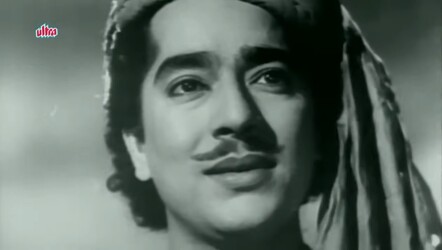
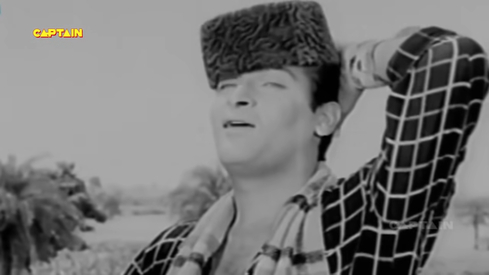
This post is ten days late. January 4, 2025 marked the 100th birth anniversary of an actor who, in an industry dominated by Punjabis, was one of just a handful of Bengali leading men. And, unlike—say, Biwasjit or Joy Mukherjee—to have a respectably long innings as an actor, playing lead roles right through the 50s and 60s, and then continuing as a character actor up to the last years of the 1900s. Impressive.
When, to celebrate the birth centenary (on December 24, 2024) of the one and only Mohammad Rafi, I compiled this list of my favourite Rafi songs for the top leading men of the 1950s and 60s, I was uncomfortably aware that I wasn’t doing justice to Rafi’s oeuvre. Even though I had tried my best to bung in mentions (and links) to many other songs Rafi had sung for these men. Because there were many other Rafi songs I could think of, which he had sung for actors absolutely opposite to these: extras, or actors who had woefully short-lived careers—in many cases men whose entire career might be said to hinge around one fantastic song that Rafi sang for them. A second Rafi list, arranged actor-wise, was therefore in order.
But in between the stars and the entities were a host of other actors who had the honour to lip-sync to Rafi’s voice. These were often character actors, or men who acted as villains. Even, in cases like Sanjay Khan, Premnath and Ajit, men who did appear in a fair number of films in leading roles, but cannot be said to have ever reached the heights of popularity or success of, say, a Dilip Kumar or Dev Anand, or even a Biswajit. They were the in betweens: not at all obscure, but not the Jubilee Kumar types.
Some days back, in celebration of the birth centenary of Mohammad Rafi, I posted a list of ten Rafi songs, picturized on ten different actors. Each of those men—Dilip Kumar, Dev Anand, Shammi Kapoor, even Johnny Walker—were immediately recognizable. Big names in their own ways (yes, even Johnny Walker, whom I personally think of as the greatest comedian to have lit up the Hindi silver screen). But even as I was compiling that list, I was thinking of all the many other times I’ve listened to a Rafi song, and have been unable to put a name to the man who’s lip-syncing to his voice.
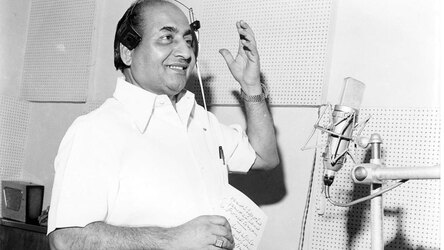
Today, December 24, 2024 marks an important birth centenary: that of one of the greatest singers ever to hail from the Indian subcontinent, the inimitable Mohammad Rafi. Born on December 24, 1924 in Kotla Sultan Singh (Punjab), Rafi would go on to dominate the world of Hindi playback singing in a way few of his contemporaries could, singing thousands of songs, winning awards by the dozen—and rarely (a rarity in itself, in a competitive industry) antagonizing those he worked with.
This is part of an admittedly sporadic series of posts that focus on multiple versions of songs in old Hindi cinema. Composers and film directors have, again and again, homed in on songs that have staying power: songs that audiences wouldn’t mind listening to repeatedly in a film. Multiple version songs, as I’ve shown in previous posts of this type, take various forms. The type, for instance, where both a woman and a man sing the same song, but as solos. Or where a song is sung both as a duet and as a solo. Or, even, where the same singer (male or female) sings the same at two different points, but usually in two different moods.
And then there’s this: where a duet is repeated. Invariably, in two distinct moods. Given that the overwhelming number of duets in Hindi cinema tend to be romantic ones, there’s a certain predictability to the tones of these songs. One version is, more often than not, a happy version: two lovers celebrating their love and vowing eternal fidelity. The other version, just as often, is the complete opposite in tone. Things have fallen apart, fate (or disapproving parents, nasty relatives, lecherous villains, etc) have intervened and either sown the seed of suspicion, or used emotional blackmail to force one of the couple into giving up the other. There are also sorts of possibilities—and they lead, as below, to the old duet being again sung (often as an impossible duet, the estranged lovers physically too far apart to be really singing together).
Many years back, I’d begun doing a series of posts on multiple version songs in old Hindi cinema. Songs that seem to have struck their composers/film directors as so impactful that they needed to be repeated, in different scenarios, sometimes in different moods and even with different singers, singing differing lyrics. I did two of those posts, then something cropped up (I don’t remember what) and the project got abandoned.
But I’ve got back to this now, and here’s a third post on multiple version songs. My earlier posts focused on solos: two-version songs sung by a male singer and a female singer; and the same song, sung by the same singer but in two versions.
This time, I’m focusing on songs that appear at least twice in a film, but at least once in the form of a solo and the other time as a duet (or more: one of the songs in this list has three singers).
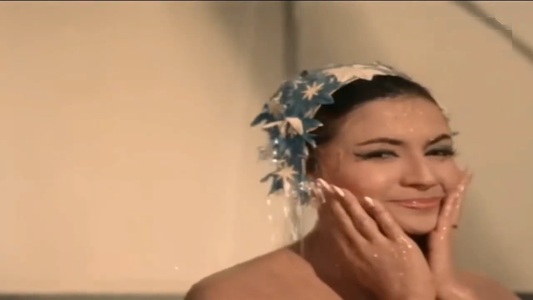
If ‘bathroom singer’ refers to ‘a mediocre or amateur singer’, then Hindi cinema belies that definition: because old Hindi films have plenty of instances of songs sung by people in bathrooms, while bathing, shaving, washing up, whatever—and all perfectly in tune. These bathroom singers are no bathroom singers at all.
If you don’t know what I’m talking about, here’s my list: ten songs that illustrate the point. Barring one song, all are from pre-1970s Hindi films that I’ve seen; the exception is a song from the cusp (1972), but I’ve included it because the film in question (Dil Daulat Duniya) always strikes me more—in tone, look, fashions, actors, etc—as a late 60s one.
The only other criterion I’ve kept in mind is that at least one verse is sung inside the bathroom.
This song list had its genesis in an earlier song list, my ten favourite title songs. In my introduction to that list, I had listed the criteria I had set for that post, and one of them was that I wouldn’t include songs for which the lyrics gave rise to film titles for a completely different film. As examples, I mentioned Yeh raat phir na aayegi (Mahal, 1949) and Dekh tere sansaar ki haalat (Nastik, 1954), both of which led to films with those lyrics as title.
That attracted the attention of several blog readers, and Harvey even suggested that it might be an interesting idea to try doing a list of such songs: songs which had lyrics that were turned into film titles. Harvey suggested a couple of songs that would fit, and so did a couple of other blog readers as well.
Given that I’ve done so many song lists, it surprises me, too, that I’ve so far never done a list of my favourite title songs. Blog reader Naghma (who has suggested some great themes for song lists over the years) suggested this one too, and I was a little taken aback to realize that—though I’d done a credits songs list, and had another noted down for climax songs or songs that end a film—I’d never even thought of doing a title songs list.
Every now and then a blog reader makes a request for a song list. Some I find interesting enough (and challenging enough) to decide to take up.
This is one such: songs that make a mention of a particular garment. A blog reader, an avid participant in antakshari, made this request, having first told me that he found my blog a very good resource for coming up with songs to fit just about any theme. Would I do a song list on items of attire, please? I had already published a list on dupattas/chunaris/odhnis, but beyond that, offhand, I could think of only a handful of other pieces of clothing that had been celebrated in song. It took a good bit of time, effort, and research to dredge up others.