Easter’s here once again, so a review of a film with a biblical theme seemed in order.


Easter’s here once again, so a review of a film with a biblical theme seemed in order.
 For those of you out there who can read and understand French, a book I’d recommend: Le Camée Anglais. Or, in English, The Englishman’s Cameo. The French edition of the novel, published by Éditions Philippe Picquier, will be released on April 8, 2010. It’s been translated by Melanie Basnel, and has a handy glossary at the end too. This is what the blurb on the back cover reads: 1656, en Inde sous le règne Shah Jahan. Un ouvrier bijoutier est injustement accuse du meurtre de Murad Begh, notable de la ville. Heureusement pour lui, il compte parmi ses amis le jeune Muzaffar, un noble un peu excentrique qui a pour fâcheuse habitude de n’en faire qu’à sa tête. Pour sauver son ami, Muzaffar se lance à corps perdu dans la quête du veritable muertrier. A force de prendre au sérieux sa nouvelle vocation de detective, il se retrouve malgré lui au cœur d’une aventure qui l’emmènera bien loin de son quotidian sans surprises et lui fera découvrier ce qui se trame derrière les murs du fort de Dilli, dans les salons des courtisanes et sous les dorures du palais imperial. Corruption, trahison, meurtres et manigances sont monnaie courante dans l’empire mohol. Et Muzaffar va l’apprendre à ses dépens. The book’s available in bookstores across France. You can also buy it online at: Amazon Canada Mollat Frnac Alapage Happy reading!
Years ago, when I was a child, Bronenosets Potyomkin (The Battleship Potemkin) was shown on television. I must have been about 10, perhaps 11—but no more than that. Five minutes into the film and I got bored of the grainy, jerky picture (this was an unrestored version) and the lack of dialogue. A silent film? And that too about a mutiny? Um, no.
For some 25 odd years, that remained my only memory of Bronenosets Potyomkin, even long after I’d discovered that it’s regarded as a sort of cult classic.
An omission, I realised, that needed correction. It was time to dust off Sergei Eisenstein’s magnum opus and see what it was really about.
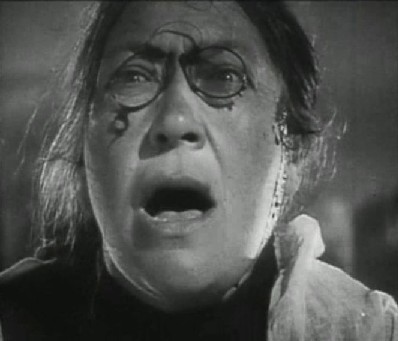
For everybody who lives in Delhi and is fond of books, here’s an opportunity to indulge… on Sunday, March 28, 2010, Friends of Books is organising an event that promises to be enjoyable (and I’m not saying that simply because I happen to be one of the authors who’ll be reading at the event)!
In the words of Arti Jain, of Friends of Books:
Programme:
Ongoing : Book Swap (6:00-8:15 P.M).
6:00-6:30 Madhulika Liddle reads from her travel writing and novel followed by Q&A
6:30-:7:00 Puneetinder Kaur Sidhu reads from Adrift followed by Q & A
7:00- 7:30 Mridula Koshy reads from her forthcoming novel set in Kerala and in the US Midwest.
7:30-8:15 Open Mic
Entry Fee : Free!
The authors featuring at the event are women who at some point chose to take a slightly different path, as authors and as people.
Puneetinder Kaur Sidhu cut loose from the pressures to conform and decided to travel through Europe-alone and for the cost of a dozen beers. Madhulika Liddle, a one time corporate employee left it all behind to wear many hats. A blogger and an author, Madhulika Liddle writes both about her journeys to far off places and about an excursion back into history with her evocative thriller set in Mughal era Delhi. She also takes a jaunt down cinema’s memory lane with her popular blog https://dustedoff.wordpress.com. Mridula Koshy has been a cashier at a Kentucky Fried Chicken, swap-meet sales clerk, backstage dresser at fashion shows, waitress, polisher of silverware, writing adviser, a professional advocate of multiculturalism, a house painter, receptionist at a law firm, collator of tax forms, union organizer and community organizer. She has also made life-altering journeys between two continents and woven her experiences into stories.
At the ‘Open Mic’ session, share your own stories about places far and close or read from your favorite travelogue or memoir, take us to another era- past or future. Take us on a journey.
Join us for the Book Swap where you get to take back as many books as you bring to the table. Sharing is caring! (Note that any books you bring must be in good condition).
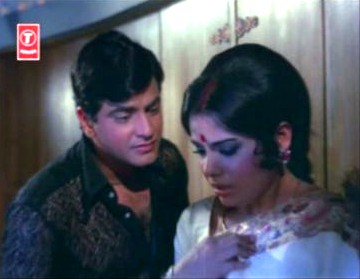
Though I usually restrict this blog to films up to about 1970, I occasionally make exceptions for films that have a 60’s feel to them—Fiddler on the Roof, for instance. And this one, which despite the bell bottoms, the unbelievably gaudy outfits of the supporting cast and the horrendous decor, has a definitely 60’s feel about it. Another reason (and one which I’m not ashamed to admit is probably the main reason) that I’ve decided to make an exception for Ek Nari Ek Brahmachari is that it stars the lovely and vivacious Mumtaz, one of my very favourite actresses.
Okay, one last post for Shashi Fest.
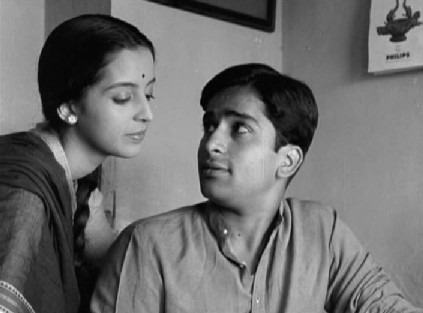
There’s something a little strange about seeing a film you’ve heard so much about. An English film, but with a primarily Bollywood star cast? With a story line that wavers between the usual hiccups of a middle class urban couple, doing the painful transition from carefree single existences to married life—and an American, floundering about as he tries to reach for a higher spirituality? Part Indian, part foreign outlook? And all of it with its roots in the Manusmriti, which says that of the four states of man, that of the grihastha (the householder) is the most important…?
I’d planned to watch (and review) something quite different this week, but when Beth announced Shashi Fest, I couldn’t resist the temptation to participate. That resolve was strengthened when I realised that in a year and a half of blogging about cinema, I’ve never once reviewed a Shashi Kapoor starrer. For shame! This, therefore: a farcical and fun film that never lets itself slip into seriousness. It features some of Hindi comedy’s greatest stalwarts, has superb music, and—of course—stars Shashi Kapoor, showing how good he is at comedy.

The other day, just for kicks, I was trying to make a mental list of all the directors, 30’s-60’s, whose work I admire. Guru Dutt. Akira Kurosawa. Hrishikesh Mukherjee. Bimal Roy. Raj Khosla (usually). And, of course, the inimitable Alfred Hitchcock. That led to another realisation: I haven’t seen, or reviewed, a Hitchcock film in months. Therefore this, an unusual Hitchcock in that it’s not a suspense film. Instead, it’s a ‘journey’ film, set in a lifeboat bobbing about on the high seas during World War II.

Today’s Holi and much of Delhi has been busy slathering everybody else with colour. Out in the street (and in the neighbours’ yard) I saw people drenched in purple, green, yellow and red.
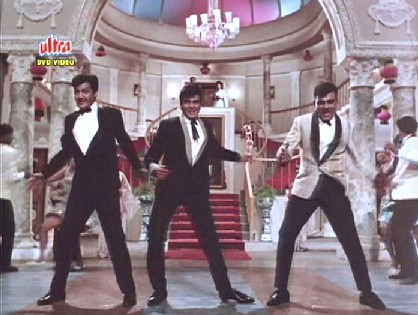
My husband and I don’t celebrate Holi—we’re both too fastidious and have better things to do in life than wasting hours getting colour off ourselves. So here’s my way of celebrating Holi: watching a Hindi film. And that too a colour film—yes, I’ve suddenly realised that the last Hindi colour film I reviewed was Leader, way back in June 2009. A situation pleading to be amended!
The first time I heard about this film, it was in connection with the Hindi film Do Bigha Zameen (1953), the story of a poor family that tries desperately to cling on to the one thing that stands between it and utter destitution—a tiny plot of land. I’d heard that Do Bigha Zameen was based on Vittorio De Sica’s Ladri di Biciclette (The Bicycle Thieves).
Having finally seen this, I have to admit I find little similarity between the two films. True, as in Do Bigha Zameen, here too only one thing can save the family from starvation: in this case, a bicycle. And here too, it’s the father and his young son who set out together in a desperate attempt to save themselves. Other than that, the tone, the story and the general mood of the two films is very different. And much as I admire Bimal Roy, I have to admit: De Sica wins. Ladri di Biciclette is much more powerful and haunting than the relatively melodramatic Do Bigha Zameen.

 Dustedoff