Ek Phool Do Maali (1969)

A very frank admission: I am not intellectual. I cannot summon up the brainpower to analyse a film and go deep into the philosophy of it—which is why arty films are completely lost on me. I never, after seeing a film, question it, delve into its profundities, or explore the hidden meaning of so and so scene.

I am therefore proud to announce that I have finally seen a film that has gone a long way in remedying this lamentable situation. Ek Phool Do Maali made me sit up and think. It made me ask a lot of questions. And it made me vow never to assume that just because a film had a cast I generally liked, meant that the film would be good too.
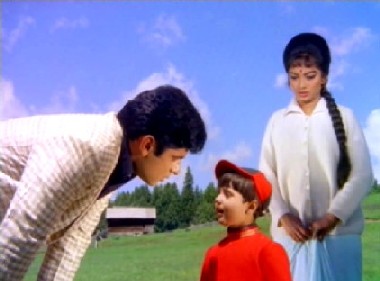
Sanjay Khan, Bobby and Sadhana in Ek Phool Do Maali

Continue reading

The Trouble with Harry (1955)

Looking through my blog archives, I realised that the last Hitchcock film I reviewed, Dial M for Murder, was way back in November 2008. For someone who’s a self-confessed Hitchcock fanatic, this amounts to blasphemy. Service recovery seemed in order.
May I present, therefore, one of my favourite Hitch films: The Trouble with Harry. In true Hitchcock style, it’s full of suspense—but a suspense that’s quirky in the extreme. This is dark humour: farcical, irreverent, and very funny. No, not typical Hitchcock, but one of his best works.

Shirley MacLaine, John Forsythe, Mildred Natwick and Edmund Gwenn in The Trouble with Harry

Continue reading

Raat aur Din (1967)

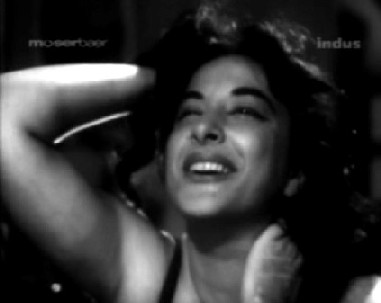
I’m always on the lookout for old, offbeat Hindi films. Something without the hackneyed romances, the clashes between rich/poor, urban/rural, good/evil, the sudden breaking into song and the neat tying up of all loose ends once the regulation three hours are up. Don’t get me wrong; I have nothing against masala films—some of my favourite old films are masala to the spice-sodden core. But somehow a film like Kanoon, Ittefaq, Anokhi Raat, Kabuliwala or Dekh Kabira Roya, each unusual in its own way, has a certain je ne sais quoi. So does this, Nargis’s last film. There’s something a little hat ke about a film in which the romance is really quite minimal, and the strange light-and-shadow personality of a schizophrenic woman is the main focus of the plot.

Nargis in Raat aur Din

Continue reading

Send Me No Flowers (1964)

Every now and then, I come across a film that makes me wish there were more like it. This is one of those: full of laughs, very enjoyable and utterly repeatable.
Doris Day and Rock Hudson had already starred in two fabulous romantic comedies—Pillow Talk and Lover Come Back—before they worked together for the last time in Send Me No Flowers. Unlike the two earlier films (which had very similar plots: girl falls for a guy who’s a wolf in sheep’s clothing), this one isn’t a romantic comedy per se; more an out-and-out comedy. But yes, there’s plenty of love and affection, and Hudson and Day look gorgeous together!

Rock Hudson and Doris Day in Send Me No Flowers

Continue reading

Asli-Naqli (1962)

I tend to associate Hrishikesh Mukherjee with films that focus on the everyday lives of people like you and me (I’m assuming here that you aren’t a multimillionaire, a film star or something equally glamorous; I’m not, at any rate). Anupama, Anuradha, Anand, Satyakam—all of them amazing films whose protagonists are very real. Asli-Naqli is perhaps a little different, because it begins in the world of the spoilt young heir of a very rich man.

Dev Anand in Asli-Naqli

Continue reading

I’m No Angel (1933)

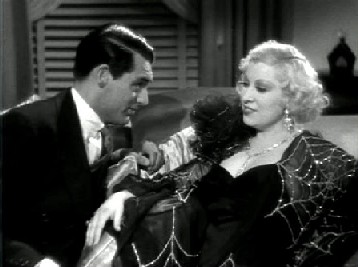
I’d heard lots about Mae West, and seen plenty of still photos, but never any films. So when I came across this one, it seemed like a good introduction to the star—especially as I’m No Angel also stars Cary Grant. I’m all for Mr Grant: that man was awesome.
One and a half hours (or what was it? Seemed like an eternity) later, I’m wondering what this was all about. Mae West has some great one-liners in the film (she wrote it, after all—story, screenplay and dialogues; so all the juiciest lines are hers), but other than that? Ahem.

Cary Grant and Mae West in I'm No Angel

Continue reading

If only I were a film star…

……I’d have had a vegetable named after me.

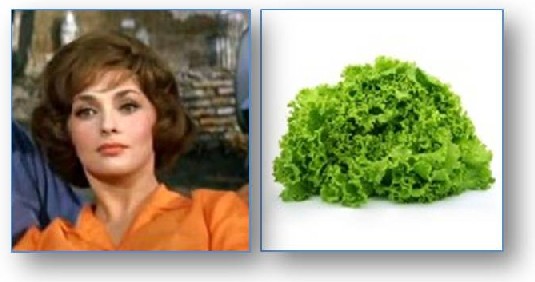
Seriously. Gina Lollobrigida has a humble lettuce named after her. The lollo lettuce—green and red varieties—supposedly looks like the gorgeous Italian’s hair style, all curly and wavy and yummy. See the resemblance?

Gina Lollobrigida and lollo lettuce

Continue reading

Kabuliwala (1961)

There are some films I see because of the people who act in them (Shammi Kapoor, Asha Parekh, Mumtaz, Dharmendra, etc). Some I see because of the people who direct them (Guru Dutt, Vijay Anand, Raj Khosla). Some—relatively few—I see simply because of the music (Parasmani, Aah, Saranga—pretty awful otherwise, but great music).
And then there are some I see because they’re a bit of it all. Like Kabuliwala. The story’s by Rabindranath Tagore, it’s produced by Bimal Roy (directed by Hemen Gupta), it stars Balraj Sahni, and it has one of the loveliest patriotic songs I’ve ever heard: Ae mere pyaare watan.

Balraj Sahni in Kabuliwala

Continue reading

Scaramouche (1952)

The French Revolution’s been the setting for a handful of films, but I’ve got to admit I don’t much care for everything that’s been produced. For instance, A Tale of Two Cities—despite starring Dirk Bogarde—has too sad an end to invite repeated watching. The Scarlet Pimpernel, though definitely more entertaining, stars Leslie Howard and Merle Oberon, neither of whom tops my favourites list.

Scaramouche, with an oh-so-ooohh Stewart Granger in the title role, some absolutely unbeatable swordplay, lots of wit (plus two beautiful heroines), therefore wins hands down. You may not learn much about the French Revolution, but entertainment’s guaranteed.

A scene from Scaramouche

Continue reading

Ten of my favourite O P Nayyar songs

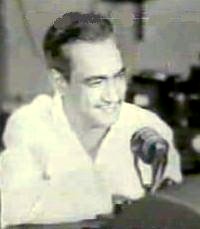
My sister gave me Ganesh Anantharaman’s Bollywood Melodies: A History of the Hindi Film Song for Christmas. Yes, I know, my sister’s a gem: I adore her. I also adore a lot of the people Anantharaman writes about in his book. He admits he’s biased towards classical music, but then he does go on to acknowledge the worth of people like O P Nayyar, who’s a classic example of unclassical.
Omkar Prasad Nayyar was born on January 16, 1926 (now you know why this post today, of all days). He grew up in Lahore, and was composing music for All India Radio Lahore by the time he was fifteen (makes me feel utterly worthless. All these child prodigies do). When India was partitioned in 1947, Nayyar left Lahore and came to Bombay. Thank heavens. The rest, clichéd though it may sound, is history.

O P Nayyar

Continue reading