Hindi film characters with books, Part 2

Just last month, on the occasion of World Book Day (in Britain and some other parts of the world), I published a post on characters in English-language cinema who are readers. This post had been inspired by a much earlier post, from some years back, where I had listed characters from Hindi cinema who are shown with books. This time, for the English books post, a blog reader suggested I do a sequel to the post on books in Hindi cinema.

And why not, I thought. After all, books aren’t all that uncommon in Hindi films. True, Life magazine or newspapers do seem to rule the roost when it comes to people reading, but there are books to be seen now and then.

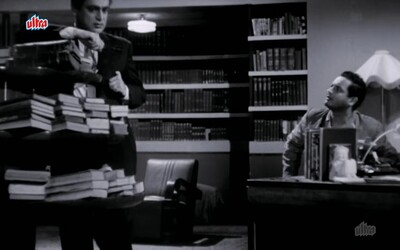
Today, April 23, is the day designated by UNESCO as World Book Day. And here is the sequel to that long-ago post on characters in Hindi cinema with books: another instalment of screenshots of Hindi film characters with books; and not just characters with books in the background, such as this:
Continue reading

Lata Mangeshkar: Ten Solos, Ten Composers – Part 3

When I posted a Lata Mangeshkar tribute to mark the passing of the singer, I had thought I’d just focus on ten songs with ten different composers; but that, as it turned out, wasn’t enough. There were too many composers, too many good songs, that fell by the wayside in compiling that first post. So I ended up compiling a second, follow-up post, with ten other composers. In the process, I wound up with more songs, more composers than could fit in that second post.

Here, then, is a third list of solos sung by Lata Mangeshkar: ten songs, ten different composers. Of course, none of these composers feature in my two earlier lists. Also, these songs do not overlap with the ones on my very first ‘Lata in Ten Moods’ song list. As always, these songs are all from pre-1970s Hindi films that I’ve watched.

Continue reading

Ten memorable food scenes from Hindi cinema

While ‘food songs’ are not utterly unknown in old Hindi cinema, it’s rather more difficult to track down memorable scenes featuring food. Talk about new cinema, and it’s easier—and when I talk of ‘new’ cinema, I don’t just mean very recent films like Stanley ka Dabba, The Lunchbox, Cheeni Kum, or Chef: I even mean films from the 70s and 80s.

There was Bawarchi, where Rajesh Khanna’s eponymous bawarchi promised Harindranath Chattopadhyay’s character shukto and some three hundred or so types of chutney (he also made kababs out of elephant yams). There was Amitabh Bachchan, surreptitiously stuffing himself on a thali full of puris and other goodies in Do aur Do Paanch, only to be stuffed all over again by a stream of little kids, all instigated by a wily rival (Shashi Kapoor). In Sau Din Saas Ke, Lalita Pawar played an evil mother-in-law, so vicious that she tried to poison her bahu with kheer simmered with gecko.

Pre-70s cinema is a little less easily remembered for its food scenes.

Continue reading

Ten of my favourite Khwaab/Sapna songs

Some months back, I was listening to a music programme on the radio, and heard a song I hadn’t heard for ages: the title song from Dreamgirl. Once upon a time, a six- or seven-year old me used to love Kisi shaayar ki ghazal, not just because it sounded good, but because to me, Hema Malini, in all those frilly, frothy dresses was just—oh, gorgeous. This time, I heard the song with a warm sense of nostalgia; and it struck me that dreams have been, for a long time now, an important part of Hindi cinema. And of Hindi film songs.

For one, there are several songs which are set completely in people’s dreams. The heroine (or the hero) goes to sleep and dreams of singing a song along with the beloved. Then, there are songs which fit the very specific cinematic style known as the dream sequence: a dream which does not require anybody to be really asleep (though some of the best dream sequences in cinema history do involve people who are asleep). In a dream world, there can be little semblance to reality: special effects, grand backdrops, feats that people would not achieve in real life—all come to the fore, and are celebrated, in dream sequences. Look at Ghar aaya mera pardesi, for instance.

And then, there are the literal ‘dream songs’, songs which talk about dreams. Dreams in which the beloved features, dreams about a rosy future alongside the love of one’s life. (It’s interesting that dreams, in the context of Hindi film lyrics, almost always seem to refer to happy dreams, never nightmares. Those dreams may be shattered, but that doesn’t mean they weren’t wonderful to start with).

Continue reading

Anuradha (1960)

While I’m a sucker for masala films that bear not a shred of resemblance to reality, I’m also very fond of the sort of films that directors like Bimal Roy and Hrishikesh Mukherjee sometimes made: films about everyday people and their everyday lives. The protagonist of this film, Anuradha, is one of those: a young woman who gives up her dreams for the love of a man—only to discover eventually that even that sacrifice hasn’t brought her what she wanted.
And this is, of course, a belated tribute to one of Hindi cinema’s most luminous faces: Leela Naidu. If I hadn’t been exulting over Robert Mitchum last month when Leela Naidu passed away, I’d probably have reviewed this film then. But better late than never, I guess. RIP.

Leela Naidu in and as Anuradha

Continue reading