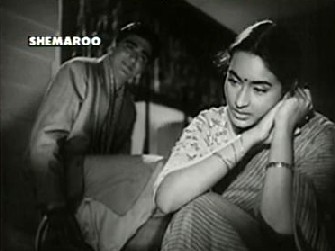
The last Hindi film I reviewed was a Bimal Roy production – and it left me feeling very disappointed. To get over that (and to remind myself that Bimal Roy’s films can generally be counted upon to be good), I decided to rewatch this one, an old favourite that reinforces Bimal Roy’s style of film-making: everyday stories of life, real life, with all its joys and sorrows and mundane happenings.
Tag Archives: Asit Sen
Benazir (1964)
‘Bimal Roy’s Benazir’ is what it says on the DVD cover. Enough to conjure up, for me, memories of some of the greatest Bimal Roy films I’ve seen: tender, thought-provoking, real films about real people. Benazir, perhaps because it wasn’t directed by Bimal Roy himself but by S Khalil (who also scripted the film) falls short of the standard of Parakh, Prem Patra, Sujata, Do Bigha Zameen, or Bandini. A top-notch cast, a very well-respected production company, a master music director—but why does this film rarely get mentioned in the same breath as those?
Junglee (1961)
For a lot of people of my generation – or those younger than me, who have seen Shammi Kapoor in his earlier films, this is the film that is probably representative of Shammi Kapoor: the ‘Yahoo! Kapoor’ as a friend of mine says with a sneer.
Junglee is one of the major successes of Shammi Kapoor’s heyday. It is also, with Shammi’s wild whooping and crazy antics in songs like Suku suku, an important reason for him getting saddled with that ‘Yahoo! Kapoor’ epithet.
Mere Sanam (1965)
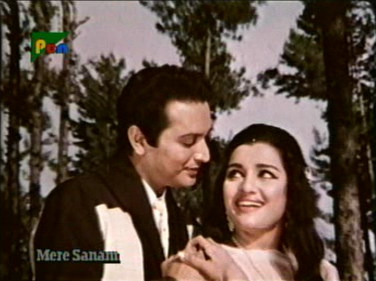
Nasir Hussain may have made his Tumsa Nahin Dekha story into four separate – and equally successful – films, but did that induce others to be original? On the contrary. Narinder Bedi, at least, probably seemed to think that what worked for Nasir Hussain might well work for him. Therefore, Mere Sanam, which has a storyline similar in many ways to Tumsa Nahin Dekha. (Both films also have fantastic music by OP Nayyar, by the way).
Bees Saal Baad (1962)
Several people who read my last post – which, as I’d mentioned, was an adaptation of a suspense novel, and in turn was remade in another language – guessed what this post would be all about. You were all kind enough to not let the cat out of the bag, but I guess you all got it right. The Hound of the Baskervilles, made in 1939 with Basil Rathbone as Sherlock Holmes, was remade in Hindi 23 years later, as Biswajit’s first Hindi film, Bees Saal Baad.
Shaheed (1965)
One thing that has long puzzled me is Bollywood’s reluctance to do real life stories. Where Hollywood has created films on the lives of people ranging from Napoleon’s one-time fiancée to an obscure British missionary in China, we have, to show for years of fascinating history… Shahjehan and Changez Khan, both so badly warped that they bear little resemblance to fact. Dr Kotnis ki Amar Kahani is a refreshingly unusual film in being relatively accurate, as well as entertaining—but a flash in the pan.
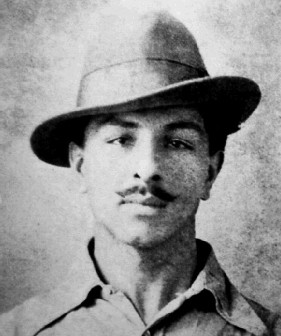
Our generally avid enthusiasm for the freedom movement and its exponents gave me hope that Shaheed, the story of Bhagat Singh, might be worth a watch. This, after all, was the young man who inspired an entire slew of films, beginning with (or so Wikipedia would have us believe) a film in 1954, followed by a 1963 film starring Shammi Kapoor, and this one: the first of Manoj Kumar’s many patriotic films. There have been later films—2002, for instance, saw two films, one a superb one starring Ajay Devgan and the other with Bobby Deol as Bhagat Singh—but Shaheed was the first major Bhagat Singh story.
Khamoshi (1969)
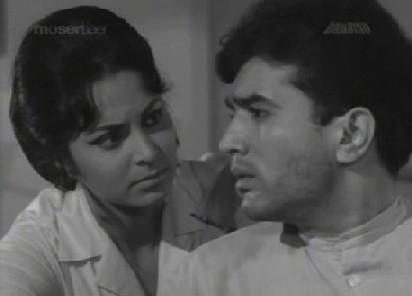
I first watched Khamoshi when I was a child (and too immature to really understand it). I last watched it as a teenager, more able to appreciate the film—which left a handful of clear, sharp images burnt into my memory: Dharmendra, looking out over a balcony and singing Tum pukaar lo; Dharmendra flinging a glass of water at Waheeda Rehman and then watching, half-bemused, half-shy, as she laughingly wipes her face against the front of his shirt. Waheeda Rehman, clinging to Rajesh Khanna but thinking of Dharmendra.
So, considering that this last week saw Dharmendra’s 74th birthday (on December 8th), and having read some very enjoyable posts by fellow bloggers: I decided it was time to re-view and review Khamoshi. It came as a bit of a surprise to realise that Dharmendra actually appears onscreen for just over 5 minutes (and that includes a song). The male lead is Rajesh Khanna. And the film belongs to Waheeda Rehman.
Anuradha (1960)
While I’m a sucker for masala films that bear not a shred of resemblance to reality, I’m also very fond of the sort of films that directors like Bimal Roy and Hrishikesh Mukherjee sometimes made: films about everyday people and their everyday lives. The protagonist of this film, Anuradha, is one of those: a young woman who gives up her dreams for the love of a man—only to discover eventually that even that sacrifice hasn’t brought her what she wanted.
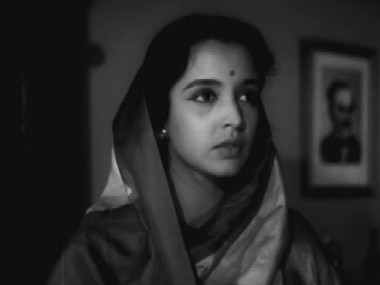
And this is, of course, a belated tribute to one of Hindi cinema’s most luminous faces: Leela Naidu. If I hadn’t been exulting over Robert Mitchum last month when Leela Naidu passed away, I’d probably have reviewed this film then. But better late than never, I guess. RIP.

Chhaya (1962)
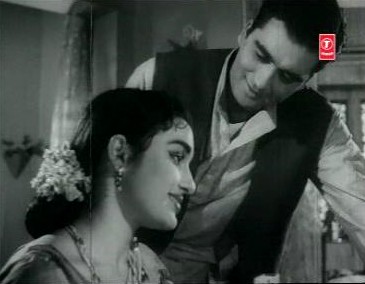
Like Sujata, Chhaya is the story of a girl brought up in the house of someone she’s not related to. Like Sujata, it stars Sunil Dutt (and looking gorgeous, too!), and like Sujata, it’s got great music. Also like Sujata, it was directed by a Bengali director: Hrishikesh Mukherjee in this case.
That’s where the resemblance ends, because Mukherjee makes Chhaya a less poignant, less socially relevant film than Bimal Roy made of Sujata. Where Sujata focussed on the understated emotion of a family and a `daughter who’s not quite one’, Chhaya focuses on a mother who’s forced by circumstances to yield up her child to another.

Sujata (1959)
Another film from one of my favourite directors, and with two of my favourite stars as well. Like many of Bimal Roy’s other productions—Parakh, Usne Kaha Tha, Bandini, Kabuliwala, Do Bigha Zameen—Sujata is about people like you and me, not outright villains (I like to think I’m not one!!), but not saints either (yes, well, I have to admit I’m not one of those, either). People who’re shades of grey, not black and white. And, like most of Bimal Roy’s other films, this one too focuses on the underdog: in this case, an ‘untouchable’ girl.