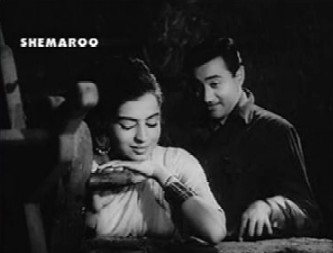
I’m very fond of Bina Rai. I’m also a fan of Premnath in his pre-paunchy days. And a film that starred both of them? I didn’t even bother to try and find out what it was all about. So, when I began watching it and saw this, it made me sit up a bit:


I’m very fond of Bina Rai. I’m also a fan of Premnath in his pre-paunchy days. And a film that starred both of them? I didn’t even bother to try and find out what it was all about. So, when I began watching it and saw this, it made me sit up a bit:
With most films, by the time I see The End come up on the screen, I’ve more or less decided what I’m going to write about it, till which point I’m going to reveal the plot, and so on. With Haqeeqat, I’m still a little dazed. This is one of Bollywood’s earliest—and most realistic—war films, set against a backdrop of what was then the almost inaccessible region of Ladakh. It’s a blend of war and melodrama, propaganda and patriotism… and I’m not sure exactly what can be considered the main story of the film, since it actually consists of a number of stories woven into each other.

Memsaab’s excellent review of the Dev Anand-Waheeda Rehman starrer Solva Saal reminded me of this film. Also Dev Anand, also a suspense thriller, and also with great music. And, may I add, like Solva Saal, extremely entertaining.
So I rewatched this and enjoyed myself all over again, ogling Dev Anand, humming along with the songs, and wishing there were more films like this.
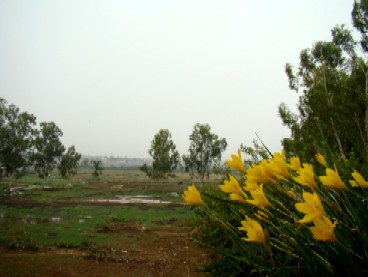
I’m sitting near an open window, breathing in what we always knew as the saundhi khushboo of wet earth (I’ve since discovered the correct English term is petrichor). Outside the window is a balcony, crowded with plants that are suddenly no longer limp and weary with the heat. Beyond the balcony is a field dotted with cows and cattle egrets. Pools of water shimmer silver in the field. The grass and the trees around the edges are bright green against the brooding grey of the clouds beyond. The monsoon is here. Finally, thankfully, here.
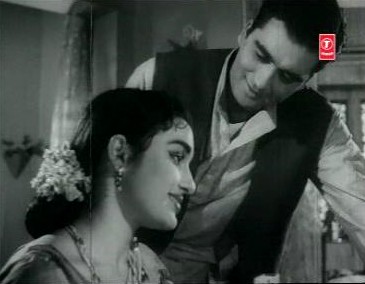
Like Sujata, Chhaya is the story of a girl brought up in the house of someone she’s not related to. Like Sujata, it stars Sunil Dutt (and looking gorgeous, too!), and like Sujata, it’s got great music. Also like Sujata, it was directed by a Bengali director: Hrishikesh Mukherjee in this case.
That’s where the resemblance ends, because Mukherjee makes Chhaya a less poignant, less socially relevant film than Bimal Roy made of Sujata. Where Sujata focussed on the understated emotion of a family and a `daughter who’s not quite one’, Chhaya focuses on a mother who’s forced by circumstances to yield up her child to another.
Having spent most of my life avidly watching Hindi films—especially pre-80’s—I’m inclined to be indulgent. I don’t bat an eyelid when a heroine’s hairdo goes from stylish bob to flowing tresses from one scene to the next. I don’t wonder how an arch villain can defy the cops of an entire nation (occasionally, most of the world) and still fall before the combined efforts of the hero, his comic sidekick, and a faithful pooch. I forgive completely illogical turns and plot elements, ascribing them to artistic license. I mumble a puzzled “What the—!” or “How the—!” or even a “Why the—!” and move on.
Leader is one of those (thankfully rare) films that’s a “What/Why/How the—!” moment from beginning to end.
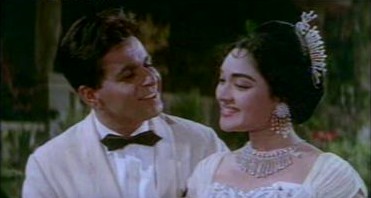
Long before TV came into our lives, a family treat would be to go out for dinner or for a film at a local cinema. And though Bobby was the first film I saw, CID was the first black and white film I remember. I don’t recall anything of the film except a very brief bit from the climax, but you can imagine how gripping that must have been to have stayed in my memory for well over thirty years.

After having done a fairly thorough job of lambasting The Charge of the Light Brigade for depicting India idiotically, I decided I had to show that I’m unbiased. If Hollywood could make a mess when it came to foreigners and foreign settings, Hindi cinema could surpass it. And how!
Dr Kotnis ki Amar Kahani is based on the real-life story of Dr Dwarkanath S Kotnis, who went to China in 1938 as part of a medical mission and did exemplary work in China. This, on its own, would be too insipid for the average Hindi film. But the fact that Kotnis married a Chinese girl while he was treating the ailing masses—well, that gives this story plenty of potential, and V Shantaram, director and lead actor of this film, milks it to the melodramatic full.
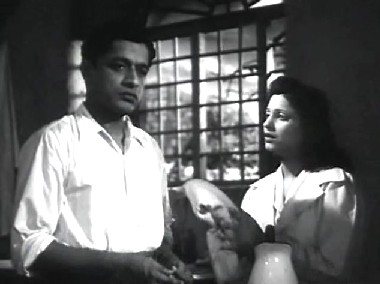
Another film from one of my favourite directors, and with two of my favourite stars as well. Like many of Bimal Roy’s other productions—Parakh, Usne Kaha Tha, Bandini, Kabuliwala, Do Bigha Zameen—Sujata is about people like you and me, not outright villains (I like to think I’m not one!!), but not saints either (yes, well, I have to admit I’m not one of those, either). People who’re shades of grey, not black and white. And, like most of Bimal Roy’s other films, this one too focuses on the underdog: in this case, an ‘untouchable’ girl.
This is going to be my last post for a couple of weeks: I leave on Friday for a two-week jaunt through Switzerland and Alsace, so film watching and reviews are going to take a back seat. But before I go, I decided to do one last post, on parodies. I am providing translations, but they’re rather slipshod. Sorry!
Hindi film songs offer plenty of scope for parodying. In fact, I’ve come across songs that actually parody earlier film songs. My favourite is Suno suno kanyaaon ka varnan (Haseena Maan Jaayegi, 1968), with a madcap Shashi Kapoor singing Mere desh ki ladki sona nigle, nigle heere-moti (“The girl of my country swallows up gold, diamonds and pearls”) instead of the more patriotic Mere desh ki dharti sona ugle, ugle heere-moti (“The land of my country produces gold, diamonds and pearls”), from Upkar (1967). Amusingly enough, the song includes a parody of a song which was originally filmed on Shashi Kapoor: Pardesiyon se na ankhiyaan milaana (Jab Jab Phool Khile, 1965). Best of all? He’s in drag through most of the song. Awesome!
 Dustedoff