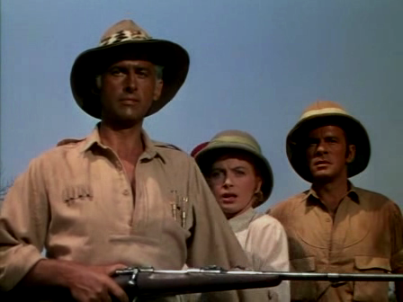
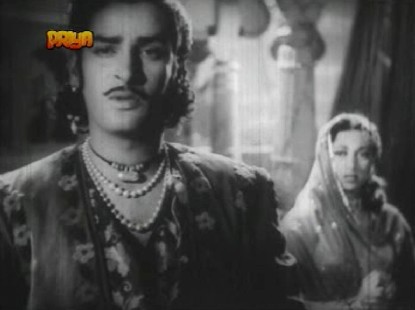
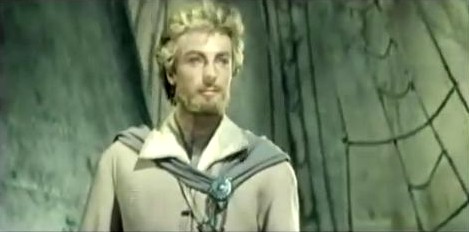
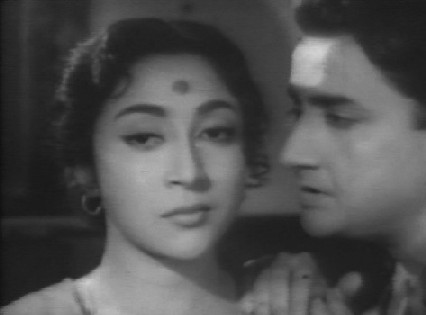
Khozhdenie Za Tri Moray (aka Pardesi) (1957)

Frequent readers of this blog have probably realised I have a soft spot for ‘real life’ stories: Gladys Aylward, Dr Kotnis, Changez Khan, Shahjahan: I’m game. Of course, I don’t always end up with films that bear any resemblance to the life of the person in question, but there’s no harm in trying.

So, another. Afanasy Nikitin was a horse trader from Tver in Russia, who came to India in the late 15th century, having started off from Tver in 1466. His travels took him down the Volga River, through Persia, and then via dhow to India. He is believed to have disembarked in present-day Maharashtra; over the years that followed, he travelled through a large part of peninsular India, including Bidar and Vijaynagar. He died in 1472 in Smolensk, on his way home; his travelogue of India, however, endures: entitled Khozhdenie Za Tri Moray (‘The Journey Beyond Three Seas’), it describes in detail all that Nikitin saw of what was to him a wild, exotic land like nothing he knew.

Continue reading

Gyaarah Hazaar Ladkiyaan (1962)

What is a writer without readers? What is a blogger without people who stop by to read, comment, suggest, recommend, and encourage?
So, in gratitude to everybody who’s been visiting this blog over the months: this month on Dusted Off is dedicated to you. All through September 2010, the posts here will be connected in some way or the other to the readers of Dusted Off. The film reviews will be of films that have been recommended, given, or otherwise suggested by readers; and the lists—those ‘top tens’ I’m so fond of—will be of requests made by readers.

To begin with, this film. When I posted a review of Bhai Bahen a while back, it sparked off a discussion on N Dutta’s music—and reader Ash mentioned Gyaarah Hazaar Ladkiyaan, for which too the score had been composed by Dutta. After we’d indulged in much speculation about the film’s plot (what an intriguing title, right?!), another reader, Shalini, was kind enough to say that she had a copy, and was even more kind enough to share it. Therefore…

Continue reading

The Seahawk (1940)

Another offering for Flynn Week.

It was said, at one time, that if Bette Davis was the queen of Warner Brothers, Errol Flynn was the king. And a king, too, with a lineage that was astounding, to say the least. The Tasmanian-born Flynn spent a few years as a young man in Papua New Guinea holding down jobs as varied (and in some cases illegal) as diamond smuggler, slave recruiter, gold prospector, sheep castrator, and manager of tobacco and coconut plantations, before washing up in the big bad world of cinema. Flynn’s first role was as his own ancestor, Fletcher Christian, a mutineer on the HMS Bounty; two years later, opposite Olivia de Havilland (who was a very distant relative of his), Flynn acted as the pirate Captain Blood—and the king of swashbucklers had arrived.

Continue reading

The Dawn Patrol (1938)

Strangely—considering that Errol Flynn is best known for his swashbuckling roles—the film I most vividly remember of his is this one, an unusual war film. I first watched it years ago as a teenager, and ever since—in spite of having notched up The Prince and the Pauper, Captain Blood, The Adventures of Robin Hood and other blockbuster Flynn hits—this remains my favourite Errol Flynn film. Touching, thought-provoking, and utterly memorable.

Continue reading

Ek Sapera Ek Lutera (1965)

And besides that ‘one snake charmer, one bandit’ (and not a single snake, mind you)—there’s also one pretty lady, a nasty patricidal king, a ghost (who appears for all of one very short scene) and a trio of comic courtiers who go bananas trying to differentiate between their crown prince and an impostor. There’s also, to add to the fun, a variety of disguises. And a decent enough score by Usha Khanna, including the depressing hit song Hum tumse judaa hoke.

Continue reading

Shaheed (1965)

One thing that has long puzzled me is Bollywood’s reluctance to do real life stories. Where Hollywood has created films on the lives of people ranging from Napoleon’s one-time fiancée to an obscure British missionary in China, we have, to show for years of fascinating history… Shahjehan and Changez Khan, both so badly warped that they bear little resemblance to fact. Dr Kotnis ki Amar Kahani is a refreshingly unusual film in being relatively accurate, as well as entertaining—but a flash in the pan.

Our generally avid enthusiasm for the freedom movement and its exponents gave me hope that Shaheed, the story of Bhagat Singh, might be worth a watch. This, after all, was the young man who inspired an entire slew of films, beginning with (or so Wikipedia would have us believe) a film in 1954, followed by a 1963 film starring Shammi Kapoor, and this one: the first of Manoj Kumar’s many patriotic films. There have been later films—2002, for instance, saw two films, one a superb one starring Ajay Devgan and the other with Bobby Deol as Bhagat Singh—but Shaheed was the first major Bhagat Singh story.

Continue reading

The Shop Around the Corner (1940)

What is it that tempts film-makers to say “Ah! Let’s do a remake of this one!”? A conviction that a script that’s worked once will work again? Also perhaps a somewhat egoistic belief that they will be able to make a better adaptation than whoever made the original film? This story, a classic Ernst Lubitsch romantic comedy, certainly had a lot going for it: sweetness, dewy-eyed romance, and a heart-warming wholesomeness set against a backdrop of wartime Budapest. No wonder, a mere 9 years after it was made, The Shop Around the Corner was remade as In The Good Old Summertime.

But which is better? And how do they compare?

Continue reading

In the Good Old Summertime (1949)

Like Love Affair/An Affair to Remember, In the Good Old Summertime is also one of those romances that’s proved very popular across time and space. This is a cheery little love story, of a man and a woman who begin corresponding with each other, fall in love through their correspondence (all without even knowing the name of the other person), and when they eventually meet, become instant enemies. Sounds familiar? Yes, that’s The Shop Around the Corner. Also You’ve Got Mail. And Sirf Tum. It’s also this film, a sweet musical remake of the original The Shop Around the Corner.

Continue reading

Jaagte Raho (1956)

As I’d mentioned in my last post, I’m not much of a Raj Kapoor fan. I have seen most of his films, but I like very few of them. Jaagte Raho, a flop when it was first released (even though it won an award at Karlovy Vary) is one of the exceptions: an RK film that I found engrossing and worth the watch. Part of it probably is the fact that it features a veritable who’s who of 50’s Hindi cinema character actors. Part of it is due to Salil Choudhary’s superb music. And more than that, it’s because this is a well-scripted story, socially relevant in a tongue-in-cheek way.

Continue reading

Shahjehan (1946)

After a longish hiatus, I’ve begun working on my next novel. Like my first book, The Englishman’s Cameo, this one too features the Mughal detective Muzaffar Jang, and is set during the final years of Shahjahan’s reign. I’ve been doing other bits of writing—very little of it related to history—and decided I needed something to help build up atmosphere and get me back in the mood. A historic film, set in Shahjahan’s time? Shahjehan? With Naushad’s hit score, and the chance to hear (and see) K L Saigal singing some of his best-known songs?

Alas. Alas, alas, alas. Or, to put it more bluntly: &$%@##%@!!!

Continue reading