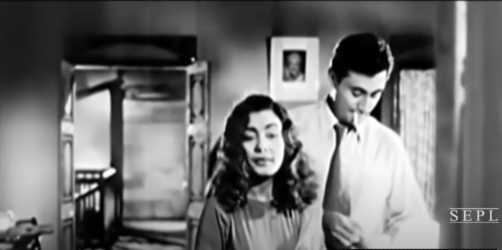
Baaz (1953)

Today, July 9, 2025, marks the 100th birth anniversary of one of Hindi cinema’s best-known film directors. Born in Mysore on this day in 1925 as Vasant Kumar Shivshankar Padukone, Guru Dutt studied in Calcutta before joining Uday Shankar’s India Culture Centre (in Almora, present-day Uttarakhand) to train in dance. By the time he turned 19, he had moved to Pune, where he began working as a choreographer for Prabhat Studios. By the time Prabhat Studios folded up (in the early 1950s), Guru Dutt had formed a close friendship with Dev Anand, because of whom he received his first break as a director: in 1951, he directed Navketan’s Baazi, starring Dev Anand, Geeta Bali and Kalpana Karthik in a noir thriller that was to become a defining film for Navketan: edgy, stylish, dark, very urban.

Guru Dutt is today revered more for the hard-hitting, cynical cinema he made: films like Pyaasa, Sahib Bibi aur Ghulam and Kaagaz ke Phool hold up the mirror to a world that is selfish, cruel and opportunistic. These are bitter films, films that plumb the depths of human nature; films that—despite following most of the standard tropes of commercial Hindi cinema (a romance between the lead couple; a fair number of songs; a comic character invariably played by Johnny Walker)—were quite different from other Hindi films.

These, too, are the films for which Guru Dutt is mostly remembered today. Is that because over the decades, people have seen how the tragedy and turmoil of Guru Dutt’s personal life was probably reflected in films like these? Is there a voyeuristic tendency to try and spot the man behind the director?

But Guru Dutt also made other films, on other subjects. This one, for instance, an adventure/patriotic film set on the high seas, with Geeta Bali starring as the eponymous ‘Baaz’ (falcon), a woman who becomes a pirate to free her land of a colonial tyrant.

Continue reading

Sapan Suhaane (1961)

Starring Balraj Sahni and Geeta Bali. With music by Salil Choudhary.

How could I—with a well-established reputation for watching films based on a single name I like among the crew and cast—pass up this one? Balraj Sahni is a favourite, as is Geeta Bali. And Salil Choudhary is one of those rare music directors for whom I’ll watch a film (even if I could just as well just listen to a playlist of the songs online).

These three were the reason I watched Sapan Suhaane, and I’ll admit that till more than midway through the film, I was congratulating myself on having stumbled on a hidden gem. Or, if not strictly a ‘gem’, at least a film that was watchable enough. After that…

But to start at the very beginning, when we are introduced to Shankar (Balraj Sahni) and his younger brother Dilip (Chandrashekhar). Shankar and Dilip are stepbrothers, but deeply devoted to each other. Shankar has given up his own comfort, his own prospects, in order to work so that he can finance Dilip’s studies.

Continue reading

Howrah Bridge (1958)

Aaiye meherbaan baithiye jaan-e-jaan, and Mera naam Chin Chin Choo. Two great actresses, two iconic songs.

When I was doing the Helen tributes last month, I was reminded of Mera naam Chin Chin Choo all over again—and remembered, too, that I had never reviewed Howrah Bridge on this blog. It has also been many years since I last watched the film (before I launched Dusted Off), so I decided it was high time I revisited this.

Howrah Bridge begins very far from the bridge, and in fact from Kolkata: in Rangoon, where Prem Kumar (Ashok Kumar) finds his father (Brahm Bhardwaj) in a flap. Daddy is distraught because Prem’s elder brother Madan (Chaman Puri, in a cameo role) has run off from home, taking with him an invaluable family heirloom, a dragon which has been in the family for generations. We later discover that the dragon was crafted in China many centuries ago, and from there came to be owned by the king of Burma, after which it passed into the possession of Prem’s family.

Continue reading

Woh Kaun Thi? (1964)

I began this blog on November 4. 2008 (with a review of Vacation from Marriage), so this post marks the fifteenth birthday of Dusted Off. I dithered over how I might celebrate the occasion, and finally came to the conclusion that it would be good to mark it with a review of a film I’ve been meaning to review ever since I decided to start blogging about classic cinema. Woh Kaun Thi? is a film I enjoy a lot, and which I’ve seen in various avatars: first on Doordarshan, when I was a teenager. Then, when VHS tapes became available, multiple times on our VCR. Then, when CDs came along, this was one of the first VCDs I bought… then the DVD. Now YouTube.

The story begins on a stormy night. Dr Anand (Manoj Kumar) is driving down a pot-holed and lonely road when he sees a woman (Sadhana), clad in white and standing in the middle of the road. Anand tells her to move out of the way, but when she doesn’t respond, he is compelled to get out and talk to her. To all his questions—who is she, where is she going, isn’t she scared to be out here alone—she gives evasive, mysterious answers. Finally, however, she consents to let Anand give her a lift, but on one condition: he is not to ask any questions. [Given the way he’s been bombarding her with questions, I’m not surprised].

Continue reading

Amrapali (1966)

Happy birthday, Vyjyanthimala! (it’s either her 90th birthday or her 87th today, it doesn’t seem very clear which, but anyway).

Among the recent books I’ve read is Advait Kottary’s Siddhartha: The Boy Who Became the Buddha, a fictionalized retelling of the story of the Buddha. While Siddhartha is the focal point of the narrative, several other important historical personages appear in the book, among them the nagarvadhu or courtesan of Vaishali, Amrapali. Amrapali is shown to have originally had a relationship with the ruler of Magadha, Bimbisara: so much so that she bears him a son, whom she is later compelled by circumstances to hand over to the Buddha to bring up. Bimbisara’s belligerent and headstrong son and heir, Ajatshatru, though he’s never seen ‘his father’s courtesan’ (as Kottary describes her), detests Amrapali.

… until he, injured in a way with Vaishali, impersonates a Lichhavi (native to Vaishali) soldier in order to escape with his life. Fate brings Ajatshatru and Amrapali together: she, thinking him to be Lichhavi, tends to his wounds and heals him, and they fall in love.

It’s been ages since I watched the Vyjyanthimala-Sunil Dutt Amrapali, and while I remembered some of the core elements, I’d forgotten much of it. As far as I remembered, the film had nothing whatsoever about Amrapali’s relationship with Bimbisara or her having a son with him. To be honest, I’d have been very surprised if that aspect of her life had been shown: it would have been far too bold for Hindi cinema, back then, to have a heroine who could have affairs with both father and son, and bear a child out of wedlock.

So I decided it was time to rewatch Amrapali, which begins in Magadha. Here, the king, Ajatshatru (Sunil Dutt), is in conference with his trusted advisor, friend, and Magadha’s commander-in-chief, Veer (Premnath). Ajatshatru is a hot-headed warmonger, and right now baying for the blood of the democratic Lichhavis, whose land, Vaishali, lies across the river to the north.

Continue reading

Aandhiyaan (1951)

In 1951, fresh from the success of the Dev Anand-Geeta Bali-Kalpana Karthik starrer Baazi, Chetan Anand decided to make a film that would highlight the very interesting aspects of film-making he had been learning from studying the works of various European directors. ‘Based on a true incident that took place in Amritsar’, as the film’s credits read, the story of Aandhiyaan was written by Chetan Anand himself, along with Hameed Butt.

The film’s credits roll to an unusual sequence of shots: in each frame, one actor or the other is shown, battling the eponymous ‘aandhi’ or storm, though in this case literal rather than metaphorical.

The story is centred round a young and zealous lawyer named Ram Mohan Kapoor (Dev Anand). Ram lives upstairs from his munshi (Ratan Gaurang), whose daughter Rani (Nimmi) has long been in love with Ram, though she’s too shy to let him know that. When the story begins, Ram’s mother (Durga Khote) is due to arrive, and Ram is getting ready to go to fetch her from the station. Rani makes tea for him, and an excited Ram confides in her: he’s asked his mother to come because he wants her to fix a match for him. With a girl he likes a lot.

Continue reading

Chalti ka Naam Gaadi (1958)

In response to that unwarranted comment about me ‘wasting my time watching silly Indian films’, I’ve done something (reviewed Bhabhi ki Chudiyaan and Devi) to uphold my contention that all Indian films are not silly. Now it’s time to look at Indian films which are silly, but where the silliness is intelligent, and deliberate.

What, after all, is wrong with silliness, or with humour? For me, the stuffy idea that humour is somehow low is very irritating. Some humour may be unpalatable to certain people (I, for one, find nothing humorous about sexist or racist jokes, or toilet humour), but humour can be sophisticated, it can be the result of a great intelligence.

As, I think, comes through in this delightful film about three brothers, all motor mechanics, who run a garage.

Brijmohan Sharma ‘Bade Bhaiya’ (Ashok Kumar), as he’s known, is the eldest of the three, and he rules with an iron fist in an iron gauntlet.  Bade Bhaiya is a hard taskmaster, and lords it over Jagmohan ‘Jaggu’ (Anoop Kumar) and Manmohan ‘Manu’ (Kishore Kumar), as also their apprentice Maujiya (Mohan Choti). One important aspect of Bade Bhaiya’s personality is his aversion to women: he sees red even when Maujiya hangs up a calendar with a painting of a woman on it.

Continue reading

Jigri Dost (1969)

Mostly, the films I review on this blog are either the ones I like so much I want more people to watch them; or films I hate so much I want to warn people off them. Or, sometimes, films which may not be otherwise exceptional but have, I think, something that sets them apart: they’re unusual, or they’re somehow of historic importance.

Now and then, along comes a film I decide I have to review because while I don’t find it dreadful, I wonder what it would have been like with a different cast. Even just one actor being replaced by another.

Jigri Dost begins in the palatial home of Chairman Neelkanth (KN Singh), who is a baddie of the first order. He summarily orders his henchmen to raze this bunch of poor people’s huts, extort money from that lot, and so on. He has no scruples, no mercy, no nothing… no inkling, either, that a maid (Aruna Irani) in his home eavesdrops on his every conversation.

Continue reading

Funtoosh (1956)

Today may (or may not) be the birth centenary of the film maker, writer, and actor Chetan Anand, eldest brother of Dev Anand and Vijay Anand. Different sources list different dates of birth: most sites (including IMDB) list his birth date as January 3, 1921; others, including Wikipedia (yes, I know not the most reliable of sources) say it’s January 3, 1915. (This article says it’s 1921, but then goes on to write that Chetan Anand was 27 years old in 1943, which is either dodgy maths or a suggestion that the year of birth was indeed 1915). The article, barring that slip, is a good, interesting introduction to the life and career of Chetan Anand.

Anyway. Even if I’m six years too late to the party, at least today is Chetan Anand’s birthday.

Continue reading

Hulchul (1951)

Today is the hundredth birthday of one of India’s greatest and most popular dancers of yesteryears. Sitara Devi was born in Calcutta on November 8, 1920, to a father who was a Sanskrit scholar and also both performed as well as taught Kathak. Her mother too came from a family with a long tradition in performing arts, so it was hardly a surprise that from a very young age, Sitara (her birth name was Dhanalakshmi) began to learn Kathak. By the time she was ten, Sitara was giving solo performances; two years later, at the age of twelve, she (having since moved to Bombay with her parents) performed onstage and so impressed film-maker/choreographer Niranjan Sharma that he recruited her to work in films.

Unlike several other skilled danseuses—Vyjyanthimala, the Travancore Sisters, Waheeda Rehman, etc—Sitara Devi did not let cinema take over her dance completely. She danced in a number of films, through the 40s and right up to Mother India (1957), which is believed to be her last onscreen appearance. She continued to give stage performances, even performing at New York’s Carnegie Hall and at the Royal Albert Hall in London.

Sitara Devi wasn’t merely a film actress; she was also a great dancer. I wanted to pay tribute to her through a review of one of her films, and decided I’d choose Hulchul, which I wanted to watch for other reasons as well (more on this later).

Continue reading