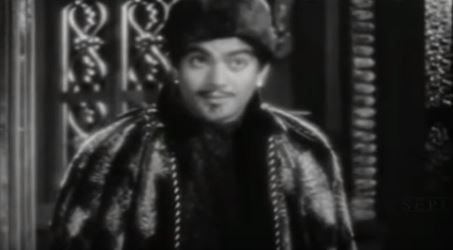
Kaala Paani (1958)

Today is the 100th birth anniversary of one of my favourite Hindi film directors, the suspense-specialist Raj Khosla (I hasten to add: I am well aware that that’s a generalization, since Khosla made a lot of films, too, that had nothing to do with the thriller/suspense genre: Mera Gaon Mera Desh, for example; Chirag, Main Tulsi Tere Aangan Ki, Do Badan, etc). But it is Khosla’s prowess with this particular genre that I especially admire, a skill and talent he showcased in classics of the genre such as Woh Kaun Thi? ((1964), Mera Saaya (1966), CID (1956) and Kaala Paani (1958). In each of these films, he managed to combine the classic elements of the Hindi masala film—a romance, a comedic side track, lots of fabulous songs—while making sure that the suspense remained (mostly) taut, the mystery a solid one.

To commemorate Khosla’s birth centenary, I wanted to review one of his suspense films. Several of these (CID, Mera Saaya, Ek Musaafir ek Haseena, Woh Kaun Thi?) I have already reviewed; I was torn between some of the others: Solva Saal, Kaala Paani, and Anita, all of which I have seen at some time or the other. I decided, eventually, that it was time to rewatch Kaala Paani, a film that I’ve watched several times, but too far back to have reviewed it on this blog.

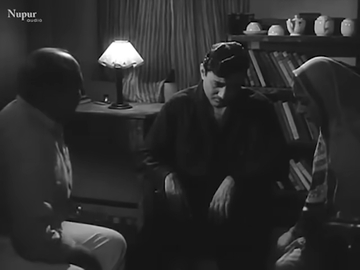
The story begins on a night in Bombay, with a woman (Mumtaz Begum) hurrying through the streets to the home of a family friend, Mr Kapoor (?). She is in great distress, and confides in Kapoor: Karan has discovered the truth. What this truth is we discover when Kapoor hurries to Karan’s home to find Karan (Dev Anand) sitting, looking bereft. He has found out (how, we aren’t told) that his father Shankar Lal has, for the past fifteen years, been incarcerated in Hyderabad jail for the murder of a tawaif named Mala. Not, as Karan has been led to believe all these years, dead.
Continue reading

Police (1958)

If you’ve been reading this blog some years, you probably know by now that I am a fan of Madhubala’s. I’ve watched most of her films (several of which I have not got around to reviewing on this blog), I’ve done lists of my favourite songs of hers, and I have waxed eloquent every now and then about how much I like her.

One of the things I dislike about much of the online (at least) raving about Madhubala is that the praise is invariably just about her beauty. How gorgeous, how exquisite. Yes, indeed; but Madhubala’s beauty, I think, often comes in the way of people appreciating what a good actress she was, too. Watch her performances in films like Mughal-e-Azam and Amar, for instance, and if you can look past her face, you will see how well she holds her own against heavyweight thespians like Dilip Kumar and Prithviraj Kapoor.

And she was a fantastic comedienne too. The madcap way she matches Kishore Kumar in Chalti ka Naam Gaadi, for example. Or her airhead character in Mr & Mrs 55. Interestingly, Madhubala is often compared to Marilyn Monroe, almost entirely on the basis of their beauty and popularity; but I think the two stars had one more thing in common: both could portray the ditzy beauty very well. This, in fact, is just the type of woman Manju, of Police, is: nutty, silly, a clown. But so endearing too (and, it goes without saying, so gorgeous).

Continue reading

Howrah Bridge (1958)

Aaiye meherbaan baithiye jaan-e-jaan, and Mera naam Chin Chin Choo. Two great actresses, two iconic songs.

When I was doing the Helen tributes last month, I was reminded of Mera naam Chin Chin Choo all over again—and remembered, too, that I had never reviewed Howrah Bridge on this blog. It has also been many years since I last watched the film (before I launched Dusted Off), so I decided it was high time I revisited this.

Howrah Bridge begins very far from the bridge, and in fact from Kolkata: in Rangoon, where Prem Kumar (Ashok Kumar) finds his father (Brahm Bhardwaj) in a flap. Daddy is distraught because Prem’s elder brother Madan (Chaman Puri, in a cameo role) has run off from home, taking with him an invaluable family heirloom, a dragon which has been in the family for generations. We later discover that the dragon was crafted in China many centuries ago, and from there came to be owned by the king of Burma, after which it passed into the possession of Prem’s family.

Continue reading

Chalti ka Naam Gaadi (1958)

In response to that unwarranted comment about me ‘wasting my time watching silly Indian films’, I’ve done something (reviewed Bhabhi ki Chudiyaan and Devi) to uphold my contention that all Indian films are not silly. Now it’s time to look at Indian films which are silly, but where the silliness is intelligent, and deliberate.

What, after all, is wrong with silliness, or with humour? For me, the stuffy idea that humour is somehow low is very irritating. Some humour may be unpalatable to certain people (I, for one, find nothing humorous about sexist or racist jokes, or toilet humour), but humour can be sophisticated, it can be the result of a great intelligence.

As, I think, comes through in this delightful film about three brothers, all motor mechanics, who run a garage.

Brijmohan Sharma ‘Bade Bhaiya’ (Ashok Kumar), as he’s known, is the eldest of the three, and he rules with an iron fist in an iron gauntlet.  Bade Bhaiya is a hard taskmaster, and lords it over Jagmohan ‘Jaggu’ (Anoop Kumar) and Manmohan ‘Manu’ (Kishore Kumar), as also their apprentice Maujiya (Mohan Choti). One important aspect of Bade Bhaiya’s personality is his aversion to women: he sees red even when Maujiya hangs up a calendar with a painting of a woman on it.

Continue reading

Saqi (1952)

I still remember my first glimpse of Premnath in a different persona than the fat, balding, beetle-browed villain of so many ‘70s films.

This was in the mid-80s. My sister and I (I was then not even in my teens) were watching Chitrahaar, and Thandi hawaayein lehraake aayein came on. It was proceeding fine, with Nalini Jaywant flitting across the screen, when suddenly a strikingly handsome man, tall and broad-shouldered, sprang up by her side, danced with her, and then disappeared. Who was that? We asked each other, and couldn’t supply an answer. We turned to our father, our source of information for all things old Hindi cinema. Papa said that Naujawan starred Premnath. Who Premnath, we asked in disbelief. That paunchy and somewhat repellant man in Johnny Mera Naam?

It took a watching (incomplete, sadly, because the electricity went) of the 1951 film Sagaai to convince us that yes, Premnath was indeed quite a hottie in his heyday.

If you think so too (or if you haven’t seen Premnath in the early 50s, when he was paid more than Raj Kapoor and several other leading actors), you should watch Saqi.

Continue reading

Gateway of India (1957)

Hindi cinema has a tendency towards stories that stretch over long periods of time. Days, at the least, but often months, often many years too (that old trope of children growing up has been a part of too many films to name). It is the unusual film, especially in the 50s and 60s, that extends over just a few hours. Solvaa Saal was one such; Gateway of India is another. Both films are about runaway girls who meet the loves of their lives in the course of one night. That, though, is where the resemblance stops.

Continue reading

Baadal (1951)

The last Hindi film I’d reviewed was the Sanjeev Kumar swashbuckler Baadal. When I’ d begun watching that, I wondered briefly if it would be a remake of the Premnath Baadal, a film I’d seen too long back to remember much of. As it happened, while the later Baadal did borrow some of the basics—the rebel hero who falls in love with a noblewoman whom he should probably be hating instead—it is actually a very different film. Premnath’s Baadal, for one, is no poet, and instead of borrowing from The Three Musketeers, this Baadal is explicitly stated as having been inspired from Robin Hood.

Continue reading

Sangdil (1952)

Hindi cinema has, over the years, borrowed liberally from English literature. Shakespeare (Hamlet, and in more recent years, Angoor, Omkara, Maqbool, and Haider), Agatha Christie (Gumnaam), Arthur Conan Doyle (Bees Saal Baad), AJ Cronin (Tere Mere Sapne): Hindi cinema seems to have drawn inspiration from a lot of authors, whether or not that inspiration has always been acknowledged or not.

Here, then, is another film derived from a literary work by a writer in the English language. Charlotte Brontë’s Jane Eyre, published in 1847, has spawned a number of cinematic adaptations (one of the first I ever saw starred Orson Welles and featured a very young Elizabeth Taylor as Helen Burns; one of my favourites stars the brilliant Toby Stephens as Rochester). In Hindi cinema, too, Jane Eyre was made into a film: Sangdil. I’ve been wanting to watch this for a while, and when recently I finally got around to reading the complete, unabridged version of Jane Eyre, I decided it was also time to watch the film.

Dilip Kumar and Madhubala in Sangdil

Continue reading

Raj Hath (1956)

Despite my love for historicals and Madhubala, I was surprised when Ava mentioned this film on her blog. A historical (and a Sohrab Modi one, too), with Madhubala, and I’d never heard of it? Ava recommended it, so I decided to keep an eye out for it. Fortunately, I discovered Raj Hath on Youtube—therefore, this post. Ava, thank you. This was an enjoyable film.

Madhubala and Pradeep Kumar in Raj Hath Continue reading

Sharaabi (1964)

Today, September 26, 2012, would have been Dev Anand’s 89th birthday. To commemorate that occasion, I decided it was time to watch a film that had been sitting in my to-watch pile for nearly a year. Just looking at the cast and crew—Dev Anand, Madhubala, Lalita Pawar, Madan Mohan, Rajinder Krishan—and listening to some of the songs from the film made my mouth water.

Continue reading