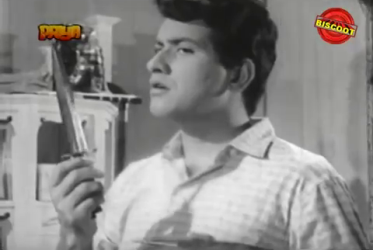
Anita (1967)

When, for May 31st this year (the 100th birth anniversary of film director Raj Khosla), I wanted to review one of his films, Anita was on my shortlist. Over the course of the years I’ve been writing this blog, I’ve reviewed several of Khosla’s films, including two of the three films (Woh Kaun Thi?, Mera Saaya and Anita) that comprise Khosla’s Sadhana suspense trilogy. Since Manoj Kumar had also passed away earlier this year, it seemed fitting to watch and review Anita, the last of the three films, and a film that starred Manoj Kumar opposite Sadhana.

For a tribute to Khosla, I ended up reviewing Kaala Paani instead. But I did watch Anita (a film that I’d last seen so long back, I remembered only the basics of it). And it seemed appropriate to review it too.

Therefore…

The film begins with a short, rather abrupt scene in which Seth Biharilal (Sajjan) visits a somewhat shady-looking pandit (Ulhas). Biharilal has brought along the horoscope of his 19-year-old daughter Anita for the pandit to have a look at, and to comment upon. The pandit has a peek, and says that this year is going to be really vile for Anita.

Continue reading

Ten of my favourite Manoj Kumar Songs

RIP, Manoj Kumar.

The first week of April has seen two major actors of the film world pass away. Hollywood great Val Kilmer (whom I actually always associate with The Saint, though most others probably think Batman and Jim Morrison of the Doors), on April 1st; and on April 4th, Manoj Kumar. Kilmer, though I’ve watched several of his films, isn’t part of my timeline when it comes to blogging; but Manoj Kumar certainly is.

Continue reading

Himalaya ki God Mein (1965)

I realized the other day that there are umpteen well-known old films that I have seen but have never got around to reviewing on this blog—invariably because I had watched them before I started Dustedoff, and because there were so many ‘new’ old films to watch and write about, I never got around to rewatching stuff. It’s time to amend that, and revisit some films that perhaps should be talked about.

To begin with, Himalaya ki God Mein. Directed by Vijay Bhatt, Himalaya ki God Mein beat Haqeeqat and Waqt to win the Filmfare Best Film Award, and was a superhit. I had watched this donkey’s years ago, when it was telecast on Doordarshan. I remembered almost nothing of it except the fact that Manoj Kumar played a city doctor who relocated to the mountains to treat villagers and ended up falling in love with a village girl played by Mala Sinha. That was it. Time for a rewatch, I decided.

The film begins at night, on an aeroplane where Dr Sunil (Manoj Kumar) and his fiancée, also a doctor, Neeta (Shashikala) are travelling. Another passenger on the plane suddenly clutches his chest; Sunil examines him, diagnoses a heart problem, and asks that the plane land immediately.

Continue reading

Woh Kaun Thi? (1964)

I began this blog on November 4. 2008 (with a review of Vacation from Marriage), so this post marks the fifteenth birthday of Dusted Off. I dithered over how I might celebrate the occasion, and finally came to the conclusion that it would be good to mark it with a review of a film I’ve been meaning to review ever since I decided to start blogging about classic cinema. Woh Kaun Thi? is a film I enjoy a lot, and which I’ve seen in various avatars: first on Doordarshan, when I was a teenager. Then, when VHS tapes became available, multiple times on our VCR. Then, when CDs came along, this was one of the first VCDs I bought… then the DVD. Now YouTube.

The story begins on a stormy night. Dr Anand (Manoj Kumar) is driving down a pot-holed and lonely road when he sees a woman (Sadhana), clad in white and standing in the middle of the road. Anand tells her to move out of the way, but when she doesn’t respond, he is compelled to get out and talk to her. To all his questions—who is she, where is she going, isn’t she scared to be out here alone—she gives evasive, mysterious answers. Finally, however, she consents to let Anand give her a lift, but on one condition: he is not to ask any questions. [Given the way he’s been bombarding her with questions, I’m not surprised].

Continue reading

Poonam ki Raat (1965)

One style of mystery story popular in the early 60s (though there was the odd film even earlier, like Mahal) was the one where the suspense includes a seemingly supernatural element. A woman in white, singing a ghostly song of eternal yearning as she wanders half-seen (or unseen) through the gloom. Woh Kaun Thi?, Yeh Raat Phir Na Aayegi, Bees Saal Baad, Gumnaam, Raaz: all of them used this trope to the hilt.

As did this relatively lesser-known film [and you’ll probably realize, by the end of this post, why it’s little-known]. Poonam ki Raat was made by actor/writer/director Kishore Sahu, who played an important role in this film, the star of which was Manoj Kumar, quite a veteran of these suspense thrillers.

Manoj Kumar in Poonam ki Raat

Continue reading

Nakli Nawab (1962)

Muslim socials are among the genres I can never have too much of. Back in their heyday, they had some of the best music around (remember Chaudhvin ka Chaand? Barsaat ki Raat? Mere Mehboob? The inimitable Pakeezah?) There was the chance to savour the mellifluous sound of Urdu; to peek into a social structure and lifestyles that often went otherwise unexplored in cinema; and to see women in shararas and men in achkans [the latter, like military uniforms, equipped with some inexplicable means of making even Bharat Bhushan and Rajendra Kumar look good].

pic1 Continue reading

Saajan (1969)

The other day, a fellow blogger, mentioning her distaste for Manoj Kumar’s films said that while she has “nothing against the man himself”, she really hates his films. I know what she meant (at least I think I do): I hate that insufferably xenophobic “all that is Indian is good, all that is Western is bad” philosophy espoused by films like Upkaar or, even worse, Purab aur Pachhim.
But I tend to shove that lot of films to the boundaries of my recollection of Manoj Kumar’s films. For me, his best films are the outright entertainers, the romances and suspense thrillers he worked in. Especially the suspense thrillers: Woh Kaun Thi?, Anita, Gumnaam—and this one.

Manoj Kumar and Asha Parekh in Saajan Continue reading

Ten Bits of Trivia from Classic Hindi cinema

This is another of the prize posts for those who participated in the Classic Bollywood Quiz I hosted on this blog last year. I’ve two awards left to ‘hand out’ – (read ‘two more posts to dedicate to readers’) – but this post is dedicated to Neha, whose blog is really niche: it’s a collection of interesting trivia about black-and-white Hindi films. Neha won the Hope Springs Eternal Award in the quiz, simply because she didn’t allow herself to be deterred by the fact that she couldn’t guess more than a handful of the answers. Atta-girl, Neha! That’s the attitude.

Anyway, here goes: a post for Neha. Since Neha’s so keen on trivia, I decided to do something along those lines for her post. Not, unfortunately for Neha, from just black-and-white Hindi films, but at least from pre-70s Hindi films. Just some little snippets that I’ve discovered over the years, and thought were fun.

Continue reading

Gumnaam (1965)

For anybody who’s been following my idea of ‘linked posts’ – each post connected to the one before, and to the one after – this probably comes as no surprise. And Then There Were None was based on Agatha Christie’s highly popular novel and play; Gumnaam is, in turn, an adaptation of And Then There Were None. Not a completely faithful adaptation, but a vastly entertaining one, as you’ll see if you scroll through the comments on my And Then There Were None post: most of my readers, even if they’ve not seen the Hollywood film, have had something to say about Gumnaam.

Continue reading

Shaheed (1965)

One thing that has long puzzled me is Bollywood’s reluctance to do real life stories. Where Hollywood has created films on the lives of people ranging from Napoleon’s one-time fiancée to an obscure British missionary in China, we have, to show for years of fascinating history… Shahjehan and Changez Khan, both so badly warped that they bear little resemblance to fact. Dr Kotnis ki Amar Kahani is a refreshingly unusual film in being relatively accurate, as well as entertaining—but a flash in the pan.

Our generally avid enthusiasm for the freedom movement and its exponents gave me hope that Shaheed, the story of Bhagat Singh, might be worth a watch. This, after all, was the young man who inspired an entire slew of films, beginning with (or so Wikipedia would have us believe) a film in 1954, followed by a 1963 film starring Shammi Kapoor, and this one: the first of Manoj Kumar’s many patriotic films. There have been later films—2002, for instance, saw two films, one a superb one starring Ajay Devgan and the other with Bobby Deol as Bhagat Singh—but Shaheed was the first major Bhagat Singh story.

Continue reading