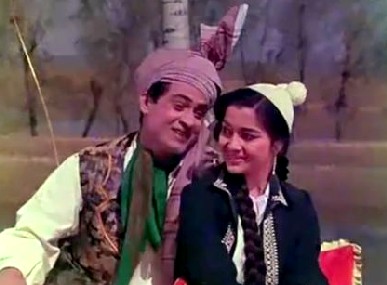
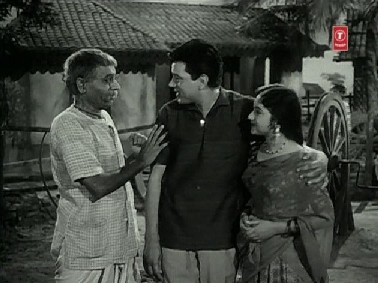
For anybody who’s been following my idea of ‘linked posts’ – each post connected to the one before, and to the one after – this probably comes as no surprise. And Then There Were None was based on Agatha Christie’s highly popular novel and play; Gumnaam is, in turn, an adaptation of And Then There Were None. Not a completely faithful adaptation, but a vastly entertaining one, as you’ll see if you scroll through the comments on my And Then There Were None post: most of my readers, even if they’ve not seen the Hollywood film, have had something to say about Gumnaam.
Tag Archives: Pran
Abe-Hayat (1955)
I’ve been very busy the last couple of days, and the busy-ness doesn’t look like it’ll come to an end soon. My husband, therefore (and what a model of husbandly devotion!) offered to write the review of Abe-Hayat for me. This, mind you, without having seen the film, just on the basis of a very sketchy gist I’d narrated of the first half while we were on our evening walk. Tarun said he’d do a 3-sentence review:
Once there was an evil jaadugar named Saamri. There was a prince, and a princess. The prince killed Saamri, and then he and the princess lived happily ever after.
Munimji (1955)
It has been a sad year for us lovers of classic cinema. After the passing away of Spanish filmmaker Berlanga, I’d hoped December would pass in the usual round of festivities, punctuated perhaps with a couple of posts on some Christmas-themed old films, or a list of ten songs with which to usher in the New Year. Alas, instead, there have been two deaths. The first, on December 15, was director, producer and writer Blake Edwards, the man famous for having made the Pink Panther series starring Peter Sellers. The second, on December 24, was the beautiful and highly expressive Nalini Jaywant. I’ll do a review of a Blake Edward classic later; this post is dedicated to Ms Jaywant. RIP.
Madhumati (1958)
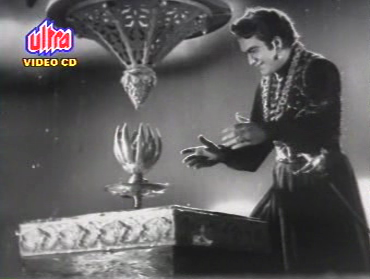
A Johnny Walker film, but one that’s known for a lot else besides.
I always associate Bimal Roy with the Do Bigha Zameen or Parakh sort of film: deeply rooted in reality, both harshly real and heart-warmingly real. Stories about people like us, people with problems and joys like ours. His films are socially relevant ones that discuss issues like untouchability and corruption, poverty, alcoholism and the plight of those who aren’t economically or socially powerful enough to stand up for themselves.
Madhumati is the glaring exception, the extremely surprising entry in Bimal Roy’s filmography: a film that’s chockfull of everything one doesn’t expect of Bimal Roy. Reincarnation, spooks, multiple roles, atmospheric storms: one could almost think Ramsay Brothers. Thankfully, no; because Madhumati, though in a completely different genre than Bimal Roy classics like Sujata, Bandini, Do Bigha Zameen or Devdas, still bears the mark of a master craftsman. And it’s good entertainment value.
Shaheed (1965)
One thing that has long puzzled me is Bollywood’s reluctance to do real life stories. Where Hollywood has created films on the lives of people ranging from Napoleon’s one-time fiancée to an obscure British missionary in China, we have, to show for years of fascinating history… Shahjehan and Changez Khan, both so badly warped that they bear little resemblance to fact. Dr Kotnis ki Amar Kahani is a refreshingly unusual film in being relatively accurate, as well as entertaining—but a flash in the pan.
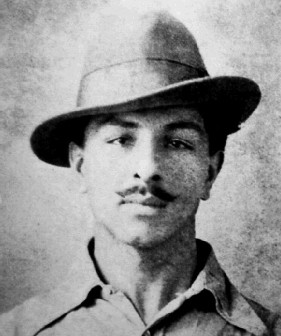
Our generally avid enthusiasm for the freedom movement and its exponents gave me hope that Shaheed, the story of Bhagat Singh, might be worth a watch. This, after all, was the young man who inspired an entire slew of films, beginning with (or so Wikipedia would have us believe) a film in 1954, followed by a 1963 film starring Shammi Kapoor, and this one: the first of Manoj Kumar’s many patriotic films. There have been later films—2002, for instance, saw two films, one a superb one starring Ajay Devgan and the other with Bobby Deol as Bhagat Singh—but Shaheed was the first major Bhagat Singh story.
Love in Tokyo (1966)
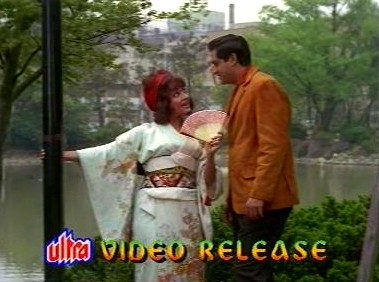
Love in Tokyo was before my time, but I can well imagine what its trailer should’ve been:
Japanese gardens! Asha Parekh in a kimono! Joy Mukherji in a wet shirt! Mehmood as a geisha! Mehmood as an Arab doctor! Mehmood as a nawab! Mehmood as Asit Sen!
And so on and so forth. It probably would’ve mentioned a few other attractions: Pran as a lecherous villain (so what’s new?), Lalita Pawar as a tyrannical matriarch with a soft heart (ditto), surprise revelations, a gold digger without a conscience, and a comic side plot without a shred of sense in it.
In spite of all that lunacy, though, this is an entertaining film with a certain mad charm about it.

Phir Wohi Dil Laya Hoon (1963)
Someone once said that Nasir Hussain came to Bombay with one story in his briefcase, and created a series of blockbusters out of it. This is one of them, and a vastly entertaining film: total paisa vasool. You get your money’s worth.
The story’s similar to that of Dil Deke Dekho, Tumsa Nahin Dekha, and Jab Pyaar Kisise Hota Hai: a couple separates, and one of them raises their only child, a son. He grows up, meets his `other’ parent (who’s wealthy), and they don’t quite hit it off—but he does fall for that parent’s adopted daughter. To complicate matters, there’s a villain who pretends to be the long-lost son, whom the parent has been yearning for all these years.

Pooja ke Phool (1964)
I’ve been on a Dharmendra-Mala Sinha spree, and it’s been a disaster. Baharein Phir Bhi Aayengi started off promisingly, but deteriorated; and Neela Akash was an even bigger disappointment. I had grave doubts about Pooja ke Phool, and sadly, it proved even worse than Neela Akash. I’m not sure I want to watch any more Dharmendra-Mala Sinha starrers. I’ve had enough.
The film begins in a village where a poor blacksmith called Hansraj (Nana Palsikar) is slogging his butt off trying to scrape together money to pay for a college education for his younger brother Balraj `Raj’ (Dharmendra). The only other member of the family is Hansraj’s daughter Vijay (Sandhya Roy).