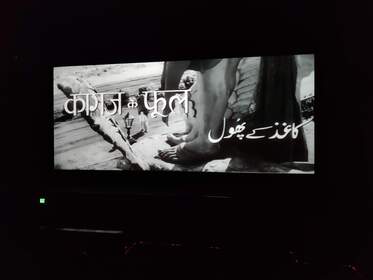
Kaagaz ke Phool (1959)

That first photo, because the space beyond the screen is so dark, may not be very obvious as regards context. But this is a photo from a full-sized film theatre, where I watched the re-released Kaagaz ke Phool on July 17th. The re-release was to mark the 65th anniversary of this film, a semi-autobiographical work that was a flop when it was first released, but has gained in popularity ever since. My niece had alerted me to the fact that PVR Inox would be showing Kaagaz ke Phool across its theatres, one show a day for a week, and I knew I couldn’t miss this one. If only for the fact that I get to see precious few old films on the big screen (Hum Dono was the last I saw).

I had thought I’d probably be one of a handful (ten, at the most?) of people in the theatre, because this, after all, is an old film; and this was an afternoon show on a weekday. But to my surprise, there were actually quite a few people, and—best of all—many of them were fairly young. Heartening.

But, to get to the film.

Continue reading

Paigham (1959)

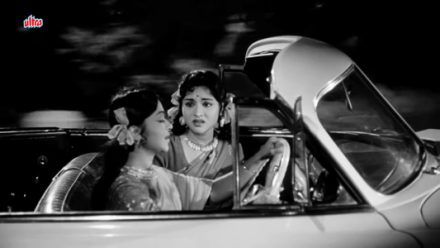
This is a film that’s been on my radar for a while now. Dilip Kumar, Vyjyanthimala. A cast also boasting of Motilal and Johnny Walker. Some good songs. Paigham, I thought, might be worth a watch.

I will admit, though, that my heart sank a bit when I saw the opening credits and discovered that this is a Gemini Studios release. Like AVM, I now approach Gemini with trepidation: while their films often had great casts and excellent music, they were invariably just too melodramatic for my liking.

But I persevered.

Paigham begins by introducing us to Manju (Vyjyanthimala) who, along with her best friend Malti (B Saroja Devi), has just finished college: Manju at the top of her class, Malti at the bottom. Malti isn’t fazed by this; she’s a wealthy girl, her father Seth Sewakram (Motilal) a prosperous cotton mill-owner. Malti, in fact, has promised Manju that she will ask her father to give Manju (who’s done a course in shorthand and secretarial work) a job at the cotton mill, which is in a town named Rangpur.  

Continue reading

Lahore (1949)

I’d been meaning to watch this film for a while now, because there’s a family history related to Lahore.

My uncle David Vernon Liddle ‘Verni’, as some of you may know, was a guitarist in Hindi cinema (this guest post, written by my father, Verni’s younger brother, is all about him). In 1947, Verni—then very young, no more than 16 years of age, but already an accomplished musician and making inroads into the Hindi film industry—was in Lahore and recording the songs for Lahore. Partition happened, and of course, there was so much violence and chaos that Verni had to flee Lahore and head eastwards into India. En route, during his travels, he ended up losing his sole pair of chappals and for quite a few days wandered about barefoot. Once he landed up in Punjab, he was able to make his way to some relatives in Ludhiana, and an aunt finally gave him a new pair of slippers! Verni also spent some time right after he came into Indian Punjab, working at a langar in a camp. The camp included Muslims and Sikhs, and Verni, being a Christian, was one of the few who was therefore not regarded with suspicion by anyone. This was what got him a job (sort of) serving food at the camp.

I am not sure about the story behind how Lahore came to be made. Since the music of most films back then used to be recorded before the film itself was completed, it’s possible that the songs of Lahore (written by Rajinder Krishan and composed by Shyam Sundar) had been readied even before filming began. As it is, it’s not as if the songs are very specific to this film or any particular scenarios; they are ‘generic’ love songs and sad songs, which could be fitted in pretty much anywhere in the average 50s or 60s film. It may just be that the real story of Lahore, of Partition disrupting a romance and a family, evolved somewhere in the course of time before, during and just after Partition.

So, this was a film I wanted to watch.

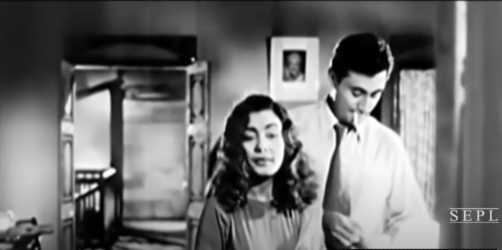
Sadly, I could find only one copy online (on the SEPL YouTube channel, never one I am happy to view films on because they have zero QA). This version turned out to be a mess: not only were there scenes arbitrarily chopped off, midway through the film, the sequence of the reels went for a toss too, so the chronology was all haywire.

This review, therefore, will be a little different from my usual style. What follows is not as detailed a synopsis as I usually provide, and it includes most of the film, so be aware that there are

Some spoilers ahead.

The story is set in Lahore, where Chaman (Karan Dewan) and Leelo (Nargis) are neighbours as well as collegemates, and sweethearts. Their love story is known and approved by their respective families. Leelo only has her mother (?), but Chaman lives with a fairly large family.

Continue reading

Aandhiyaan (1951)

In 1951, fresh from the success of the Dev Anand-Geeta Bali-Kalpana Karthik starrer Baazi, Chetan Anand decided to make a film that would highlight the very interesting aspects of film-making he had been learning from studying the works of various European directors. ‘Based on a true incident that took place in Amritsar’, as the film’s credits read, the story of Aandhiyaan was written by Chetan Anand himself, along with Hameed Butt.

The film’s credits roll to an unusual sequence of shots: in each frame, one actor or the other is shown, battling the eponymous ‘aandhi’ or storm, though in this case literal rather than metaphorical.

The story is centred round a young and zealous lawyer named Ram Mohan Kapoor (Dev Anand). Ram lives upstairs from his munshi (Ratan Gaurang), whose daughter Rani (Nimmi) has long been in love with Ram, though she’s too shy to let him know that. When the story begins, Ram’s mother (Durga Khote) is due to arrive, and Ram is getting ready to go to fetch her from the station. Rani makes tea for him, and an excited Ram confides in her: he’s asked his mother to come because he wants her to fix a match for him. With a girl he likes a lot.

Continue reading

Naya Daur (1957)

Happy 100th birthday, Dilip Kumar!

It was on this day that Mohammad Yusuf Khan, who was to go on to become one of India’s most-loved and finest actors, was born in Peshawar’s Qissa Khwani Bazaar.

In a career spanning several decades, and some sixty-odd films, Dilip Kumar attained a status all his own. He was one of the first to win a Filmfare Award, and went on to win the most Best Actor Awards (until the record was equalled— though not yet surpassed). His scenes have been copied and re-done, his dialogues have become familiar to fans of cinema, his films and his acting closely dissected.

Continue reading

Chanda aur Bijli (1969)

Chanda aur Bijli is one of those films I’ve known about for a long time—because of a family anecdote that is centred around a song from this film. My sister, a toddler when Chanda aur Bijli was released, quickly fell in love with Bijli hoon main toh bijli. Her version of it, though, was somewhat different (and suggests a mind that dwelt rather heavily on food):

Bijli hoon main toh bijli
Bun khaake jab bhi nikli
Logon ke dil mein machhli
(And here she’d add a little line completely off her own bat: ‘Wohi machhli jo Baby ne khaayi thhi!’)

For those who don’t understand Hindi, that means:

Lightning; I am lightning,
When I went out after eating a bun,
There was a fish in people’s hearts
That same fish that Baby ate!

The original, of course, is a rather more predictable Hindi film song:

Bijli hoon main toh bijli
Bal khaake jab bhi nikli
Logon ke dil mein machli

(Lightning; I am lightning,
Every time I went out, tripping along,
I made people’s hearts trip)

Continue reading

Seema (1955)

Every now and then, I am reminded of a film which I’ve seen—often, many years ago—and which would be a good fit for this blog. Right time period, a cast I like, music I like. Some of these (like Pyaasa, Mughal-e-Azam or Kaagaz ke Phool) have been analyzed and reviewed so often and by so many stalwarts infinitely more knowledgeable than me that I feel a certain trepidation approaching them. Others are a little less in the ‘cult classic’ range, but good films nevertheless.

Like Seema. I remembered this film a few weeks back when I reviewed Naunihaal (also starring Balraj Sahni). At the end of that post, I’d inserted a very striking photo I’d found, of a young Balraj Sahni standing in front of a portrait of Pandit Nehru. Both on my blog and elsewhere on social media, some people remarked upon that photo: how young and handsome Balraj Sahni was looking in it. And I mentioned Seema, as an example of a film where Balraj Sahni appears as the hero. A hero of a different style than the type he played in Black Cat, but a hero nevertheless.

Continue reading

Daaera (1953)

From one birth centenary to another.

Less than a week after Chitalkar Ramachandra was born in Maharashtra, on January 17, 1918, in the town of Amroha (in north-west Uttar Pradesh) was born, into a wealthy family of landowners, Syed Amir Haider Kamal Naqvi. Syed (or Kamal, as it probably more appropriate to refer to him) began writing Urdu stories at a young age and harboured a dream of making them into films—a dream quickly shot down by a father who did not think cinema a worthwhile profession. Faced with the prospect of having to manage the family’s estates, the 16-year old Kamal sold his sister’s gold bangles to finance his clandestine escape to Lahore. Here, he continued to write stories while studying (at Lahore’s Oriental College) and by managing to have some of these published, was able to finally save up money enough to travel to Bombay.

In 1938, when he was just 21 years old, his story Jailor was adapted to the screen by film-maker Sohrab Modi.

And that was how Kamal Amrohi made an entry into the Hindi film industry. This was the man who would write perhaps the most memorable Urdu dialogues of any film in Hindi film history (Mughal-e-Azam). This was the man who made what is arguably the finest and most memorable Muslim social in Hindi cinema (Pakeezah). This was the man, too, who—even though he directed only five films—made a mark for himself with those films, three of them (Mahal, Pakeezah and Razia Sultan) becoming pretty much cult classics.

Continue reading

Mahal (1969)

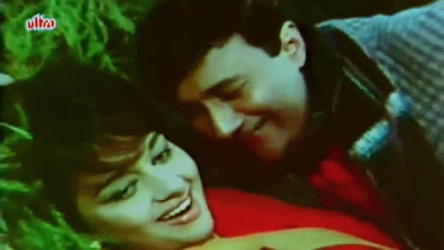
I had no particular film review or song list in mind for this week, but when Anu declared August Dev Anand month over at her blog, and Harini reviewed Duniya, I saw a bandwagon that I liked—and decided to jump on to it. With a film that reminds me of Duniya in some ways: Dev Anand, late 60s, suspense.

Asha Parekh and Dev Anand in Mahal

Continue reading