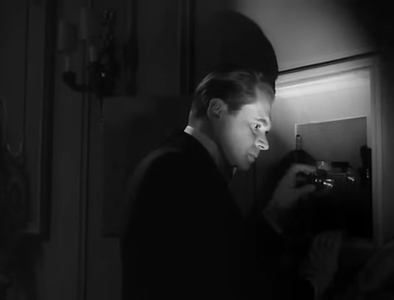
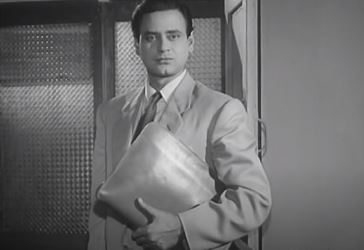
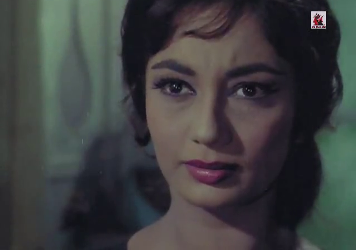
Anita (1967)

When, for May 31st this year (the 100th birth anniversary of film director Raj Khosla), I wanted to review one of his films, Anita was on my shortlist. Over the course of the years I’ve been writing this blog, I’ve reviewed several of Khosla’s films, including two of the three films (Woh Kaun Thi?, Mera Saaya and Anita) that comprise Khosla’s Sadhana suspense trilogy. Since Manoj Kumar had also passed away earlier this year, it seemed fitting to watch and review Anita, the last of the three films, and a film that starred Manoj Kumar opposite Sadhana.

For a tribute to Khosla, I ended up reviewing Kaala Paani instead. But I did watch Anita (a film that I’d last seen so long back, I remembered only the basics of it). And it seemed appropriate to review it too.

Therefore…

The film begins with a short, rather abrupt scene in which Seth Biharilal (Sajjan) visits a somewhat shady-looking pandit (Ulhas). Biharilal has brought along the horoscope of his 19-year-old daughter Anita for the pandit to have a look at, and to comment upon. The pandit has a peek, and says that this year is going to be really vile for Anita.

Continue reading

Point and Line (1958)

In the original Japanese, Ten to Sen. The English title is also often translated as Points and Lines, which was how I originally saw it being referred to.

In a cinema that—at least to the outside eye—seems to be dominated by the works of directors like Akira Kurosawa and Yasujiro Ozu, films that are rather more ‘pure entertainment’ tend to get overlooked. The amusing yet insightful little look at childhood, Ohayo (1959), for example; or this classic noir, a police procedural that revolves around trains: their schedules, their stations, their networks… and how they (along with a ferry and various aeroplane routes) might have been instrumental in helping a murderer pull off a crime.

The story begins on a bleak and deserted seashore, where two dead bodies have been found. The cops from the Fukuoka Police Department have come to investigate, and seem to have reached a consensus that this is a case of a double suicide: everything points to it. A man and a woman, her head sweetly pillowed on his arm, lying stretched out beside each other. The police doctor comes to the conclusion that they’ve died of cyanide poisoning.

Continue reading

Sleeping Car to Trieste (1948)

This little-known British film was recommended to me by YouTube, and given that I am a fan of train films (The Lady Vanishes is a favourite, as are Murder on the Orient Express and North-West Frontier), I decided I had to watch.

The story starts off with a bang (actually, almost literally: there’s a fatal gunshot in the very first scene). In an unnamed embassy in Paris, a party is in progress, when one of the guests, a Captain Zurta (Albert Lieven) slips out of the ballroom, makes his way to one of the more secluded rooms in the embassy, and having broken into a safe there, purloins a diary. He is caught red-handed by a footman who enters just then.

Continue reading

The Man Who Knew Too Much (1956)

I knew something connected to Doris Day long before I had even heard of her. When I was about six years old, my mother used to sing Que sera sera to me, and that song became such a favourite of mine that I ended up writing down the lyrics (misspelt, I admit: Kay sera sera is what I recall having written) and belting  them out, night and day.

It was only many years later that I finally watched Alfred Hitchcock’s The Man Who Knew Too Much, and got to see Doris Day sing that song onscreen, in a tense, nail-biting climax that both highlighted Doris Day’s singing ability as well as her acting prowess. By the time I watched this film, I had already seen Doris in other, more light-hearted roles, the sort of films (mostly musicals or screwball comedies, including the delightful ones which she did with good friend Rock Hudson) where she lit up the screen with the sheer joy of her presence. I had heard Wham! sing “… You make the sun shine brighter than Doris Day…” I had listened to plenty of songs Doris Day had sung, and I had fallen in love with the vivacity and good humour Doris seemed to radiate.

Continue reading

Apradhi Kaun (1957)

The world of Hindi cinema is peppered with names that anyone familiar with the industry (at least the industry of the 50s and 60s) can quickly slot into categories. Star. Villain. Comedian. Character actor. There are many, many names that automatically fall into (almost exclusively) one of these categories. Those that have shifted from one category to another—like Pran, for instance, once the quintessential villain but in later years the more interesting ‘good man’, or Ajit and Premnath, both initially hero and later villain—have again usually not done too many shifts.

Abhi Bhattacharya is one of those relatively rare individuals who seem to have appeared in a wide variety of roles, a wide variety of films. He was the idealistic school teacher of Jagriti, the ‘other man’ of Anuradha. The kind-hearted, principled example of the bhadralok in films like Amar Prem, and the straying older brother of Dev Anand in Love Marriage. He played Krishna and Arjun and Vishnu (the latter in a slew of mythologicals). He even played the villain, in the Vinod Khanna-Yogita Bali starrer, Memsaab.

This year marks the birth centenary of Abhi Bhattacharya (as far as I’ve been able to find out, he was born in 1921, though I’ve not been able to discover exactly when in 1921). To commemorate his career, I wanted to watch a Bhattacharya film, but a dilemma presented itself: which one? Hindi or Bengali? (since Bhattacharya had what seems to have been a very successful career in Bengali cinema as well). Eventually, I homed in on this film, a rare whodunit in Hindi cinema that’s pretty well made too.

Continue reading

Chase a Crooked Shadow (1958)

One of my favourite genres is suspense. Give me a good Hitchcock film, and I’m a happy camper (Hitchcock happens to be among my favourite directors, but no, that doesn’t mean I regard only him as a great director when it comes to suspense films; there are many films not directed by Hitch that are favourites of mine, including Charade, Gaslight, and How to Steal a Million).

Anyway, talking of suspense: someone mentioned Chase a Crooked Shadow, telling me that it was a good suspense film, and I decided I had to watch it. This one wasn’t directed by Alfred Hitchcock, but by Michael Anderson.

Continue reading

The Big Clock (1948)

For someone who loves books with as much passion as she does old cinema, it’s hardly surprising, perhaps, that I get especially excited when I discover a screen adaptation of a book I like—or vice-versa.

Earlier this year, I stumbled upon Kenneth Fearing’s novel The Big Clock. I had never heard of it before, and the first couple of chapters of the book didn’t endear me to it: too dry, too full of journalistic jargon, too business-y. But I persevered, and suddenly, the story took a turn that caught me by surprise. And then it became such a gripping, unputdownable book that I ended up racing through it, eager to see where it would go.

… which was why, when I found it had been also made into a film, I approached the cinematic The Big Clock with some trepidation: would they have been able to do justice to it?

As it turned out, yes. More than justice.

The Big Clock centres round a mammoth publication company, named Janoth Publications, after its owner, Earl Janoth (Charles Laughton). Janoth Publications is housed in a multistory building, each floor being devoted to one publication churned out by the behemoth: Styleways, Sportways, Newsways, and so on—and, the publication which becomes the focus of this story, Crimeways. As its name suggests, Crimeways is devoted to crime reporting, and is headed by George Stroud (Ray Milland).

Continue reading

Pathlaag (1964)

Some years back, a comments thread on a blog post sparked off a discussion, the net result of which was that I learnt about Pathlaag, the Marathi original of Mera Saaya.

Suspense is one of my favourite genres, and when it comes to 60’s Hindi cinema, Mera Saaya remains one of my favourite suspense films. And I am always eager to see the originals or the remakes—even in different languages—of films I particularly like. So I quickly put Pathlaag on my list, and set about trying to find a subtitled version. Some hectic trying, and I realized just how difficult this was going to be. I found VCDs aplenty; I even found a version—uploaded in five parts—on Youtube. None had subtitles. Then, Pathlaag again cropped up in conversations when I posted my review of Mera Saaya, I decided to give it another try. This time, I found an English subtitles file of Pathlaag. With much jugglery and some tech work, I managed to fit film to subs, and watch it.

Appropriate, perhaps, considering—as Harvey and Milind’s discussion indicated—‘pathlaag’ can mean ‘chase’ or ‘follow’. I really had to chase this film down.

Bhavna and Kashinath Ghanekar in Pathlaag

Continue reading

Mera Saaya (1966)

Permit me one last Sadhana-related post before I put aside my unexpected (even to me) sadness at her untimely death. I know I’ve already been through two tribute posts, but even as I was writing those posts, I couldn’t help but think of the Sadhana films I haven’t reviewed on this blog (and there are several of them, including all the ones she made with Rajendra Kumar). When I think of Sadhana, I always think of her in Raj Khosla’s suspense films. Three of them, two opposite Manoj Kumar (Woh Kaun Thi? and Anita), and this one, opposite Sunil Dutt, with whom Sadhana also starred in Gaban and Waqt.

Sadhana in Mera Saaya

Continue reading

Baat ek Raat ki (1962)

Anu had started this month with a Dev Anand film—and I, following suit, decided I would review a relatively little-known Dev Anand film too, to begin August. But, while Anu’s kept up the Dev Anand theme all through August, I’ve meandered off in different directions, all the way from The Rickshaw Man to jeep songs. But solidarity among friends counts for something, doesn’t it? So here I am back again, with another Dev Anand film. The sort of film that, on the surface, looks like it’s got everything going for it: a suave Dev Anand opposite a very beautiful Waheeda Rehman (who, along with Nutan, was, I feel, one of Dev Anand’s best co-stars as far as chemistry is concerned). SD Burman’s music. Suspense. Some good cinematography.

Waheeda Rehman and Dev Anand in Baat ek Raat ki

Continue reading