Paigham (1959)

This is a film that’s been on my radar for a while now. Dilip Kumar, Vyjyanthimala. A cast also boasting of Motilal and Johnny Walker. Some good songs. Paigham, I thought, might be worth a watch.

I will admit, though, that my heart sank a bit when I saw the opening credits and discovered that this is a Gemini Studios release. Like AVM, I now approach Gemini with trepidation: while their films often had great casts and excellent music, they were invariably just too melodramatic for my liking.

But I persevered.

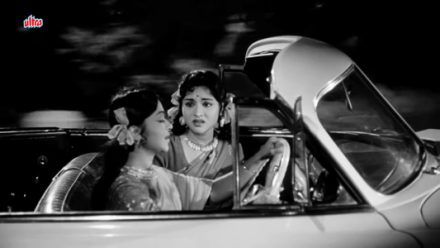
Paigham begins by introducing us to Manju (Vyjyanthimala) who, along with her best friend Malti (B Saroja Devi), has just finished college: Manju at the top of her class, Malti at the bottom. Malti isn’t fazed by this; she’s a wealthy girl, her father Seth Sewakram (Motilal) a prosperous cotton mill-owner. Malti, in fact, has promised Manju that she will ask her father to give Manju (who’s done a course in shorthand and secretarial work) a job at the cotton mill, which is in a town named Rangpur.  
Continue reading

Penn (1954)

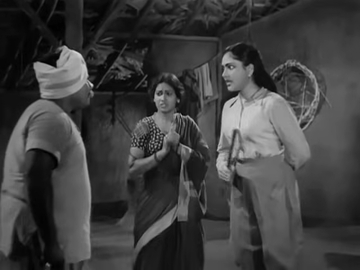
When I reviewed Zindagi (1964) some time back, blog reader Maitreyee, in a comment, asked me if I had watched any of Vjyyanthimala’s Southern films. I admitted I had not, and that mostly because it’s so difficult to find subtitled versions of South Indian films. I did have one Tamil film, with subtitles, bookmarked, and when Maitreyee too mentioned it (as a comedy), I decided it was high time I watched Penn, (in Tamil, ‘Girl‘).

The film begins by introducing us to Rani (Vyjyanthimala), a firebrand who goes about singing songs of women’s emancipation, gender equality, and the crushing of patriarchy. Rani walks the talk too: for instance, when she comes across a woman being beaten by her husband, Rani (who is an enthusiastic equestrienne) gets her whip out and uses it on the man.

Continue reading

Zindagi (1964)

The main reason I watched this film was because of the songs, which include some very good ones. And Vyjyanthimala, whom I invariably enjoy watching. The two male leads, Rajendra Kumar and Raj Kumar, are not favourites of mine, but they aren’t absolutely unbearable either. And there was a star cast of several other people I like, such as Prithviraj Kapoor and Helen. Ramanand Sagar, who wrote and directed Zindagi, also has to his credit one film I really like (Aankhen) and some (Aarzoo, Ghoonghat, Charas) that I don’t mind too much. I figured there might be enough here for me to enjoy.

The story begins with Beena (Vyjyanthimala) coming home to her mother (Leela Chitnis) with the news that she has found a job, finally. Ma is happy, until Beena tells her what the job is: Beena is now a theatre actress. Ma is very upset and goes into a long harangue of how it’s better to be poor than to be in the theatre; their name will be mud, blah blah.

Continue reading

Amrapali (1966)

Happy birthday, Vyjyanthimala! (it’s either her 90th birthday or her 87th today, it doesn’t seem very clear which, but anyway).

Among the recent books I’ve read is Advait Kottary’s Siddhartha: The Boy Who Became the Buddha, a fictionalized retelling of the story of the Buddha. While Siddhartha is the focal point of the narrative, several other important historical personages appear in the book, among them the nagarvadhu or courtesan of Vaishali, Amrapali. Amrapali is shown to have originally had a relationship with the ruler of Magadha, Bimbisara: so much so that she bears him a son, whom she is later compelled by circumstances to hand over to the Buddha to bring up. Bimbisara’s belligerent and headstrong son and heir, Ajatshatru, though he’s never seen ‘his father’s courtesan’ (as Kottary describes her), detests Amrapali.

… until he, injured in a way with Vaishali, impersonates a Lichhavi (native to Vaishali) soldier in order to escape with his life. Fate brings Ajatshatru and Amrapali together: she, thinking him to be Lichhavi, tends to his wounds and heals him, and they fall in love.

It’s been ages since I watched the Vyjyanthimala-Sunil Dutt Amrapali, and while I remembered some of the core elements, I’d forgotten much of it. As far as I remembered, the film had nothing whatsoever about Amrapali’s relationship with Bimbisara or her having a son with him. To be honest, I’d have been very surprised if that aspect of her life had been shown: it would have been far too bold for Hindi cinema, back then, to have a heroine who could have affairs with both father and son, and bear a child out of wedlock.

So I decided it was time to rewatch Amrapali, which begins in Magadha. Here, the king, Ajatshatru (Sunil Dutt), is in conference with his trusted advisor, friend, and Magadha’s commander-in-chief, Veer (Premnath). Ajatshatru is a hot-headed warmonger, and right now baying for the blood of the democratic Lichhavis, whose land, Vaishali, lies across the river to the north.

Continue reading

Naya Daur (1957)

Happy 100th birthday, Dilip Kumar!

It was on this day that Mohammad Yusuf Khan, who was to go on to become one of India’s most-loved and finest actors, was born in Peshawar’s Qissa Khwani Bazaar.

In a career spanning several decades, and some sixty-odd films, Dilip Kumar attained a status all his own. He was one of the first to win a Filmfare Award, and went on to win the most Best Actor Awards (until the record was equalled— though not yet surpassed). His scenes have been copied and re-done, his dialogues have become familiar to fans of cinema, his films and his acting closely dissected.

Continue reading

Sunghursh (1968)

This was the first film I watched after Dilip Kumar passed away on July 7 this year. The tributes and reminiscences were still in full flow two days later, on July 9, which marked what would have been the 83rd birthday of Sanjeev Kumar. On a Sanjeev Kumar tribute post on Facebook, I read a comment in which someone recalled Dilip Kumar’s remark about Sanjeev Kumar, who was his co-star in Sunghursh: “Is Gujarati ladke ne toh paseena nikaal diya!” (“This Gujarati boy made me sweat!”)

This, I thought, might be an interesting film to review by way of tribute to both Dilip Kumar as well as Sanjeev Kumar. But I had other Dilip Kumar films to also watch: Musafir and Sagina Mahato for the first time, Ram aur Shyam for a long-overdue rewatch. So, while I watched this and wrote the review, I decided the publishing of the review could wait for now.

Because today, August 21, 2021, marks the birth centenary of Harnam Singh Rawail, the director of Sunghursh.  HS Rawail, as he was usually billed, debuted in 1940 with the film Dorangia Daaku, but it wasn’t until 1949, with Patanga (of Mere piya gaye Rangoon fame) that he became famous. Rawail was to make several well-known films through the following decades, but his two best-known works are probably Mere Mehboob (1963) and Sunghursh.

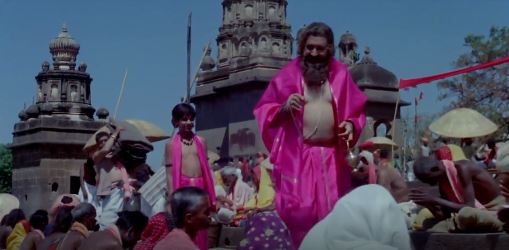
The story, based on Mahashweta Devi’s Laayli Aashmaaner Aaina, begins in Banaras of the 19th century (the riverfront, sadly, looks very mid-20th century). Bhawani Prasad (Jayant), bearded and seemingly benevolent, walks back from the temple after pooja. At his heels follows his grandson Kundan (?). Bhawani Prasad is much venerated, and the way he hands out alms to the poor and blesses those bowing before him, one might be forgiven for thinking him a good man.

Continue reading

Sitaaron Se Aage (1958)

When I was reading Balaji Vitthal and Anirudha Bhattacharjee’s The Prince Musician, I came across a mention of this film, which I had never heard of. But the songs listed as being part of Sitaaron Se Aage were familiar to me, and both leads—Ashok Kumar and Vyjyanthimala—are among my favourites. Recently, reading HQ Chowdhury’s Incomparable Sachin Dev Burman, I was reminded again of Sitaaron Se Aage, and decided it was high time I watched it.

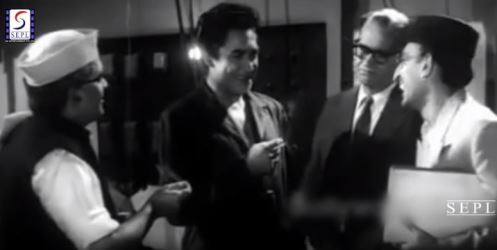
And what a showcase of SD Burman’s music this film is—right from the start. It begins with Sambhalke yeh duniya hai nagar hoshiyaaron ka, with Lattu (Johnny Walker) and his cronies, the pickpockets Bajjarbattu and Nikhattu, going about relieving passersby of their belongings. The three end up outside a theatre, where the superstar actor Rajesh (Ashok Kumar) has just completed yet another highly-acclaimed performance.

Continue reading

Yasmin (1955)

Fellow blogger and soul sister Anu, at Conversations Over Chai, watched Bahaar for two reasons: one, that it starred Vyjyanthimala; two, that it featured the delightful Saiyyaan dil mein aana re. As it happened (and both Anu and I agreed this was nothing new) she—as I have been, countless times—found herself a victim of the somewhat irrational logic that good music + an actor we like = good film.

But, to get down to this week’s post. A film I watched because, one, it stars Vyjyanthimala; and two, because it has great music. I had steeled myself for something pretty irritating, so perhaps the fact that I began this film with low expectations had much to do with my eventual enjoyment of it. Yasmin isn’t  a masterpiece, but I still liked it, predictability and all.

Continue reading

New Delhi (1956)

Over the years, I have heard and read much praise for this relatively little-known film. Its songs, which various people have introduced to me over the years, are good, and Anu—whose taste and opinion usually match my own—had good things to say about New Delhi in her review of the film. I decided it was time to watch it for myself.

New Delhi is set, of course, in New Delhi (though a bit of Old Delhi intrudes now and then, even as it does in everyday life in Delhi today). The film begins outside New Delhi Railway Station, where Anand Kumar (Kishore Kumar) has just arrived from Jalandhar, to study radio engineering. Anand hails a passing taxi at the same time that Janaki (Vyjyantimala), who is standing a few steps further along the road, does too. One taxi draws up; both Anand and Janaki get into it, and then start arguing over whose taxi this is.

Anand meets Janaki in a taxi

Continue reading