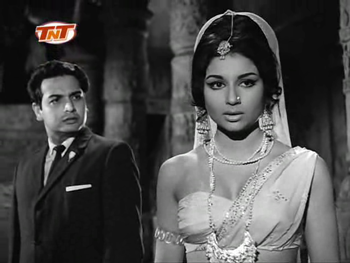
Poor Biswajeet must have gotten thoroughly sick of romancing spooky women in the ‘60s. True, in this one, the spookiness is rather more pronounced (Waheeda Rehman was pretty sunny and un-mysterious in Bees Saal Baad; everything else seemed steeped in mystery). But there is the inexplicability of everything around, dozens of very loud and pointed hints of someone haunting an area, and a song that’s sung again and again like a broken record.
Yearly Archives: 2012
Lizzie (1957)
This photo of Eleanor Parker is the current wallpaper on my laptop screen:

…and I’ve decided it’s time to change it, simply because it gets in the way of my work. Every now and then, while I’m working, I need to move to the desktop to open a folder or file that’s there. Invariably, I end up gaping at the gorgeous Ms Parker and forgetting all about why I’d arrived at the desktop in the first place.
Ten of my favourite car songs
I don’t often need to take a taxi to get around, but when I do, I always steel myself, because 9 times out of 10, the taxi driver will have music playing—a CD or a radio—and 99% of the time, it’ll be some completely vile stuff with just a monotonous beat, and no melody to speak of.
Last Friday, I had to take a taxi (for a longish ride, moreover—Delhi to Gurgaon and back, nearly 2 hours in the taxi). Sure enough, the radio was turned on. And what a pleasant surprise!—this driver had tuned into a radio channel that seemed to play only old Hindi film songs.
Those two hours were total bliss, and I was reinforced in my belief that good music can make a long and otherwise boring car journey also pleasurable.
La Grande Guerra (1959)
My original plan had been to watch and review Neecha Nagar, and follow it up by watching and reviewing Kurosawa’s Donzoko (also based on The Lower Depths). By the time I’d read Gorky’s play and seen Neecha Nagar, that plan had changed a bit—because I was feeling sorely in need of a funny film.
La Grande Guerra was what I chose, because it had come highly recommended by friends whose judgment I trust.
Neecha Nagar (1946)
I am a bit of an iconoclast. Maxim Gorky’s play The Lower Depths, while considered one of the great classics of Russian literature, left me cold when I read it. To me, it seemed too cluttered with characters, too devoid of plot, and just—well, without anything that would make me want to go back to it all over again.
So I approached Neecha Nagar—Chetan Anand’s debut film as a director—with a good deal of trepidation. Because Neecha Nagar was inspired by The Lower Depths, and I expected something horrendously morbid and impossible to understand without the benefit of footnotes.
Pyaar ka Mausam (1969)
Or, The Nasir Hussain Rule Book of Fool-proof Rehashing.
I’m beginning to think I’m an idiot for trying to think up new stories every time I write. Look at people like Betty Neels or Nasir Hussain; they managed to get by with basically the same story, over and over again, and very successfully too. [which makes me wonder: were Hussain and Neels long-lost brother and sister?]
Take the latter’s Pyaar ka Mausam, for example. I’d seen this film as a kid and remembered little of it except the very good music and the pretty lead pair. A rewatch last night revealed that it amounted to a cocktail of Nasir Hussain’s earlier films: Tumsa Nahin Dekha, Dil Deke Dekho, and Phir Wohi Dil Laaya Hoon. Same story, same plot elements, same rules from The Rule Book.
[Note: These rules will make more sense if you’ve seen one or more of the films I’ve mentioned above. If you haven’t, think of it this way: you’ll get to know about four films just from one review].
Ten of my favourite ‘Kashmir songs’
Some of you may have noticed my recent hiatus. Some of you may even know the reason for that—a trip to Kashmir (or, to be more specific, Srinagar). I lived in Srinagar for 3 years, beginning with when I was about 9 years old. I loved Srinagar. It was a beautiful place, and the beauty of it changed with the seasons: from the golds and reds of the chinars in autumn to the billowy white of winter (winter also meant teeth-chattering cold and long power cuts and occasionally no water, but never mind). From the masses of narcissi and daffodils, and the flowering fruit trees in spring, to the gardens bursting with poppies, roses and pansies in summer.
Cinematic Adaptations of Books: Some Ramblings
While writing my review of Piccadilly Jim—and comparing it to P G Wodehouse’s book—I was struck by the fact that most of the time, when I watch a film based on a novel I’ve read, I end up feeling let down. What is it, after all, that makes it difficult to recreate the magic of a book onscreen?
No, I’m certainly not saying all cinematic adaptations of books are bad; some are very good, as you’ll see in my list of ‘Goodies’, below. But there are Baddies too, and they, to my mind, far outnumber the Goodies.
When I began thinking about this topic, the first thing that came to mind was: I’m a purist. I like my books to be retained as is even on screen.
Piccadilly Jim (1936)
… a review, to be followed (probably tomorrow) by some ramblings on film adaptations of books, and why so many tend to fall flat on their faces.
I adore the books of P G Wodehouse. His writing is utterly charming, very witty, and very intelligently (not to mention intricately) plotted. From the loony Lord Emsworth and his pig, the Empress of Blandings, to the always-broke-but-ambitious Ukridge, to Psmith, Bertie Wooster and the omniscient Jeeves… all absolutely fantastic.
Waqt (1965)
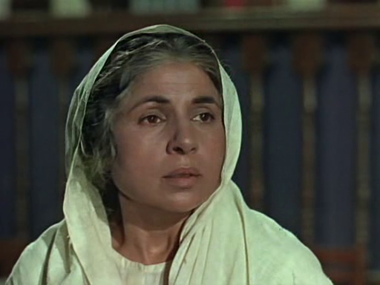
By some strange oversight, despite the fact that Waqt is one of my favourite masala films, I’ve never reviewed it on this blog. And I’m wishing I didn’t have to end up writing about it on such a sad occasion—because Achla Sachdev, the actress who played the self-sacrificing, long-suffering mother and wife in this film, passed away on April 30, 2012.