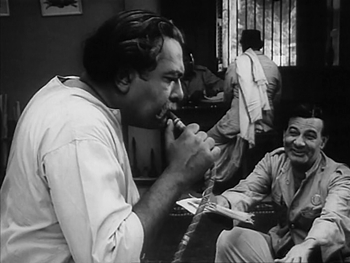
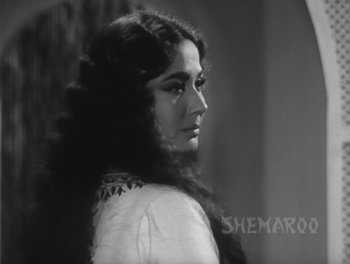
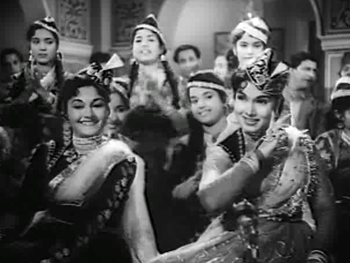
The last Hindi film I reviewed was a Bimal Roy production – and it left me feeling very disappointed. To get over that (and to remind myself that Bimal Roy’s films can generally be counted upon to be good), I decided to rewatch this one, an old favourite that reinforces Bimal Roy’s style of film-making: everyday stories of life, real life, with all its joys and sorrows and mundane happenings.
Yearly Archives: 2012
Charade (1963)
I hadn’t been able to decide on which film to review after Benazir, so I asked a bunch of friends to help me out – just by suggesting a genre. I got a varied lot of answers. Romance. Comedy. Social drama, à la Ladri di Biciclette. Suspense. Something with Cary Grant.
The result? This film, which is suspense, has a good bit of romance and comedy – and stars Cary Grant. (Sorry, Harvey: I’ll review something along the lines of Ladri di Biciclette sometime soon).
Benazir (1964)
‘Bimal Roy’s Benazir’ is what it says on the DVD cover. Enough to conjure up, for me, memories of some of the greatest Bimal Roy films I’ve seen: tender, thought-provoking, real films about real people. Benazir, perhaps because it wasn’t directed by Bimal Roy himself but by S Khalil (who also scripted the film) falls short of the standard of Parakh, Prem Patra, Sujata, Do Bigha Zameen, or Bandini. A top-notch cast, a very well-respected production company, a master music director—but why does this film rarely get mentioned in the same breath as those?
Ten of my favourite filmi qawwalis
I have been meaning to write this post for a long time now—I love qawwalis—but I’ve kept putting it off, because I’ve always thought that it would be impossible to create a list of just ten filmi qawwalis that are my favourites. (Barsaat ki Raat itself features at least three qawwalis that completely bowl me over).
But. I’ve finally decided to take up the challenge, and do it. These are ten fabulous qawwalis from pre-70s films that I’ve seen (though I must confess that I like the qawwalis of some 70s films—especially Rishi Kapoor ones). To make this post a little more challenging, I decided not to include more than one qawwali per film.
Zulu (1964)
While this blog is all about old films—and the bulk of my film-watching is old films—that doesn’t mean I don’t watch new films. I do; lots of them. But the odd thing is that invariably, new films that I watch end up having some connection (even if in a roundabout way) to an old film.
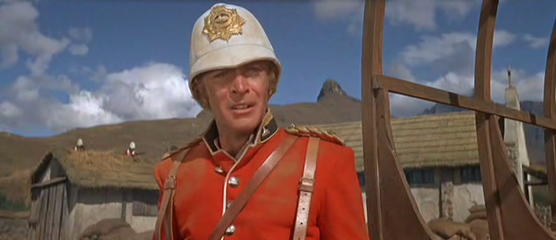
Last weekend, I watched two new films. One, of course, was the latest big release: The Dark Knight Rises. The other was the 2011 Michael Fassbender-starrer, Centurion. Both films reminded me of one old film, Zulu. Like The Dark Knight Rises, Zulu has Michael Caine in its cast (it was one of his first major film roles). And, like Centurion, Zulu too is about conquered versus conquerors.
Noor – Mrs. Johnny Walker
We’ve mourned the passing of a favourite star, but now—in the yin and yang way of zindagi and maut that Anand would possibly have appreciated—it’s time to celebrate a birthday. Today, July 21st, is the 77th birthday of a very lovely lady who began a career in cinema, appeared in some landmark films, and then bagged her biggest offscreen role: as the wife of possibly India’s best-loved comedian ever. This is Noor, the beautiful Mrs Johnny Walker.
On Rajesh Khanna and the Ephemerality of Life
I saw very few films till I was about ten years old. Till then, my father had been posted in small towns that had rather dreadful cinema halls. Then, in late 1982, we acquired a TV. And suddenly, though there wasn’t a spate of films to see (Doordarshan’s Sunday 5:45 PM film was the highlight of our week), there were some films to see. And, thankfully, I was old enough to understand what was happening onscreen.
One of my earliest recollections of that period is of watching Anand. For me—exposed till then to the usual Hindi film, where the hero always had a love interest, and where there were few (and mostly pretty melodramatic) moments of tragedy—Anand was different.
There was never any doubt that Rajesh Khanna’s character was the hero. He was ebullient, full of life, charming, friendly, yet (in those moments of solitude) sensitive. I kept waiting for a heroine to pop up.
Bringing up Baby (1938)
The other day, I was thinking aloud, wondering what to do for my next blog post, and my husband said, “Review a comedy.”
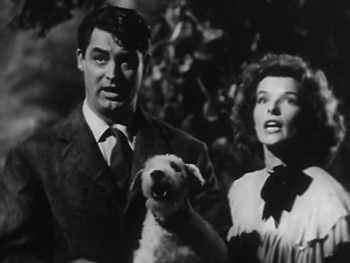
So here it is. A review of a film that’s intentionally funny, and which, furthermore, stars one of my favourite Hollywood actors: the incomparable Cary Grant, a leading man who had a fantastic flair for comedy. In this one, he teams up with the equally superb Katharine Hepburn in a crazy story involving a millionaire aunt, a big game hunter, a tame leopard, and a Brontosaurus bone, among other odds and ends.
Rustom-e-Rome (1964)
Another tribute, to yet another great who’s passed on. Dara Singh, the wrestler-turned-actor who made such a big niche for himself in a slew of films, especially in the 1960s, passed away on July 12, 2012.
As a child, nearly all my movie-watching was restricted to what was aired on Indian TV—Doordarshan—(and later, the few TV channels that showed Hindi movies). Somehow, I never ended up watching any Dara Singh movies. Despite that, Dara Singh was a very familiar figure and name. A synonym for formidable strength, for something like the Rock of Gibraltar: utterly immovable, impossible to defeat.
Dupatta (1952)
I saw a mention of this film for the first time on Richard’s blog a couple of years ago. Richard had mentioned that Dupatta (or Dopatta, as it’s referred to in some places) was available for viewing online. I’d stored away that snippet of information somewhere in the back of my mind, and forgotten about it later. Then, recently, Richard published an unusual (and interesting) post on his favourite filmi nurses, and Noorjehan’s character in Dupatta topped his list.