Book Review: Amitava Nag’s ‘Soumitra Chatterjee: His Life in Cinema and Beyond’

For someone who didn’t know of Soumitra Chatterjee till fairly late in life, I fell under the actor’s spell pretty fast. Initially (as I mentioned in this review of another Soumitra Chatterjee biography) seeing him in Charulata, I liked him well enough to want to explore more of his work. I watched him then in various other films, and always, so far, with admiration. His versatility, the way he manages to mould himself to believably depict such different characters: exemplary acting.

So when another Soumitra Chatterjee biography—Amitava Nag’s Soumitra Chatterjee: His Life in Cinema and Beyond (Speaking Tiger Books, 2023)—came to me to read, I wasn’t averse to the idea. Perhaps Nag would have something different to say about the subject?

Continue reading

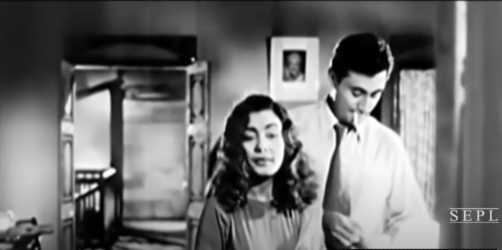
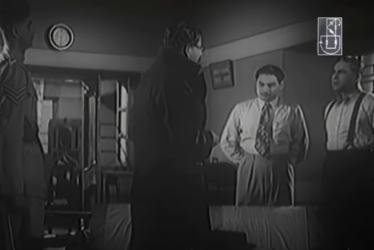
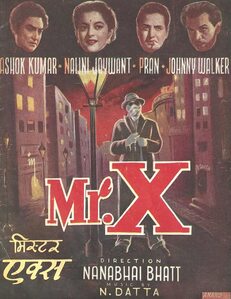
Mr India (1961)

A simple-hearted—even outright simple, really—man turns out to be the look-alike of a much-wanted criminal. As a result, the police train him to impersonate the criminal so that they can get enough evidence to crack down on a web of crime.

I have no idea if Don (1978) was inspired by Mr India. Don is in many ways a very different film (the criminal, for one, dies fairly early on in the proceedings; for another, it’s a much more complex plot): but there is that fleeting resemblance.

Mr India begins by introducing us to Gullu (IS Johar), naïve and simple, as he goes about job-hunting, and getting rejected at every office because he doesn’t fit the regional profiles demanded by the parochial employers of these places. Gullu gets briefly hired by someone who wants to rig a ‘Mr India’ weight-lifting competition, with Gullu pretending to hoist what is actually wooden dumbbells rather than iron.

Continue reading

Book Review: Jerry Pinto’s ‘Helen: The Making of a Bollywood H-Bomb’

This is a reblog of an old post, in which I had reviewed an earlier edition of this book.

(The other day, I happened to meet Jerry Pinto—he was in Delhi for an event—and I couldn’t stop myself from telling him how much I enjoyed his Helen book. The next day, I discovered that Jerry’s Helen book has just been released in a new edition, with a lovely new cover, this time by Speaking Tiger Books. This book, which I read only about three years ago, is one of my favourite books on Hindi cinema: it combines intelligent analysis with humour, a genuine affection for the Hindi films of yore, and of course, Jerry Pinto’s very readable writing style).

Here, then, is my review of Helen: The Life and Times of a Bollywood H-Bomb. Or Helen: The Making of a Bollywood H-Bomb.

dustedoff's avatarDustedoff

I won’t go so far as to say that Helen was the first Hindi film actress I remember seeing (that would be Shakila, since CID was the first Hindi film I remember watching). But I distinctly remember being about 10 years old, watching Chitrahaar, and being very excited because an old favourite of mine, a song I had till then only heard and never seen, was going to come on (in Chitrahaar, there would always be a sort of intertitle between songs, a single frame in which the name of the next song, the film it was from, and the names of the music director, the lyricist, and the singer(s) would be listed).

This song was Mera naam Chin Chin Choo, and my feet were already tapping when it began. All that frenetic movement, those men in sailor suits dancing about. The energy, so electric that it…

View original post 1,412 more words

Guess Who’s Coming to Dinner? (1967)

This is a film that’s been on my watchlist for a long time. It was recommended to me all over again last year when Sidney Poitier passed away, and since then, I’ve been meaning to watch it. So, finally.

Guess Who’s Coming to Dinner? is a film that can be easily summed up in one sentence: a young white woman and an African American man fall in love, and their shocked families have to learn to cope with their feelings. This is a story not so much of plot—very little actually happens, and most of the nearly two hours of the film consists of dialogue, of people discussing this frighteningly new development that has hit all of them—but in that time, the film manages to make several very pertinent points, not just on racism (which is, naturally, the most obvious) but other issues as well.

Continue reading

Lata Mangeshkar: Ten Solos, Ten Composers – Part 4

Last year, when Lata Mangeshkar passed away, I did a series of posts featuring songs she’d sung for different composers. This post, the fourth and final one, had been lying waiting to be published for the past several months.

I began the first list as a tribute to Lata when she passed away, but that, I realized, was too little; there were too many very talented composers, too many wonderful songs, which had perforce been left out of that list. I therefore ended up making another list. And then another.

Here, I cover ten more composers, most of them unfortunately either forgotten now or never really given their due. But, as can be seen (or heard?) by this list, they were not short of talent. These ten solos are all, as always, from pre-1970s Hindi films that I’ve seen. Plus, these songs do not overlap with the very first Lata Mangeshkar post I had published on this blog, here.

Continue reading

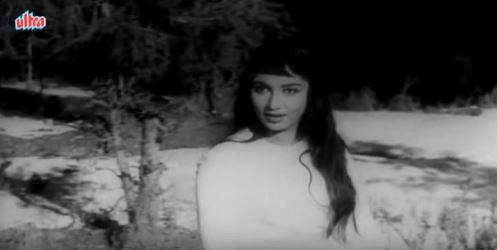
Arpan (1957)

When I was going through Chetan Anand’s filmography last year (to commemorate his birth centenary), I stumbled across a Chetan Anand film in which he starred, besides directing it: a film, too, which immediately struck me as unusual, just given its length: a mere one hour. For a Hindi film, rare indeed. Though I didn’t watch Arpan back then, I bookmarked it and decided I’d watch it sometime later.

And it is an unusual film. Not just short, but also somewhat surreal in places. Hauntingly beautiful at times, outright odd at others.

Arpan is set, we are told, 2,500 years ago. A famine is ravaging the land, and people are starving left, right and centre. In this situation, the royalty, of course, is expected to set an example, and thus Princess Madhavi (Sheila Ramani) is going about, a large entourage with her, distributing food to her father’s subjects.

Continue reading

Apur Sansar (1959)

Aka The World of Apu.

The third, and last, film of Satyajit Ray’s Apu Trilogy, Apur Sansar came a full three years after its prequel Aparajito had been released. Aparajito, while it hadn’t been received well in India (Indian audiences baulked at the obvious callousness and self-centredness of Apu in the film, so contrary to the established ideas of how a offspring must behave towards a mother), had won critical acclaim—and many awards—abroad. This was what encouraged Ray to make Apur Sansar, rounding off the story of Apu as he grows from a teenager to a man.

Apur Sansar introduces us to Apurba Ray ‘Apu’, (Soumitra Chatterjee, in his debut role) now a young man living in Calcutta. Apu is really down at heel: it shows in the ragged curtain hanging at the window of his single room; in the drab dreariness of that room, even the fact that he has to sleep with his outdoor clothes neatly folded and kept under the mattress so that the wrinkles get smoothed out.

Continue reading

The LO Goes to Assam, Part 2: Kaziranga

To read the first part of this travelogue (Guwahati), click here.

Having spent the few hours we got in Guwahati sightseeing and eating out, we got up the next morning and set off for Kaziranga. Kaziranga, a UNESCO World Heritage Site, is about 195 km from Guwahati, a distance that can be accomplished in about 5 hours (or less). The road is pretty good, a well-tarred, well-maintained, broad highway that goes mostly through the plains. Getting out of Guwahati itself took us close to an hour, and the LO kept remarking throughout: “It looks just like Ring Road!” (Delhi’s Ring Road, or at least those stretches of it we traverse frequently, often has construction work going on: flyovers being made, half the road cordoned off, traffic jams aplenty and the roadside trees choked with dust).

Interestingly, the outskirts of Guwahati abut onto Meghalaya; for about 15 minutes or so, the Innova that had come to take us to Kaziranga travelled through Meghalaya before re-entering Assam.

We traversed other interesting, and often very scenic, stretches of road once we were past the urban sprawl of Guwahati. The Assam countryside is very pretty: the villages nestle among coconut and betel nut palms, banana plants, and fields of paddy, or—even more striking right now, when it bursts into sunny yellow bloom—mustard. We passed many village ponds covered with deep pink waterlilies, and there were fishing nets anchored here and there, waiting for the catch.

Continue reading

The LO Goes to Assam, Part 1: Guwahati

Some of you may know about my now nine-year old daughter, the Little One or LO (though at her age, I guess it’s high time I thought up another epithet; she’s hardly little any more). The LO has, since she was a little mite, been keenly interested in nature; and when, last summer, we went to Jim Corbett National Park, she enjoyed it immensely. So much so that I promised her we’d try to visit at least one national park every year.

This time, we decided to go to Kaziranga, in Assam.

It was a short holiday, only six days in all, and of that the sojourn in Kaziranga was bookended by a day in Guwahati, which was where our flights to and from Delhi were connecting.

The excitement had been building up over the past several weeks, with the LO planning what she would pack (it seemed she was outfitting herself for an Arctic expedition; I had to drastically prune her list). On the day of our departure, though we had to leave home at an unearthly hour, the LO didn’t utter a squeak of protest. It was all adventure, all fun, even to leave home when it was still dark.

In Guwahati, we were booked at the Radisson Blu. This hotel is about half an hour from the airport, about 20 minutes from the city, therefore easily approachable from both directions. The only problem is the transport: Guwahati has private taxis, as well as Ola and Uber, but booking an app-based taxi, we soon discovered, was a real pain: the drivers were obstinate about how they wanted to be paid, many would refuse to go to a particular place, and it would take several tries before one could get a driver who would agree.

Anyhow, we ended up hiring a local taxi to get to the Radisson. The LO (and I must admit, me) was unimpressed by the lobby—large and bare, with one massive bit of sculpture in the middle—but our room met with the LO’s approval. Not only was there plenty of space to dance about (dancing about is important in the LO’s life), the bathroom was huge. There was a big bathtub in it (which the LO insisted she wanted to bathe in), and enough space for a luggage rack, ironing board, and more. This was the life, the LO decided, and made her father take photos so that she could show a friend back home (said friend having raved about a large bathroom in a hotel she’d stayed in in Rajasthan a couple of years back).

Continue reading

Nagina (1951)

This Gothic mystery story has an interesting claim to fame: it was the film Nutan wasn’t permitted to watch at the premiere, even though she starred in it.

Nutan had debuted in the film Hamari Beti (1950; it was directed by her mother, Shobhna Samarth) when she was all of fourteen. The following year, after having spent the intervening period at a finishing school in Switzerland, she was cast as the female lead in Ravindra Dave’s Nagina, which starred Dilip Kumar’s brother Nasir Khan. Nagina was released under an A certificate because it was considered too frightening for children; Nutan, then not even sixteen years old, was escorted to the premiere of the film by family friend Shammi Kapoor, but was not allowed in because she was underage.

The story begins [rather choppily; I wonder if this is the modern-day slash-and-burn style of video editing that’s reflected here, rather than the original film’s editing] with Srinath (Nasir Khan) having a conversation with his wheelchair-bound mother (Anwari Bai). As it later emerges from the story, Srinath’s father, a jeweller named Shyamlal, has been missing these last twelve years, ever since he was accused of having murdered the wife of a zamindar, Raiji, over a valuable gemstone (a ‘nagina’) set in a ring.

Continue reading