
It’s been a long time since I reviewed a restaurant on this blog. That’s partly because most of the restaurants I’ve eaten at in the past few months have either been places I’ve reviewed before, or places that just didn’t … Continue reading

It’s been a long time since I reviewed a restaurant on this blog. That’s partly because most of the restaurants I’ve eaten at in the past few months have either been places I’ve reviewed before, or places that just didn’t … Continue reading
When I was about twelve years old, there were two important developments in my literary life.
My blog posts come about in odd ways. Some are suggestions or recommendations from blog readers, or from friends. Some strike me as I go through life. Some are serendipitous—a video appearing on the sidebar in Youtube while I’m watching something else. And some are like this: an idea which strikes two people at almost the same time. Anu and I don’t always see eye to eye (pun intended), but more often than not, we look at things in exactly the same way.
Therefore, it came as no surprise that Anu’s ‘zulfein’ songs post gave me the idea for an ‘aankhen’ songs post (and, even less surprising, that Anu had already thought of an ‘aankhen’ songs post too). Or that, as I was publishing my post, I thought, “I should do a post on either nigaah or nazar next.” Or, that Anu should send me an e-mail later the same day, in which she wrote: “Perhaps I should do ‘Nigahein’ as a complementary post.”
Anyway, to cut a long story short: Anu and I decided we’d do twin (but not quite; look-alike, as in Hum Dono or Mujrim, might be a more appropriate description) posts. And then Anu suggested we ask our third soul sister, Bollyviewer, if she’d like to join the party as well: with a post about nayan/naina songs. Bollyviewer, good sport that she is, agreed. So here we are, with a trio of song lists. Head over to Anu’s blog to read her post on nigaahein songs, to Bollyviewer’s for her post on nayan/naina songs—and read on for my list of ‘nazar’ songs.

Considering I’d reviewed Jhuk Gaya Aasmaan last week, and that was based on Here Comes Mr Jordan, it seemed appropriate to follow up that review with this one. I hadn’t heard of Here Comes Mr Jordan before, though I have seen a later film (Ernest Lubitsch’s Heaven Can Wait) which was based on the same story—and which, interestingly, retained the name of the original story. Heaven Can Wait, as it turned out, is quite different from Here Comes Mr Jordan.
This story begins by introducing us to prizefighter Joe Pendleton (Robert Montgomery) as he trains somewhere out in the country while his manager and good friend Max Corkle (James Gleason) looks on. Joe is in fine form and is looking forward to an upcoming fight which can get him within arm’s reach of the world championship.

Rajendra Kumar is one of those actors whom I’ve repeatedly mentioned as ‘not being one of my favourites’. Saira Banu, beyond her first few films (notably, Junglee and Shaadi), I find too shrill for my liking. Despite the fact that these two star in Jhuk Gaya Aasmaan, it remains one film I like a good deal—because it has such an unusual story.
A story to which there’s a brief nod in the first scene. Sanjay (Rajendra Kumar) and Priya (Saira Banu) meet in what looks like an obviously ‘indoor set’ representation of a cliff. There’s a little banter, she insisting that he’s irritating her with his wooing, he professing his love for her and asserting that he could do anything for her—even give up his life. Priya eggs him on: yes, please. Go ahead. Show us.
This film has been on my to-watch list for years, one major reason being that it stars one of my favourite actors, the very attractive Stewart Granger. It also stars, opposite Granger, the beautiful Jean Simmons, whom he was to go on to marry the year after Adam and Evelyne was released. Plus, what I’d read of this film sounded enticing—romantic, somewhat Daddy Long-Legs style, just the sort of film that would appeal to me.
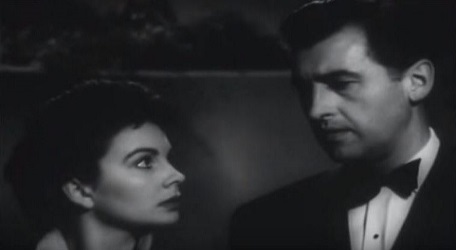
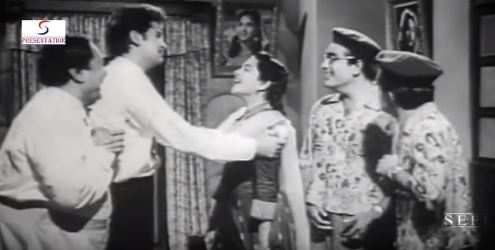
I have to admit that I watched this film against all advice. Anu had watched it a couple of years back (and had written up a review of it); but I—remembering a long-ago viewing of Hum Sab Chor Hain, which I’d enjoyed immensely—decided to give it a try anyway.
And, it seems the version I got to watch, while as incoherent in the second half as the one that Anu saw, at least had some more parts intact. The main problem, from what I could see, was that—possibly in transferring the film from celluloid to digital—the reels got mixed up, with one of the reels that should’ve come early in the film ending up later, thus making things very confusing. Despite that (and despite some shameful editing in the last half-hour by the video production company), this evoked one reaction in me: If only this could’ve been available in the original version. Because, if you try to fit the pieces together and imagine what might have been in the bits so summarily chopped off, you can see the outline of what must have been a pretty funny and entertaining film.

A couple of weeks back, I wrote a post on how to write better: some basic tips on grammar, on punctuation, on dos and don’ts that help create a more polished manuscript. It drew a lot of attention, and several … Continue reading
At the risk of being labelled an iconoclast and being trolled by diehard Lata fans, I have mentioned several times on this blog how much I like Asha Bhonsle. It’s not that I don’t like Lata: I do, very much, and there are many, many songs of hers that I cannot imagine anyone else singing, or singing better than she does. But when I think of Asha, of Aage bhi jaane na tu and Saba se yeh keh do and Yehi woh jagah hai… I cannot help but think that Asha is too often unfairly dismissed as being second to her Didi.
So, when I was offered a chance to review Raju Bharatan’s Asha Bhosle: A Musical Biography (Hay House Publishers India Pvt Ltd, ₹599, 332 pages), I jumped at it. (If you want to read a shorter and more tactful review, read the one I wrote for The New Indian Express, here).

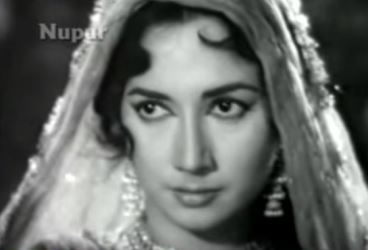
Not nayan, not naina, not chakshu or any other Hindustani/Hindi/Sanskrit word for eyes, but aankhen.
This post, though the immediate spur for it was Anu’s delightful list of zulfein songs, has been in the pipeline for the past several years, since a fellow writer first asked her friends (of whom I’m one) on Facebook for all the songs we could think of that were about eyes. I came up with so many that it occurred to me then that I could do a post about them. That idea stayed on the backburner for a while, but when Anu’s zulfein songs post appeared, I thought, “I have to do that one on aankhen.”
Because, just as hair are praised, so are eyes. And unlike hair—inanimate, more often than not, and compared perhaps only to the dark velvet of the night, or the spreading black of a storm cloud—eyes have a life of their own. They convey infinitely more than hair ever can, from love to fear to hatred: they cannot disguise the soul, the emotions.

 Dustedoff