A good way to begin a new year? Launch a series of articles on some of my favourite medieval mosques in Delhi! As is probably obvious from my article on mosque architecture, I find old mosques fascinating (well, old any … Continue reading

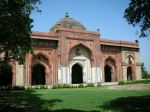
A good way to begin a new year? Launch a series of articles on some of my favourite medieval mosques in Delhi! As is probably obvious from my article on mosque architecture, I find old mosques fascinating (well, old any … Continue reading
Happy New Year!
The other day, someone mentioned that after Omkara, Maqbool and Haider—based respectively on Othello, MacBeth and Hamlet—Vishal Bhardwaj was going to be making a trio of films based on Shakespeare’s comedies. The thought came into my head: had any Hindi film maker remade a Shakespearean comedy before? The very next moment, the answer popped up. Of course: Angoor. And (my brain was beginning to work overtime by now), another film based on A Comedy of Errors and also starring Sanjeev Kumar: Gustakhi Maaf.
I hadn’t heard of Gustakhi Maaf until a few years back, when I happened to find (and subsequently buy) a delightful lobby card featuring Sanjeev Kumar in this film. I went looking for the film, discovered that it was based on A Comedy of Errors and that it starred the ever-bubbly Tanuja—but I couldn’t get hold of the film anywhere. Until Harini (over at bagsbooksandmore) pointed me to it. So here goes: review #1 of 2015, of a fun, frothy film.
There are two traditions I’ve maintained on this blog ever since I began blogging. One is to celebrate my birthday with a pertinent post (coming up in two weeks’ time). The other is to, for Christmas, review a Christmas-themed film (of which there are examples aplenty). For once, though, the Christmas film I’ve chosen is one with a difference. It’s a Western, and – while it doesn’t have any actual blood and gore shown – there is death here. It’s not a sugary film, and even though the first half has its share of humour, the final impression is one of a bittersweet story of a world that isn’t quite black and white.
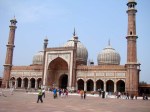
In my not-too-recent posts about the impact of the Revolt of 1857 on Delhi’s monuments, I’d dwelt quite a bit on the mosques of the city. The many masjids, which are among Delhi’s most visible historical monuments, and which suffered … Continue reading
I was born in an odd generation that somehow missed the Rajesh Khanna euphoria. I missed inheriting it from my parents, who had been young and film-crazy when Ashok Kumar, Shammi Kapoor and Dev Anand had been in their prime. And I missed being part of it; I was born just after Rajesh Khanna—who had one of the shortest-ever reigns of any superstar anywhere—had come to the last of his 15-in-a-row super hit films.
Yes, I admit it: I am not too much of a Rajesh Khanna fan. I like him alright; I think he’s gorgeous in films like Aradhana, and so very poignant in Anand. But I wouldn’t go out of my way to read a biography of the man. So, when I received a review copy of Gautam Chintamani’s Dark Star: The Loneliness of Being Rajesh Khanna (Harper Collins Publishers India, P-ISBN: 978-93-5029-620-2; E-ISBN: 978-93-5136-340-8; ₹499; 242 pages), I was a little ambivalent. I was not particularly interested in the life of Rajesh Khanna. On the other hand, this man had acted in some of the greatest hits of the late 60s, films that were both extremely popular as well as critically acclaimed.

Tamura has been around for a long time (or so I was told by various people who recommended it to me), and in various locations. There is one in Green Park Extension, and one in New Friends Colony Community Centre—and … Continue reading
Happy birthday, Dharmendra!
Considering I am so fond of Dharmendra (and I’ve reviewed so many of his films—including his debut film, the forgettable Dil Bhi Tera Hum Bhi Tere), it seems odd that I’ve never created a list of my favourite Dharmendra songs. Even though he did have a lot of good songs picturised on him. And he acted in some excellent films.
Born on December 8, 1935, in Sahnewal (Punjab), Dharmendra arrived in Bombay after winning the Filmfare New Talent Award. His first films weren’t huge successes: Dil Bhi Tera Hum Bhi Tere, Shola aur Shabnam, and Boyfriend were all flops, despite (in the case of Boyfriend) having an otherwise very popular lead pair. Within a couple of years, though, by appearing in hits like Anpadh and Bandini (in both of which, though, he didn’t have very major roles), Dharmendra began to be a known face—and was soon, by the mid-60s, one of Hindi cinema’s hottest (literally). He was to go on to become the ‘Garam Dharam’ of the 70s, but to me, the Dharmendra is the 60s hero: the quiet, sensitive poet of Anupama; the idealist of Satyakam; the dashing spy of Aankhen.

‘Food festival’ is a term that’s been happily applied to just about any food-related (or remotely food-related event) in Delhi. Restaurants are fond of doing food festivals, often focusing on a specific cuisine, or a specific event. Dilli Haat (and … Continue reading
This was not the post I’d got planned for this week. But then, when so many people commenting on my Geeta Dutt solos post began writing about Geeta Dutt duets, I decided I may as well compile my list of the Geeta Dutt duets I love the most. After all, I knew I’d do this post, sooner or later. So why not now?

It’s the perfect season in Delhi to be eating alfresco. The winter’s beginning to set in—and, what with Christmas just a little over a month away, I realized it’s time to go shopping for gifts. And, since a lot of … Continue reading