On Rajesh Khanna and the Ephemerality of Life

I saw very few films till I was about ten years old. Till then, my father had been posted in small towns that had rather dreadful cinema halls. Then, in late 1982, we acquired a TV. And suddenly, though there wasn’t a spate of films to see (Doordarshan’s Sunday 5:45 PM film was the highlight of our week), there were some films to see. And, thankfully, I was old enough to understand what was happening onscreen.

One of my earliest recollections of that period is of watching Anand. For me—exposed till then to the usual Hindi film, where the hero always had a love interest, and where there were few (and mostly pretty melodramatic) moments of tragedy—Anand was different.
There was never any doubt that Rajesh Khanna’s character was the hero. He was ebullient, full of life, charming, friendly, yet (in those moments of solitude) sensitive. I kept waiting for a heroine to pop up.

Continue reading

Bringing up Baby (1938)

The other day, I was thinking aloud, wondering what to do for my next blog post, and my husband said, “Review a comedy.”

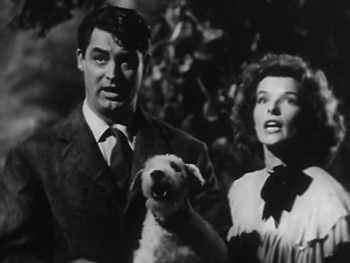
So here it is. A review of a film that’s intentionally funny, and which, furthermore, stars one of my favourite Hollywood actors: the incomparable Cary Grant, a leading man who had a fantastic flair for comedy. In this one, he teams up with the equally superb Katharine Hepburn in a crazy story involving a millionaire aunt, a big game hunter, a tame leopard, and a Brontosaurus bone, among other odds and ends.

Continue reading

Rustom-e-Rome (1964)

Another tribute, to yet another great who’s passed on. Dara Singh, the wrestler-turned-actor who made such a big niche for himself in a slew of films, especially in the 1960s, passed away on July 12, 2012.

As a child, nearly all my movie-watching was restricted to what was aired on Indian TV—Doordarshan—(and later, the few TV channels that showed Hindi movies). Somehow, I never ended up watching any Dara Singh movies. Despite that, Dara Singh was a very familiar figure and name. A synonym for formidable strength, for something like the Rock of Gibraltar: utterly immovable, impossible to defeat.

Continue reading

Dupatta (1952)

I saw a mention of this film for the first time on Richard’s blog a couple of years ago. Richard had mentioned that Dupatta (or Dopatta, as it’s referred to in some places) was available for viewing online. I’d stored away that snippet of information somewhere in the back of my mind, and forgotten about it later. Then, recently, Richard published an unusual (and interesting) post on his favourite filmi nurses, and Noorjehan’s character in Dupatta topped his list.

Continue reading

Yeh Raat Phir Na Aayegi (1966)

Poor Biswajeet must have gotten thoroughly sick of romancing spooky women in the ‘60s. True, in this one, the spookiness is rather more pronounced (Waheeda Rehman was pretty sunny and un-mysterious in Bees Saal Baad; everything else seemed steeped in mystery). But there is the inexplicability of everything around, dozens of very loud and pointed hints of someone haunting an area, and a song that’s sung again and again like a broken record.

Continue reading

Lizzie (1957)

This photo of Eleanor Parker is the current wallpaper on my laptop screen:


…and I’ve decided it’s time to change it, simply because it gets in the way of my work. Every now and then, while I’m working, I need to move to the desktop to open a folder or file that’s there. Invariably, I end up gaping at the gorgeous Ms Parker and forgetting all about why I’d arrived at the desktop in the first place.

Continue reading

Ten of my favourite car songs

I don’t often need to take a taxi to get around, but when I do, I always steel myself, because 9 times out of 10, the taxi driver will have music playing—a CD or a radio—and 99% of the time, it’ll be some completely vile stuff with just a monotonous beat, and no melody to speak of.
Last Friday, I had to take a taxi (for a longish ride, moreover—Delhi to Gurgaon and back, nearly 2 hours in the taxi). Sure enough, the radio was turned on. And what a pleasant surprise!—this driver had tuned into a radio channel that seemed to play only old Hindi film songs.

Those two hours were total bliss, and I was reinforced in my belief that good music can make a long and otherwise boring car journey also pleasurable.

Continue reading

La Grande Guerra (1959)

My original plan had been to watch and review Neecha Nagar, and follow it up by watching and reviewing Kurosawa’s Donzoko (also based on The Lower Depths). By the time I’d read Gorky’s play and seen Neecha Nagar, that plan had changed a bit—because I was feeling sorely in need of a funny film.
La Grande Guerra was what I chose, because it had come highly recommended by friends whose judgment I trust.

Continue reading

Neecha Nagar (1946)

I am a bit of an iconoclast. Maxim Gorky’s play The Lower Depths, while considered one of the great classics of Russian literature, left me cold when I read it. To me, it seemed too cluttered with characters, too devoid of plot, and just—well, without anything that would make me want to go back to it all over again.
So I approached Neecha Nagar—Chetan Anand’s debut film as a director—with a good deal of trepidation. Because Neecha Nagar was inspired by The Lower Depths, and I expected something horrendously morbid and impossible to understand without the benefit of footnotes.

Continue reading

Pyaar ka Mausam (1969)

Or, The Nasir Hussain Rule Book of Fool-proof Rehashing.

I’m beginning to think I’m an idiot for trying to think up new stories every time I write. Look at people like Betty Neels or Nasir Hussain; they managed to get by with basically the same story, over and over again, and very successfully too. [which makes me wonder: were Hussain and Neels long-lost brother and sister?]

Take the latter’s Pyaar ka Mausam, for example. I’d seen this film as a kid and remembered little of it except the very good music and the pretty lead pair. A rewatch last night revealed that it amounted to a cocktail of Nasir Hussain’s earlier films: Tumsa Nahin Dekha, Dil Deke Dekho, and Phir Wohi Dil Laaya Hoon. Same story, same plot elements, same rules from The Rule Book.
[Note: These rules will make more sense if you’ve seen one or more of the films I’ve mentioned above. If you haven’t, think of it this way: you’ll get to know about four films just from one review].

Continue reading