Sharaarat (1959)

It might surprise some of you to know just how many films I watch. No, not new ones, but old films, in the hope that I will find something worth reviewing for this blog. Perhaps one in five of those films gets reviewed, and that because either it’s worth recommending, or conversely, it’s worth warning people off. 

A lot of the Hindi films I watch, I watch because of the music. Occasionally (Duniya Jhukti Hai, Bank Manager, Chandni Chauk) there’s just one song that has prompted my viewing of the film, and the film itself turns out to be so ho-hum that I decide there’s not much point reviewing it. I assume, you see, that most people (unlike me) are sensible enough to not waste a couple of hours watching a film just because it has one good song. 

Sometimes, though, a film has a bunch of good songs, and a cast I have great hopes of. Then, even if it ends up being a bit of a dud, I feel obliged to review the film. Because I want to tell you: steer clear; despite the cast and despite the songs, this is really not worth your while. 

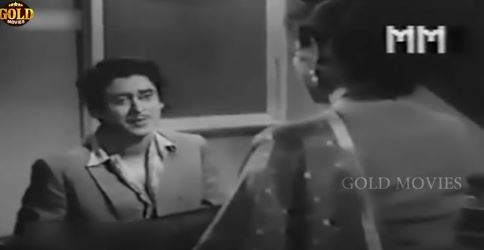
Also, in the case of Sharaarat, there was the fact that this film starred Meena Kumari. And, as I’ve seen from films like Miss Mary, Tamasha, Kohinoor, Azaad, etc, Meena Kumari was very good at comedy. Here, she was paired with Kishore Kumar. I settled down, hoping for some fun. Sharaarat, after all: that sounded promising. 

Continue reading →

Suvarna Sundari (1958)

If you’ve been reading this blog for a while, you probably know that I cannot resist good music; so much so that there are plenty of films I’ve watched just because they happened to have one song which I like a lot. Many of these films have turned out to be complete duds, not at all worthy of the wonderful song which drew me to it—but I do not, in this case, subscribe to the ‘once burnt, twice shy’ philosophy. I go on doing it, often with painful results.

Suvarna Sundari, which I watched for Kuhu kuhu bole koyaliya, will however remain one of the exceptions. A stellar song, but also a very entertaining film.

The story begins in a gurukul, where Prince Jayant of Malwa (Akkineni Nageshwara Rao, ‘ANR’) is about to graduate and go back to Malwa to be declared crown prince. At the prospect of Jayant’s departure, his guru’s daughter (?) gets all het up and confesses her love for him. Jayant, being a good and upright man who knows his guru’s daughter is out of bounds for him, sternly refuses…

Continue reading →

Noor Mahal (1965)

Or, Ten Reasons Why You Should Watch Jagdeep’s Funniest Film

First, though, a word by way of tribute. Jagdeep, who passed away last week (on July 8th), may not have scaled the heights other comedians, such as Johnny Walker or Mehmood, did, but he had a much longer innings than most. He seems to have debuted in Madhubala (1950) as a child artiste, and worked in close to 400 films, right up to 2017’s Masti Nahin Sasti.

And, interestingly enough, somewhere between his years as a child actor (in Footpath, Do Bigha Zameen, etc) and his heyday as a comedian, Jagdeep acted as leading man in several films… including Noor Mahal, of Mere mehboob na jaa, aaj ki raat na jaa fame.

Continue reading →

Dil Ne Phir Yaad Kiya (1966)

It took me five days to watch this film: I couldn’t bear to watch more than fifteen minutes of it at a time, and I couldn’t do more than two sessions in a day.

That’s what Dil Ne Phir Yaad Kiya is like. Despite starring Dharmendra, Nutan, and Rehman. Despite being picturized in some very pretty locales. And despite having a couple of not-too-bad songs. By the time this travesty of a film ended, I was wanting to tear my hair out. I thought I wouldn’t review it, but then decided this did need to be reviewed, so that other potential viewers could be warned.

This is going to be a shortish review, since I can’t bring myself to explain every fiddly little detail along the way in what is a convoluted (but pointlessly convoluted) plot.

Ashok (Dharmendra) and Amjad (Rehman) are best friends. They live in the same pokey little flat (for which they haven’t paid the rent in a long time), they work in the same toy store, and they spend all their free time telling each other about their respective girlfriends. Ashok’s sweetheart is Ashu (Nutan), who lives back in the village and is constantly being plagued by Ashok’s nasty stepbrother Bhagat (Jeevan)…

Continue reading →

Saqi (1952)

I still remember my first glimpse of Premnath in a different persona than the fat, balding, beetle-browed villain of so many ‘70s films.

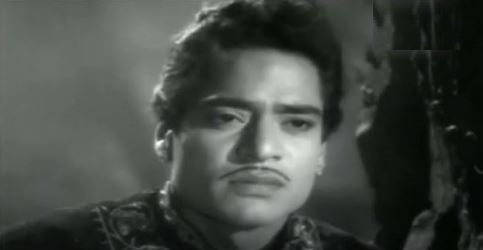
This was in the mid-80s. My sister and I (I was then not even in my teens) were watching Chitrahaar, and Thandi hawaayein lehraake aayein came on. It was proceeding fine, with Nalini Jaywant flitting across the screen, when suddenly a strikingly handsome man, tall and broad-shouldered, sprang up by her side, danced with her, and then disappeared. Who was that? We asked each other, and couldn’t supply an answer. We turned to our father, our source of information for all things old Hindi cinema. Papa said that Naujawan starred Premnath. Who Premnath, we asked in disbelief. That paunchy and somewhat repellant man in Johnny Mera Naam?

It took a watching (incomplete, sadly, because the electricity went) of the 1951 film Sagaai to convince us that yes, Premnath was indeed quite a hottie in his heyday.

If you think so too (or if you haven’t seen Premnath in the early 50s, when he was paid more than Raj Kapoor and several other leading actors), you should watch Saqi.

Continue reading →

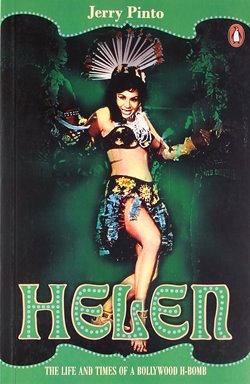
Book Review: Jerry Pinto’s ‘Helen: The Life and Times of a Bollywood H-Bomb’

I won’t go so far as to say that Helen was the first Hindi film actress I remember seeing (that would be Shakila, since CID was the first Hindi film I remember watching). But I distinctly remember being about 10 years old, watching Chitrahaar, and being very excited because an old favourite of mine, a song I had till then only heard and never seen, was going to come on (in Chitrahaar, there would always be a sort of intertitle between songs, a single frame in which the name of the next song, the film it was from, and the names of the music director, the lyricist, and the singer(s) would be listed).

This song was Mera naam Chin Chin Choo, and my feet were already tapping when it began. All that frenetic movement, those men in sailor suits dancing about. The energy, so electric that it even seemed to transmit itself to the musicians. The infectiousness of it all.

And Helen.

Continue reading →

Dil Diya Dard Liya (1966)

Despite its having a cast of several people whom I like a lot (Waheeda Rehman, Dilip Kumar, Pran, Rehman, Shyama), a music director whom I like a lot (Naushad) and being by no means an unknown film, Dil Diya Dard Liya is one I’d never got around to watching. Perhaps it is because I had been told by knowledgeable readers that it was based on Wuthering Heights—and I could imagine what a confluence of Wuthering Heights (dark, grim, with two thoroughly selfish and unlikeable leads) and typical Bollywood (melodramatic, with no lead capable of being anything but noble, even if it’s only in the final analysis)—would be like. Mishmash, hard to bear?

But when I posted a Naushad song list in tribute on Naushad’s birth centenary last year, several people mentioned the songs of Dil Diya Dard Liya, and I decided it was time to take the plunge. If for nothing else than Naushad’s music.

Continue reading →

Door Gagan ki Chhaaon Mein (1964)

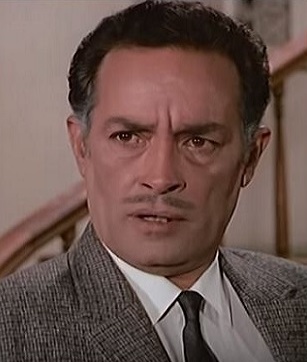
Just ten days ago, this blog celebrated the birth centenary of an actor who pretty much came to exemplify the ‘Hindi film villain’ of the 50s and 60s: the inimitable Pran. Today, it’s time to celebrate the birth centenary of another actor who carved such a niche for himself that his name became nearly synonymous with a particular kind of role. Iftekhar, who brought so much dignity and intelligence to his usual role of police officer or lawyer—or army officer, or doctor…

Continue reading →

Khandaan (1942)

If Hindi cinema has ever had an iconic onscreen villain—not a villain in one film, but in film after film—it has got to be Pran. There have been other actors, from Wasti to Ajit, Ranjeet to Madan Puri, who have played memorable villains in films: but none, in my opinion, was quite able to sustain it and make it so much his forte that his own name became a synonym for villainy (it’s common knowledge that for many years, Indian parents refused to name baby boys Pran because of Pran).

In film after film, from period dramas like Halaku to comedies like a Half Ticket, from weep fests like Do Badan to supernatural stuff like Madhumati—Pran was in them all. With aplomb, he carried off every shade of villainy, whether it was the lisping and ruthless truck driver Mohan of Kashmir ki Kali or the tuneless dacoit-cum-gentleman of Munimji. He even did the occasional unusual role (as a doctor in Aah, and as a kotha frequenter in a cameo in Devdas), until, in the late 1960s, he began to play some sympathetic characters as well. From the cynical Malang Chacha of Upkaar, to Dev Anand’s long-lost brother in Johny Mera Naam, to his role in Zanjeer: Pran proved that he wasn’t just a great villain, he was a great actor, period.

Today would have been Pran’s hundredth birthday: he was born on February 12, 1920 in Delhi. And, to mark the occasion of his hundredth centenary, I thought I’d review a Pran film with a difference. Not Pran as the villain, but Pran as the hero. A young, gangly Pran, probably not even twenty-two years old yet, plays opposite a girlish Noorjehan in one of the first Hindi films to get a lot of pre-release publicity: Khandaan.

Continue reading →

Book Review: Guide, The Film: Perspectives

I watched Guide for the first time when I was about twelve or so. Till then, all the Hindi cinema I had watched was predictable, comfortable, simple enough for a pre-teen to know what to expect. Or so I thought.

Because Guide defied every norm I thought I understood. Heroes, not even when they were the anti-hero Dev Anand had played in earlier films like Baazi, Kaala Bazaar or House No. 44, did not go anywhere near another man’s wife. Heroines, even when they were married off against their wishes to men other than those they loved (as in Dil Ek Mandir, Gumraah, or Sangam) stayed true to their marriage vows and sooner or later left their past behind (I was to watch Yeh Raaste Hain Pyaar Ke only much later). They absolutely did not leave their husbands and start living with another man.

And heroes did not die. As when I watched Anand, when I watched Guide too, I kept thinking, “This isn’t it. He isn’t dead, he can’t be dead.”

Several years later, I had to study RK Narayan’s The Guide at school, and I pretty much knew what to expect—but once again, I found myself surprised, because the book was in many ways different from the film. The book had won its author the Sahitya Kala Akademi Award (the first book in English to win the award), and the film won accolades by the handful—and continues to do so, fifty-five years after it was released. It has been analyzed, discussed, derided, lauded. Personally, other than for its music and Waheeda Rehman’s dancing, I have never really liked Guide much—but even I, when offered the opportunity to read this collection of essays about Guide, couldn’t resist it. Partly, perhaps, because I hoped to be able to discover what fans of the film saw in it that I didn’t.

Continue reading →