Celebrating International Literacy Day: People Reading Things in Hindi Cinema

Today, September 8, is International Literacy Day. In 1967, this day was designated as such by UNESCO to emphasize the importance of literacy in maintaining dignity and as a matter of basic human rights. Every year, a different theme related to literacy is used as the focus of special programmes and initiatives across the world: women’s empowerment, for instance; or the connection between literacy and controlling epidemics.

So what does that have to do with Hindi cinema? Not much, I admit, though there have been Hindi films—especially in the 50s, when India under Nehru was trying very hard to haul itself up into modernity—when there was the occasional film which made an attempt to underline the importance of being literate. Anpadh, for instance; or Bahurani, both of which showed how literacy can enlighten people. Similarly, Nartakee, and Ek ke Baad Ek, which too had literacy and education as important elements of the story.

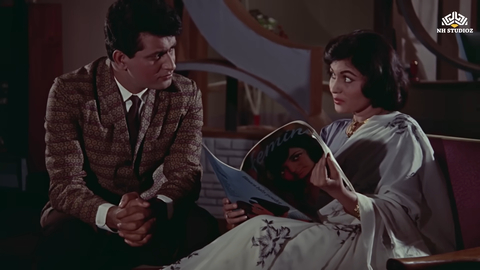
While literacy may not be the point of most Hindi films, there’s no denying that few films go by without at least one character shown reading something. A book (to be seen in many films, even clearly identifiable books, as I’ve mentioned in these posts). A letter—at times so incriminating. A newspaper, often carrying some very vital piece of news, sometimes even shown rolling off the presses or being sold on the streets. A magazine (Life? Everybody fashionable in 60s cinema seemed to read Life).
Continue reading

Neither Here nor There: Rafi Sings for the In-Betweens

When, to celebrate the birth centenary (on December 24, 2024) of the one and only Mohammad Rafi, I compiled this list of my favourite Rafi songs for the top leading men of the 1950s and 60s, I was uncomfortably aware that I wasn’t doing justice to Rafi’s oeuvre. Even though I had tried my best to bung in mentions (and links) to many other songs Rafi had sung for these men. Because there were many other Rafi songs I could think of, which he had sung for actors absolutely opposite to these: extras, or actors who had woefully short-lived careers—in many cases men whose entire career might be said to hinge around one fantastic song that Rafi sang for them. A second Rafi list, arranged actor-wise, was therefore in order.

But in between the stars and the entities were a host of other actors who had the honour to lip-sync to Rafi’s voice. These were often character actors, or men who acted as villains. Even, in cases like Sanjay Khan, Premnath and Ajit, men who did appear in a fair number of films in leading roles, but cannot be said to have ever reached the heights of popularity or success of, say, a Dilip Kumar or Dev Anand, or even a Biswajit. They were the in betweens: not at all obscure, but not the Jubilee Kumar types.

Continue reading

It Happened One Night (1934)

Last week, to commemorate the 100th birth anniversary of Raj Kapoor, I reviewed my favourite film of his as an actor: Chori Chori, which was a remake (uncredited) of It Happened One Night. I had seen Chori Chori before; I had also seen It Happened One Night before, though in both cases, I had not reviewed the film in question.

Since I’ve finally reviewed Chori Chori, it seemed to me about time I reviewed It Happened One Night as well (which is why there’s also a comparison with Chori Chori further along in this post). Directed and co-produced by Frank Capra, this film was based on a short story, Night Bus, by Samuel Hopkins Adams. It is generally regarded as the first ever screwball comedy, having pretty much invented the genre; it was also the first of only three films so far to have won all five major Oscars: Best Picture, Best Actress, Best Actor, Best Director and Best Adapted Screenplay.

But, to start at the beginning: on a private yacht moored off the coast at Miami, where Ellen ‘Ellie’ Andrews (Claudette Colbert) has been confined by her banker father (Walter Connolly). Mr Andrews disapproves, unreservedly, of Ellie’s having gotten married to a man named King Westley (Jameson Thomas), whom he (Mr Andrews) is convinced is a rotter: only interested in Ellie’s wealth, nothing else.  

Continue reading

Chori Chori (1956)

Happy 100th birthday to one of India’s greatest film makers, Raj Kapoor!

RK was born in Peshawar on December 14th, 1924. What can I say about him that hasn’t already been said or written, and by people much more erudite, well-informed, and more fond of RK’s cinema than I am? Yes; I will admit that I am not the greatest of Raj Kapoor’s fans, but let us keep the whys and the wherefores of that, the debates and the discussions, for another time. As Anu Warrier (of Conversations over Chai, not just a fellow blogger I admire hugely, but also an RK fan) said “I know there are RK films you like!”: and for RK’s birth centenary, I decided it was high time I finally reviewed an RK film that I particularly like.

I have watched Chori Chori several times, and always with great satisfaction. Even though it starred Raj Kapoor (opposite Nargis, moreover), the film is not at all the sort of film RK was known for: this was the light-hearted romp that younger brother Shammi was to go on to make his own. A road trip, a pampered heiress, a romance. Lots of songs, great chemistry.

Continue reading

Ten of my favourite Hasrat Jaipuri Songs

Today is the birth centenary of one of Hindi cinema’s greatest lyricists, the very prolific and versatile Hasrat Jaipuri. Born in Jaipur on April 15, 1922, ‘Hasrat’ was named Iqbal Hussain, and took to writing poetry fairly early in life. In 1940, not even 20 years old, Hasrat moved to Bombay, where, though he attended mushairas and wrote (and recited) a good deal of verse, he was also obliged to take up a job as bus conductor. This job helped him make ends meet for the next 8 years, when Hasrat had the good fortune to be noticed by none other than Prithviraj Kapoor at a mushaira. Kapoor was so impressed by the young poet, he recommended Hasrat to his son Raj, who was then in the midst of planning Barsaat (1949). Hasrat was taken on to write songs for the film, and that was the start of a very long association with RK Films—Hasrat wrote lyrics for all of Raj Kapoor’s films for the next two decades and more, invariably alongside fellow lyricist Shailendra.

Continue reading

Ten memorable food scenes from Hindi cinema

While ‘food songs’ are not utterly unknown in old Hindi cinema, it’s rather more difficult to track down memorable scenes featuring food. Talk about new cinema, and it’s easier—and when I talk of ‘new’ cinema, I don’t just mean very recent films like Stanley ka Dabba, The Lunchbox, Cheeni Kum, or Chef: I even mean films from the 70s and 80s.

There was Bawarchi, where Rajesh Khanna’s eponymous bawarchi promised Harindranath Chattopadhyay’s character shukto and some three hundred or so types of chutney (he also made kababs out of elephant yams). There was Amitabh Bachchan, surreptitiously stuffing himself on a thali full of puris and other goodies in Do aur Do Paanch, only to be stuffed all over again by a stream of little kids, all instigated by a wily rival (Shashi Kapoor). In Sau Din Saas Ke, Lalita Pawar played an evil mother-in-law, so vicious that she tried to poison her bahu with kheer simmered with gecko.

Pre-70s cinema is a little less easily remembered for its food scenes.

Continue reading

Ten of my favourite ‘Aaja’ songs

Or, to put that better: Hindi film songs that begin with the word “Aaja”.

Let me give the background for this. My daughter, ever since she was a baby, has always had an ear for music. All you had to do was turn on the music (or start singing) and she’d start wiggling her shoulders. When she began walking, the dancing became rather more vigorous—and the first song she totally fell in love with was Aaja aaja main hoon pyaar tera. The very first time she heard it (and she hadn’t even started talking coherently yet), she joined in at the end: “Aaja, aaja!” After that, every time she’d do a little wriggle and say “Aaja, aaja!” we knew she wanted to listen to some dance music.

So, Aaja. Literally, ‘Come!’ Though I’ve always puzzled over why aaja—which combines aa and jaa, and should create a paradox—and not simply aa? Does the imperativeness, the urgency (which is invariably a part of Hindi love songs that use aaja in the lyrics) come through more when the word is aaja and not aa?

Aaja songs

Continue reading

Ten of my favourite filmi wedding songs

It’s wedding season in Delhi (has been, in fact, for the past couple of months). Almost every night, there’s a large shamiana at our local municipal park. There are traffic jams because of huge baaraats, all the women laden with jewellery and tinsel. We see white mares (or, in some cases, a pair of mares pulling a flower-bedecked ‘chariot’) trotting along on roads. We hear a lot of music—or what passes for music.

In fact, every time I hear the sort of music that’s played at many Delhi weddings, I’m tempted to go up to whoever’s acting the DJ, and ask them to play some good shaadi songs.
Since I can’t actually do that, I decided to create my own list: ten Hindi film songs that are directly related to weddings. (Which is why Ab ke baras bhej bhaiyya ko baabul or Laali-laali doliya mein laali re dulhaniya don’t qualify; the words relate to a wedding, but the context is completely different).

Ten wedding songs, therefore, from pre-70s films that I’ve seen. Enjoy!

Waheeda Rehman as a bride in Chaudhvin ka Chaand Continue reading

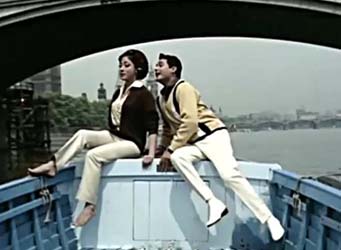
Ten of my favourite boat songs

Some of you may know that I’ve recently returned from an exhilarating time at the Bangalore Literature Festival—one of the highlights (at least for a cinema fanatic like me!) of which was that I got to meet Nasreen Munni Kabir. (And was introduced to Farhan Akhtar, and met Sidharth Bhatia, and got to get photographed within the same frame as Gulzar… but that’s a different matter). Nasreen Munni Kabir and I actually shared a cab for the two-hour trip from the airport to the hotel, and spent most of it chatting about all things cinema. I told her about this blog, of course, and happened to mention that among the most popular posts seem to be song lists.

Which reminded me: it’s time for another list. And because this popped into my head while I was travelling, I decided to do another ‘sung in transit’ list. But because I’ve already done car songs (not to mention ghoda-gaadi songs and train songs), I’m going the water way this time: with boat songs. The criteria here (besides my usual ones, of the films being all pre-70s ones that I’ve seen) are:

(a) The singer(s) should be on the boat for at least three-fourths of the song’s duration
(b) All types of boats are allowed—shikaras, rafts, motorboats, ships, anything. Moving or not.

On a boat in London Continue reading

Chaowa-Pawa (1959)

Serendipity: noun. plural: serendipities. The faculty of making fortunate discoveries by accident; the occurrence of such a discovery. Coined by Horace Walpole in 1754, based on a fairy tale called The Three Princes of Serendib (‘Serendib’ being present-day Sri Lanka)—the three princes in question often making such lucky discoveries.

And what does this have to do with Chaowa-Pawa (‘To Want and To Have’)? Simply that, while I had set about watching this film because I really, really like the lead pair—Uttam Kumar and Suchitra Sen—I realized, within the first half hour of the film, that it was a remake of one of my favourite old Hindi films, Chori-Chori (which, as many of you would know, was a remake of It Happened One Night). Serendipity? Absolutely.

Uttam Kumar and Suchitra Sen in Chaowa-Pawa

Continue reading