Jaal (1967)

I had first watched this film many, many years ago, probably as a young teen. It had been aired on Doordarshan, back in the good old days when our family used to watch pretty much every film that was shown (including some seriously grotty ones like Fauji).

I remembered little of Jaal: Mala Sinha and Biswajeet, yes; and that it was a suspense thriller set in a spooky mansion beside the sea. That was all.

While I don’t like Biswajeet, and the music of Jaal (by Laxmikant-Pyarelal) is forgettable enough to not want to watch it for the songs, I decided I should give this one another try. At least find out what it’s about.

The story begins on a stormy night at sea. A small boat is tossed about on the waves, and we catch glimpses of the lone man on board: Sunder Singh (Sujit Kumar) as he tries to control his vessel. In the distance can be seen (like the boat and the waves, looking patently artificial) a lighthouse. Sunder, however, cannot make it safely to shore; his boat crashes against the rocks and explodes in a great burst of fire.
Continue reading

Sapan Suhaane (1961)

Starring Balraj Sahni and Geeta Bali. With music by Salil Choudhary.

How could I—with a well-established reputation for watching films based on a single name I like among the crew and cast—pass up this one? Balraj Sahni is a favourite, as is Geeta Bali. And Salil Choudhary is one of those rare music directors for whom I’ll watch a film (even if I could just as well just listen to a playlist of the songs online).

These three were the reason I watched Sapan Suhaane, and I’ll admit that till more than midway through the film, I was congratulating myself on having stumbled on a hidden gem. Or, if not strictly a ‘gem’, at least a film that was watchable enough. After that…

But to start at the very beginning, when we are introduced to Shankar (Balraj Sahni) and his younger brother Dilip (Chandrashekhar). Shankar and Dilip are stepbrothers, but deeply devoted to each other. Shankar has given up his own comfort, his own prospects, in order to work so that he can finance Dilip’s studies.

Continue reading

Howrah Bridge (1958)

Aaiye meherbaan baithiye jaan-e-jaan, and Mera naam Chin Chin Choo. Two great actresses, two iconic songs.

When I was doing the Helen tributes last month, I was reminded of Mera naam Chin Chin Choo all over again—and remembered, too, that I had never reviewed Howrah Bridge on this blog. It has also been many years since I last watched the film (before I launched Dusted Off), so I decided it was high time I revisited this.

Howrah Bridge begins very far from the bridge, and in fact from Kolkata: in Rangoon, where Prem Kumar (Ashok Kumar) finds his father (Brahm Bhardwaj) in a flap. Daddy is distraught because Prem’s elder brother Madan (Chaman Puri, in a cameo role) has run off from home, taking with him an invaluable family heirloom, a dragon which has been in the family for generations. We later discover that the dragon was crafted in China many centuries ago, and from there came to be owned by the king of Burma, after which it passed into the possession of Prem’s family.

Continue reading

Zindagi (1964)

The main reason I watched this film was because of the songs, which include some very good ones. And Vyjyanthimala, whom I invariably enjoy watching. The two male leads, Rajendra Kumar and Raj Kumar, are not favourites of mine, but they aren’t absolutely unbearable either. And there was a star cast of several other people I like, such as Prithviraj Kapoor and Helen. Ramanand Sagar, who wrote and directed Zindagi, also has to his credit one film I really like (Aankhen) and some (Aarzoo, Ghoonghat, Charas) that I don’t mind too much. I figured there might be enough here for me to enjoy.

The story begins with Beena (Vyjyanthimala) coming home to her mother (Leela Chitnis) with the news that she has found a job, finally. Ma is happy, until Beena tells her what the job is: Beena is now a theatre actress. Ma is very upset and goes into a long harangue of how it’s better to be poor than to be in the theatre; their name will be mud, blah blah.

Continue reading

Helen and a Male Star: Ten Dances

If Helen danced with many other female dancers—several of them also major actresses, besides being dancers—she also did her fair share of dancing with men. Not just with the ‘dancing extras’ like Herman Benjamin and Abe Cohen, but also men who were stars. In some cases, Helen was the one doing the dancing while the man stood around and wriggled awkwardly (Dev Anand, who was not the best dancer of them all, comes to mind). In other cases, with better dancers (Shammi Kapoor, Feroz Khan, Mehmood) Helen got rather more support from her fellow dancer.

Continue reading

Helen and another Actress: Ten Dance Songs

As part of the birthday celebrations of Helen (she turned 85 on November 21st, 2023), another post of Helen songs.

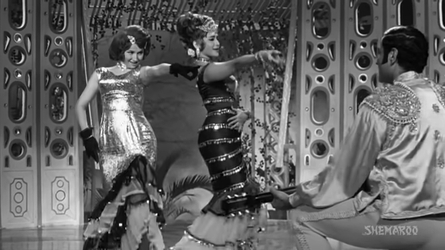
While Helen has shimmied to umpteen songs by herself (or with a band of male dancers in attendance), there are also a fair number of songs where Helen isn’t the only woman dancing. To celebrate my favourite dancer’s 85th birthday, I thought, it would be fun to come up with a list of song-and-dance sequences featuring Helen with another actress.

Continue reading

Ten of my favourite Helen songs

And, of course, that pretty much implies: Ten of my favourite Helen dances.

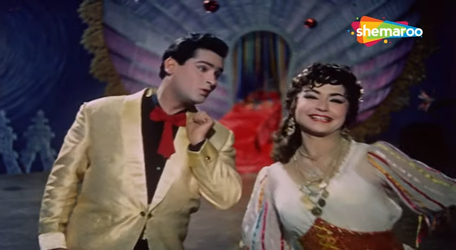
The ‘Queen of the Nautch Girls’ (as a 1973 documentary about her dubbed Helen) turns 85 today: she was born on November 21, 1938, in Yangon. The story of the long journey from Myanmar to Mumbai is not something Helen talks about (she seems to be amazingly reticent; Jerry Pinto, writing about her in The Life and Times of a Bollywood H-Bomb, says that he wasn’t able to get hold of her for even a short interview). But that she entered cinema, courtesy dancing mentor Cuckoo, as a teenager, is well-known. And that she burst upon the firmament of the Hindi silver screen and made it her own is there for everybody to see. From the mid-1950s onward, Helen was to be seen increasingly in Hindi cinema, and with the foot-tapping Mera naam Chin Chin Choo, she rocketed to the top: by the 60s, no commercial film worth its salt could be without a Helen number.

Continue reading

Woh Kaun Thi? (1964)

I began this blog on November 4. 2008 (with a review of Vacation from Marriage), so this post marks the fifteenth birthday of Dusted Off. I dithered over how I might celebrate the occasion, and finally came to the conclusion that it would be good to mark it with a review of a film I’ve been meaning to review ever since I decided to start blogging about classic cinema. Woh Kaun Thi? is a film I enjoy a lot, and which I’ve seen in various avatars: first on Doordarshan, when I was a teenager. Then, when VHS tapes became available, multiple times on our VCR. Then, when CDs came along, this was one of the first VCDs I bought… then the DVD. Now YouTube.

The story begins on a stormy night. Dr Anand (Manoj Kumar) is driving down a pot-holed and lonely road when he sees a woman (Sadhana), clad in white and standing in the middle of the road. Anand tells her to move out of the way, but when she doesn’t respond, he is compelled to get out and talk to her. To all his questions—who is she, where is she going, isn’t she scared to be out here alone—she gives evasive, mysterious answers. Finally, however, she consents to let Anand give her a lift, but on one condition: he is not to ask any questions. [Given the way he’s been bombarding her with questions, I’m not surprised].

Continue reading

Night in London (1967)

In which Biswajeet’s character ends up facing a wall studded with red-hot spikes. You don’t just skewered to death, you get barbecued in the process.

Continue reading

Mr India (1961)

A simple-hearted—even outright simple, really—man turns out to be the look-alike of a much-wanted criminal. As a result, the police train him to impersonate the criminal so that they can get enough evidence to crack down on a web of crime.

I have no idea if Don (1978) was inspired by Mr India. Don is in many ways a very different film (the criminal, for one, dies fairly early on in the proceedings; for another, it’s a much more complex plot): but there is that fleeting resemblance.

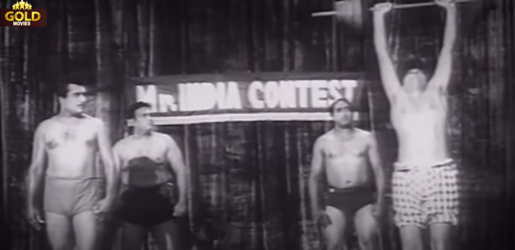
Mr India begins by introducing us to Gullu (IS Johar), naïve and simple, as he goes about job-hunting, and getting rejected at every office because he doesn’t fit the regional profiles demanded by the parochial employers of these places. Gullu gets briefly hired by someone who wants to rig a ‘Mr India’ weight-lifting competition, with Gullu pretending to hoist what is actually wooden dumbbells rather than iron.

Continue reading