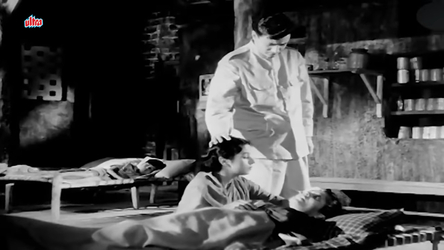
Raj Nartaki (1941)

Aka The Court Dancer.

When I was watching Amrapali some weeks back, I was reminded of another court dancer of Hindi cinema: Sadhona Bose’s character from this film, which claimed to be the first English language film to be made in India with an all-Indian cast and crew. I had made an attempt at watching Raj Nartaki a couple of years back, but I could not get into it, and abandoned it after a few minutes. I guess the concept of Indian actors speaking only English (and that back then) was sufficiently unusual to take time to get used to.

After Amrapali, though, I decided I had to give Raj Nartaki another try.

The film begins by laying the ground. This is the early 19th century, and the film is set in Manipur. Here, Prince Chandrakirti (Prithviraj Kapoor) is heir to the throne. He is also in love with the newly-appointed court dancer, the lovely Indrani (Sadhona Bose). When the story begins, Chandra (as Indrani affectionately addresses him) is at Indrani’s palace, where several of her fellow dancers are entertaining them.

Continue reading

Amrapali (1966)

Happy birthday, Vyjyanthimala! (it’s either her 90th birthday or her 87th today, it doesn’t seem very clear which, but anyway).

Among the recent books I’ve read is Advait Kottary’s Siddhartha: The Boy Who Became the Buddha, a fictionalized retelling of the story of the Buddha. While Siddhartha is the focal point of the narrative, several other important historical personages appear in the book, among them the nagarvadhu or courtesan of Vaishali, Amrapali. Amrapali is shown to have originally had a relationship with the ruler of Magadha, Bimbisara: so much so that she bears him a son, whom she is later compelled by circumstances to hand over to the Buddha to bring up. Bimbisara’s belligerent and headstrong son and heir, Ajatshatru, though he’s never seen ‘his father’s courtesan’ (as Kottary describes her), detests Amrapali.

… until he, injured in a way with Vaishali, impersonates a Lichhavi (native to Vaishali) soldier in order to escape with his life. Fate brings Ajatshatru and Amrapali together: she, thinking him to be Lichhavi, tends to his wounds and heals him, and they fall in love.

It’s been ages since I watched the Vyjyanthimala-Sunil Dutt Amrapali, and while I remembered some of the core elements, I’d forgotten much of it. As far as I remembered, the film had nothing whatsoever about Amrapali’s relationship with Bimbisara or her having a son with him. To be honest, I’d have been very surprised if that aspect of her life had been shown: it would have been far too bold for Hindi cinema, back then, to have a heroine who could have affairs with both father and son, and bear a child out of wedlock.

So I decided it was time to rewatch Amrapali, which begins in Magadha. Here, the king, Ajatshatru (Sunil Dutt), is in conference with his trusted advisor, friend, and Magadha’s commander-in-chief, Veer (Premnath). Ajatshatru is a hot-headed warmonger, and right now baying for the blood of the democratic Lichhavis, whose land, Vaishali, lies across the river to the north.

Continue reading

Insaniyat (1955)

This is one film that’s been on my to-watch list for several years now, mainly because it is the only film that stars both Dev Anand and Dilip Kumar. Also, as I’ve gathered from a few articles and posts I’ve read, this is also possibly the only film that doesn’t feature Dev Anand as a modern city slicker. He’s still somewhat of a sophisticate—by no means an illiterate rustic—but this is set in some undefined ‘raja-rani’ time period where Dev Anand spends all the film in something other than Western clothing.

But, to begin at the beginning. Zangoora (Jayant) is a nasty tyrant whose idea of ruling his kingdom is to be brutal with his subjects. Every now and then, his soldiers are sent out into the countryside to loot villages and bring back all that they can find. Zangoora’s troops are vile, uncaring, as brutal as their boss.

They’re at one village, upturning things, grabbing and snatching, when a furious village woman, Durga (Bina Rai) comes charging up. Durga lets fly at the man leading the troops, Bhanu Pratap (Dev Anand, his upper lip topped with a ridiculous moustache). Durga slaps Bhanu, and then proceeds to berate him for his mindless cruelty.

Continue reading

Zabak (1961)

Zabak is a film I’ve been wanting to watch for a while, mostly for Shyama. I like Shyama a lot, and as far as I know, this is one of the rare colour films in which she acted as a lead. Plus, given my penchant for raja-rani films, I thought this might be worth a try.

Zabak (Mahipal) is the son of a healer and hamaam owner named Hassan Shah Isfahani (?). Hassan Shah is much acclaimed as a man who knows his medicine, and everybody around, from the Haakim (the Lord) of Isfahan to the man in the street, comes to him for relief from a variety of ailments. Zabak is a happy-go-lucky sort, spending his time joking around town, and romancing Zainab (Shyama), the daughter of the Lord of Isfahan.

Continue reading

Lahore (1949)

I’d been meaning to watch this film for a while now, because there’s a family history related to Lahore.

My uncle David Vernon Liddle ‘Verni’, as some of you may know, was a guitarist in Hindi cinema (this guest post, written by my father, Verni’s younger brother, is all about him). In 1947, Verni—then very young, no more than 16 years of age, but already an accomplished musician and making inroads into the Hindi film industry—was in Lahore and recording the songs for Lahore. Partition happened, and of course, there was so much violence and chaos that Verni had to flee Lahore and head eastwards into India. En route, during his travels, he ended up losing his sole pair of chappals and for quite a few days wandered about barefoot. Once he landed up in Punjab, he was able to make his way to some relatives in Ludhiana, and an aunt finally gave him a new pair of slippers! Verni also spent some time right after he came into Indian Punjab, working at a langar in a camp. The camp included Muslims and Sikhs, and Verni, being a Christian, was one of the few who was therefore not regarded with suspicion by anyone. This was what got him a job (sort of) serving food at the camp.

I am not sure about the story behind how Lahore came to be made. Since the music of most films back then used to be recorded before the film itself was completed, it’s possible that the songs of Lahore (written by Rajinder Krishan and composed by Shyam Sundar) had been readied even before filming began. As it is, it’s not as if the songs are very specific to this film or any particular scenarios; they are ‘generic’ love songs and sad songs, which could be fitted in pretty much anywhere in the average 50s or 60s film. It may just be that the real story of Lahore, of Partition disrupting a romance and a family, evolved somewhere in the course of time before, during and just after Partition.

So, this was a film I wanted to watch.

Sadly, I could find only one copy online (on the SEPL YouTube channel, never one I am happy to view films on because they have zero QA). This version turned out to be a mess: not only were there scenes arbitrarily chopped off, midway through the film, the sequence of the reels went for a toss too, so the chronology was all haywire.

This review, therefore, will be a little different from my usual style. What follows is not as detailed a synopsis as I usually provide, and it includes most of the film, so be aware that there are

Some spoilers ahead.

The story is set in Lahore, where Chaman (Karan Dewan) and Leelo (Nargis) are neighbours as well as collegemates, and sweethearts. Their love story is known and approved by their respective families. Leelo only has her mother (?), but Chaman lives with a fairly large family.

Continue reading

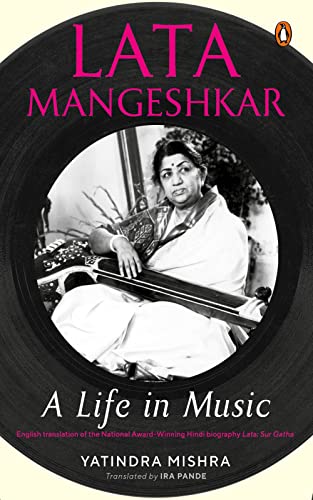
Book Review: Yatindra Mishra’s ‘Lata Mangeshkar: A Life in Music’

Over a period of about four years, from 2010 to 2014, Lata Mangeshkar was interviewed by the biographer Yatindra Mishra, the interviews coming together in the form of a Hindi book, Lata: Sur Gatha. The biography won a National Award, and was published in its English translation (Lata Mangeshkar: A Life in Music, translated by Ira Pande) earlier this year.

Continue reading

Night in London (1967)

In which Biswajeet’s character ends up facing a wall studded with red-hot spikes. You don’t just skewered to death, you get barbecued in the process.

Continue reading

Aandhiyaan (1951)

In 1951, fresh from the success of the Dev Anand-Geeta Bali-Kalpana Karthik starrer Baazi, Chetan Anand decided to make a film that would highlight the very interesting aspects of film-making he had been learning from studying the works of various European directors. ‘Based on a true incident that took place in Amritsar’, as the film’s credits read, the story of Aandhiyaan was written by Chetan Anand himself, along with Hameed Butt.

The film’s credits roll to an unusual sequence of shots: in each frame, one actor or the other is shown, battling the eponymous ‘aandhi’ or storm, though in this case literal rather than metaphorical.

The story is centred round a young and zealous lawyer named Ram Mohan Kapoor (Dev Anand). Ram lives upstairs from his munshi (Ratan Gaurang), whose daughter Rani (Nimmi) has long been in love with Ram, though she’s too shy to let him know that. When the story begins, Ram’s mother (Durga Khote) is due to arrive, and Ram is getting ready to go to fetch her from the station. Rani makes tea for him, and an excited Ram confides in her: he’s asked his mother to come because he wants her to fix a match for him. With a girl he likes a lot.

Continue reading

Sara Akash (1969)

When Basu Chatterji passed away in 2020, I wanted to pay a tribute to him, because he was one of my favourite directors from the 70s and 80s (and he directed Byomkesh Bakshi, a television series I love). But given that I restrict my blog to films from before the 70s, there was only one film that would fit: Sara Akash, Chatterji’s first film, which was released in 1969.

This was in June 2020, at the peak of the lockdown. The situation was dire. We were getting news of people we knew who were ill with Covid, even a few who had succumbed. Close family were suffering the fallouts of the lockdown. I tried watching Sara Akash, but couldn’t sit beyond the first five minutes. Perhaps I was not in the right frame of mind.

But now I was tempted to give it another try, because I’d been reading about the film in Anirudha Bhattacharjee’s Basu Chatterji and Middle-of-the-Road Cinema (my review here).

Continue reading

Aadhi Raat ke Baad (1965)

I dithered over this film for a long time after I’d finished watching it. Should I review it? Should I not? It wasn’t a great film, but it wasn’t terrible, either. It wasn’t as if a review was needed to warn potential viewers off it. Or vice-versa, to alert people to a film they must see.

Eventually, I decided that at least a brief review was in order, because this film had an interesting connect to another film I’ve wanted to watch for a while: Mr X.

In 1957, Nanabhai Bhatt had directed a science fiction film (borrowing from HG Wells’s novel The Invisible Man) that starred Ashok Kumar and Nalini Jaywant. According to this web page on Mike Barnum’s blog, the film is about a man who ingests a drug that makes him invisible; he uses this invisibility to go on a Robin Hood-esque spree, helping the poor by robbing the rich. The cops, baffled by the invisible man, dub him Mr X.

I’ve long wanted to watch Mr X, mostly because it features one of my favourite N Dutta songs, Laal-laal gaal. The film isn’t available online, at least, or even on DVD, from what I can tell; perhaps there are carefully guarded prints deep in some archive…

Continue reading