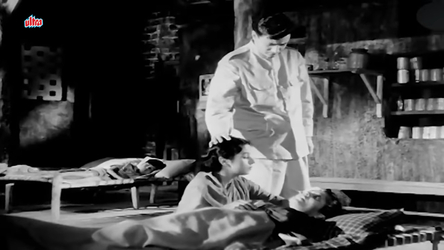
Shaheed (1948)

RIP, Kamini Kaushal. Ms Kaushal, probably the oldest of Hindi cinema stars still living, passed away at the age of 98 on November 14, 2025.

Over the years I’ve been blogging, I’ve seen one after the other of some of my favourite stars pass out of our lives: Shammi Kapoor, Sadhana, Dilip Kumar, Kumkum… but with Kamini Kaushal, I have to admit to a somewhat pronounced sense of loss. Not because she was a particular favourite of mine (though I admitted to being quite impressed with her acting when I watched Biraj Bahu some months back). But because with her passing, the door seems to have shut firmly on those who heralded the start of the Golden Age in Hindi cinema.

Anyhow, a tribute seemed in order. A tribute to Kamini Kaushal, and to a film that I’ve been meaning to watch for a while now.
Continue reading

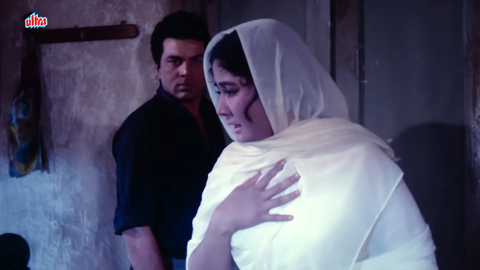
Phool aur Patthar (1966)

A couple of years back, I watched (and later reviewed) the Meena Kumari-Dharmendra starrer, Bahaaron ki Manzil. A good suspense thriller, it put me in mind of another film starring these two: Phool aur Patthar. I had seen the film many years ago, as a child (implication: this would have been in the early 80s, when Doordarshan’s sole TV channel was our only entertainment besides books and radio, which meant we watched anything that was aired, no matter how mediocre). I remembered nothing of it except that Dharmendra played a thief who ends up being cared for by Meena Kumari, playing a widow.

Continue reading

Zindagi (1964)

The main reason I watched this film was because of the songs, which include some very good ones. And Vyjyanthimala, whom I invariably enjoy watching. The two male leads, Rajendra Kumar and Raj Kumar, are not favourites of mine, but they aren’t absolutely unbearable either. And there was a star cast of several other people I like, such as Prithviraj Kapoor and Helen. Ramanand Sagar, who wrote and directed Zindagi, also has to his credit one film I really like (Aankhen) and some (Aarzoo, Ghoonghat, Charas) that I don’t mind too much. I figured there might be enough here for me to enjoy.

The story begins with Beena (Vyjyanthimala) coming home to her mother (Leela Chitnis) with the news that she has found a job, finally. Ma is happy, until Beena tells her what the job is: Beena is now a theatre actress. Ma is very upset and goes into a long harangue of how it’s better to be poor than to be in the theatre; their name will be mud, blah blah.

Continue reading

Kaala Bazaar (1960)

The first time I watched Kaala Bazaar was perhaps in my early teens: the film was being shown on Doordarshan, and given that back then I was very fond of Dev Anand, I watched it. I have very vague recollections of that viewing. What I do recall, vividly, is that I didn’t like that my hero was a criminal.

… which, as I came to realize later, was actually not so very uncommon a style for the characters Dev Anand played. Unlike the other major romantic hero of the time, Shammi Kapoor, Dev Anand didn’t just play characters who got up to ‘mischief’, so to say; his characters—from Tony in Jaal to Raju in Guide, from Chhagan in Roop ki Rani Choron ka Raja to Babu in Bambai ka Babu, plus others—were outright criminals: thieves, conmen, smugglers, men definitely on the wrong side of the law.

Like Raghubir ‘Raghu’ in Kaala Bazaar. Raghu is a bus conductor when the story begins, and within the space of a couple of minutes, his life takes an about-turn. A belligerent passenger is standing in the bus (which is against the rules), and when Raghu asks him to get off the bus, the man refuses. Both he and Raghu lose their tempers. Fists fly, and the next thing we know, Raghu is without a job.

Raghu’s mother (Leela Chitnis) is ill, and he has a sister (Nanda) and a young brother (?) as well; he cannot afford to be without a job. Desperate, Raghu flounders about, trying to find work. If not work, money.

Continue reading

Naya Daur (1957)

Happy 100th birthday, Dilip Kumar!

It was on this day that Mohammad Yusuf Khan, who was to go on to become one of India’s most-loved and finest actors, was born in Peshawar’s Qissa Khwani Bazaar.

In a career spanning several decades, and some sixty-odd films, Dilip Kumar attained a status all his own. He was one of the first to win a Filmfare Award, and went on to win the most Best Actor Awards (until the record was equalled— though not yet surpassed). His scenes have been copied and re-done, his dialogues have become familiar to fans of cinema, his films and his acting closely dissected.

Continue reading

Wahan (1937)

Aka Beyond the Horizon.

When I began this blog, it was with the intention of indulging in my love for old cinema. While that has remained the main objective of my writing here, I’ve added to it a desire to make this a means of documenting old cinema (especially Hindi cinema) too. Not all old cinema, since that would be too mammoth a task for one person to take up; but films that I think are worth documenting, in particular if they seem to be otherwise obscure now. Films that are landmarks in Hindi cinema history; films that were somewhat different, perhaps, from the usual.

Or, as in this case, films that allow us a glimpse of familiar faces that we know from another, later, period. Leela Chitnis, the perennially poverty-stricken and very distressed mother of 60s cinema, stars in Wahan as an Aryan princess, and Ulhas, the well-known character actor of the 50s and 60s, appears in his debut role as her fiancé.

Continue reading

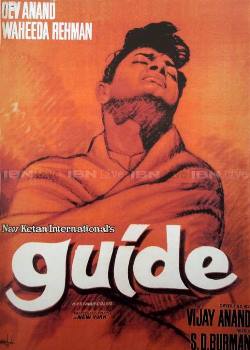
The Guide (1965)

In 1960, RK Narayan won the Sahitya Akademi Award for his novel, The Guide, published in 1958. The story is of a small town tourist guide who has an affair with the lonely wife of an archaeologist, an affair that has a lasting impact on his life.

Of course, anybody who knows anything about Hindi cinema would recognize the plot (and the name) immediately: this, after all, was (minus the ‘The’) the name of one of Hindi cinema’s most popular films ever made. The Dev Anand-Waheeda Rehman starrer Guide, directed by Vijay Anand, won an impressive seven Filmfare Awards (and that excluding what should definitely have been an award, for SD Burman’s brilliant score for the film).

Continue reading

Suhaagan (1964)

I’ve had this film on my radar for a long time. I first came across a mention of it online about ten years ago, and since Guru Dutt had acted in so few films, I was curious about this one (which, incidentally, was also his last film). Back then, I used to subscribe to a video rental service, and having found Suhaagan on that, ordered it—and what I got was the absolutely execrable, horribly regressive Suhaagan that starred Geeta Bali [if ever I decide to draw up a list of Hindi films you must not watch, that Suhaagan will be on it].

The Guru Dutt-Mala Sinha Suhaagan, which several people on my blog have mentioned in the past (including fairly recently), and which I’d searched for on Youtube now and then, finally cropped up in Youtube’s recommendations for me. So I bookmarked it.

Continue reading

Mohabbat Isko Kehte Hain (1965)

A little less than a week ago, on December 4, I received news that a very dear aunt had passed away. My parents, my sister and I made arrangements to travel to Kolkata for the funeral, the next day. Early in the morning, just as I was about to leave for the airport, the newspaper was delivered, and one headline sprang out at me: Shashi Kapoor had passed away, too. On the very same day as my aunt.

I suppose if Shashi Kapoor had passed away on any other day, on a day when I was not quite so swamped in sorrow of my own, I would have posted a tribute to him earlier. Later, I thought. When I am a little less distraught. My father, reading the newspaper, remarked that he and Shashi Kapoor had been born in the same year, just 6 months apart (my father in September 1938, Shashi in March 1938). My mother, looking at a lovely photo of a smiling and very handsome young Shashi, remarked that he looked uncannily like a cousin of mine (which I have to agree with; I have thought so many times). In our own ways, all of us remembered Shashi Kapoor.

Continue reading

Dil Hi Toh Hai (1963)

Some months back, I watched two relatively new Muslim socials: Daawat-e-Ishq and Bobby Jasoos. Both were an interesting reflection on the way the Muslim social has changed over the years (after close to disappearing during the 90s). The Muslim social of the 1950s was, more often than not, a film that, even when set amongst the wealthy upper class—the nawabs and their kin—came heavily burdened with all the stereotypical trappings of what was perceived as ‘Muslim’: the qawwalis and mushairas, the shararas and sherwanis. (I’ll write about all of those, and more, in a post to follow).

Bobby Jasoos and Daawat-e-Ishq had shed those to quite an extent. But that process had begun in earlier films, even as far back as the 60s. In Neend Hamaari Khwaab Tumhaare, for example, where Nanda’s character—the daughter of a nawab, no less—doesn’t merely have a Western education, but spends most of her time in skirts and dresses. And this film, where Nutan’s Jameela is a firebrand, giving as good as she gets, and by no means the simpering and demure Muslim girl exemplified by her contemporaries in films like Mere Mehboob, Mere Huzoor, and Chandni Chowk.

Nutan as Jameela in Dil Hi Toh Hai

Continue reading