On Salil’s Music for Madhumati

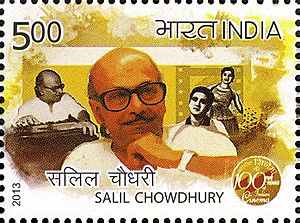
Last week, a little late in the day, I posted a list of my favourite Salil Chowdhury’s Hindi film songs. A ‘little late’ because the music director’s 100th birth anniversary had been on November 19. I had hoped to be on time for this one, because Salil is a favourite of mine.

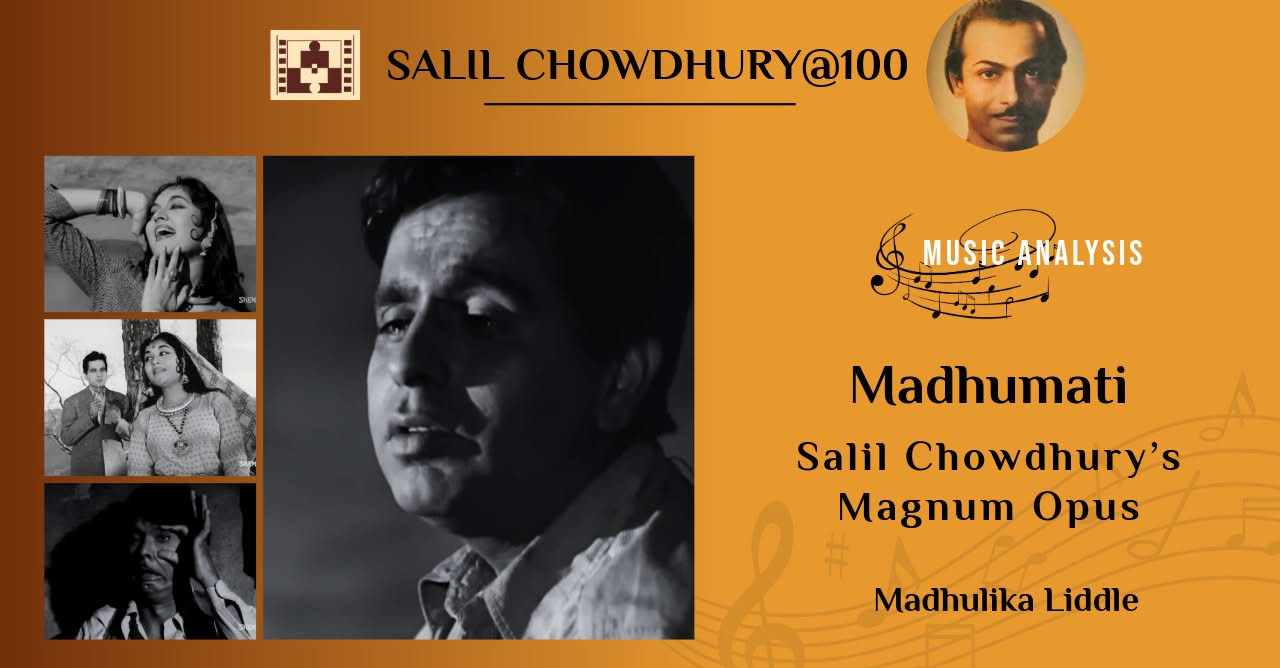
Anyhow. Though I was late to the party, at least I managed to post that list. And now, here’s another post I wrote, also on Salil Chowdhury. For Learning and Creativity’s Silhouette Magazine, an article on Madhumati (1958). Madhumati is a film I’ve reviewed earlier, on my blog, but this time I look at the film primarily through the lens of the music Salil composed for it. It was a score that brought him the Filmfare Award for Best Music Director (the film itself won a whopping nine awards, a feat unparalleled until Dilwaale Dulhaniya Le Jaayenge, 37 years later). And while Madhumati is a good film, I think Salil’s music for it plays a huge part in the film’s success, and its ability to hold its own even now, close to 70 years after it was made.

Click here to read the entire article.
Ten of my favourite Salil Chowdhury songs

In the 17 years this blog has been in existence, I’ve created song lists for a large number of music directors: OP Nayyar, Madan Mohan, Naushad, Ravi, SD Burman… but somehow, I had never got around to creating a Salil Chowdhury song list. I realized this lacuna some years back, but then, realizing that Salil’s birth centenary was in 2025, I told myself I’d plan a list to mark that. I could not ignore Salil, who has long been one of my favourite music directors.

Continue reading

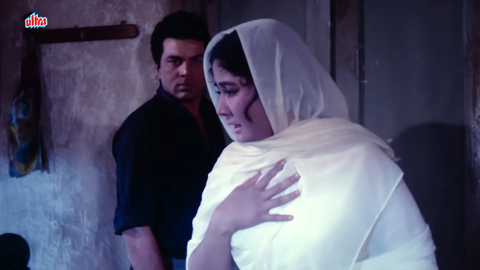
Phool aur Patthar (1966)

A couple of years back, I watched (and later reviewed) the Meena Kumari-Dharmendra starrer, Bahaaron ki Manzil. A good suspense thriller, it put me in mind of another film starring these two: Phool aur Patthar. I had seen the film many years ago, as a child (implication: this would have been in the early 80s, when Doordarshan’s sole TV channel was our only entertainment besides books and radio, which meant we watched anything that was aired, no matter how mediocre). I remembered nothing of it except that Dharmendra played a thief who ends up being cared for by Meena Kumari, playing a widow.

Continue reading

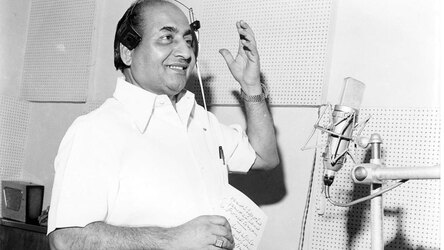
Ten Men, One Voice: The Magic of Mohammad Rafi

Today, December 24, 2024 marks an important birth centenary: that of one of the greatest singers ever to hail from the Indian subcontinent, the inimitable Mohammad Rafi. Born on December 24, 1924 in Kotla Sultan Singh (Punjab), Rafi would go on to dominate the world of Hindi playback singing in a way few of his contemporaries could, singing thousands of songs, winning awards by the dozen—and rarely (a rarity in itself, in a competitive industry) antagonizing those he worked with.

Continue reading

Kalapi (1966)

A Gujarati film starring Sanjeev Kumar.

I am always keen to watch regional films starring people I’m familiar with from Hindi cinema. With (say) Bengali cinema, it’s not too difficult—so many Bengalis (Sharmila Tagore, Kishore Kumar, Biswajeet, Suchitra Sen, Mala Sinha, etc) were big names in Hindi cinema, and managed to do quite a bit of work in Bengali films too, many of which are subtitled. With Punjabi (which I understand enough of to be able to get the gist without having to rely on subtitles) it’s also satisfying, because Punjabi cinema seems to be pretty much completely populated by the same names one keeps running into in Hindi cinema: Nishi Kohli, IS Johar, Balraj Sahni, Prithviraj Kapoor, Indira Billi…

But to come to this: I stumbled upon Kalapi completely by accident, and immediately bookmarked it. Because a subtitled version is available on YouTube, here (though I must warn you, the subtitles are pretty bad), and because of Sanjeev Kumar, one of the greatest actors of Hindi cinema. Also, I am on an eternal quest to find old regional language films that are subtitled, and since I’d never watched a Gujarati film before, this would be a first for my blog.

Continue reading

Dilip Kumar in Ten Moods

RIP, Dilip Kumar.

A living legend has gone. Yusuf Khan, aka Dilip Kumar, one of the greatest actors (many would say the greatest) of Hindi cinema, a man who could seemingly effortlessly enact any role. A man who could convincingly be the maudlin drunk, the happy-go-lucky joker, the broken-hearted lover, the cynic who looks on with contempt at a world gone awry. Unlike several of his most successful contemporaries, who let their stardom get to their heads until what you saw onscreen was always the star, never the character—Yusuf Sahib managed always, unerringly, to bring the character to life. He was Devdas, he was Noshu. Amar, Azaad, Saleem. And every other character he has played.

Continue reading

Ten of my favourite Songs of Nature

Several years back, poet, friend and fellow Sahir Ludhianvi fan Karthika Nair and I were discussing Sahir’s poetry. After a while, we arrived at the conclusion that, while everybody acknowledges the brilliance of Sahir’s more revolutionary poetry—of the Yeh duniya agar mil bhi jaaye or Chini-o-Arab hamaara—and some of his more angsty and emotional lyrics (Chalo ek baar phir se, anyone?), many people tend to overlook the fact that Sahir was also one of those poets who could describe nature brilliantly.

When I mentioned having studied Pighla hai sona in school (it was in our school textbook), Karthika remarked that, in that song, “nature became an active agent, not a landscape.” That reminded me of a theme I’d been toying with for a long time, for a song post. Songs that celebrate nature, songs that appreciate the beauty of nature. Nature or an aspect of nature should be an important part of the song; it should not merely be an incidental pretty backdrop for romance (or any backdrop for any other emotion).

Continue reading

Talaash (1969)

There are a bunch of films that I’ve read a plot synopsis of, found it interesting, thought I’d try and watch it—and then taken a look at the cast, only to discover it starred someone I didn’t like. It’s happened time and again; with Talaash, having discovered that the film starred Rajendra Kumar, I decided to put the film on the back burner, even though the synopsis sounded interesting.

Then, reading Anirudha Bhattacharjee and Balaji Vittal’s SD Burman: The Prince Musician, and seeing the list of songs (some of them truly lovely ones), I thought I may be able to sit through the film. Perhaps the rest of the cast, the interesting story, and the good music, would compensate for Rajendra Kumar.

Talaash begins with the graduation of Raj Kumar ‘Raju’ (Rajendra Kumar), who is being congratulated by all his classmates for having once again come first in the class. Raju goes off to meet his friend Lachhu (OP Ralhan, who also directed this film, which was produced by Rajendra Kumar). Lachhu has, after seven tries, finally managed to graduate too. They congratulate each other, and talk briefly of their futures. Lachhu will be roped in to work at his wealthy father’s cloth shop; Raju doesn’t know what he’ll do, but he’s certain: the wealth of his family will only be doubled. Yes, he’s not known want, ever, and he will continue to enjoy all that wealth, now through his own hard work.

Continue reading

Ten of my favourite Khwaab/Sapna songs

Some months back, I was listening to a music programme on the radio, and heard a song I hadn’t heard for ages: the title song from Dreamgirl. Once upon a time, a six- or seven-year old me used to love Kisi shaayar ki ghazal, not just because it sounded good, but because to me, Hema Malini, in all those frilly, frothy dresses was just—oh, gorgeous. This time, I heard the song with a warm sense of nostalgia; and it struck me that dreams have been, for a long time now, an important part of Hindi cinema. And of Hindi film songs.

For one, there are several songs which are set completely in people’s dreams. The heroine (or the hero) goes to sleep and dreams of singing a song along with the beloved. Then, there are songs which fit the very specific cinematic style known as the dream sequence: a dream which does not require anybody to be really asleep (though some of the best dream sequences in cinema history do involve people who are asleep). In a dream world, there can be little semblance to reality: special effects, grand backdrops, feats that people would not achieve in real life—all come to the fore, and are celebrated, in dream sequences. Look at Ghar aaya mera pardesi, for instance.

And then, there are the literal ‘dream songs’, songs which talk about dreams. Dreams in which the beloved features, dreams about a rosy future alongside the love of one’s life. (It’s interesting that dreams, in the context of Hindi film lyrics, almost always seem to refer to happy dreams, never nightmares. Those dreams may be shattered, but that doesn’t mean they weren’t wonderful to start with).

Continue reading

Doctor, Doctor: Ten songs about medical problems

It’s often struck me that there are a number of Hindi film songs that could well be interpreted to refer to medical problems. The omnipresent theme of romantic love in itself has enough substance for everything from insomnia to palpitations of the heart, giddiness, and whatnot. Bung in heartbreak (hah! Another medical problem?), and you can also tag on mental illness, in the form of depression. Of course, romance isn’t the only reason for problems concerning one’s health: betrayal, fear, family troubles—everything can be cause for singing about ailments concerning one’s heart, one’s liver, and sundry other body parts.

Continue reading