Chitralekha (1964)

I have decided it’s high time I began rewatching some of the old Hindi films I last saw when in my teens (or, in some cases, even before that). Back then, all our film viewing used to happen on India’s sole television channel, Doordarshan, which would telecast Hindi films every weekend, and sometimes in between as well. Most of the films were old classics, and I have fond memories of first viewings of films which became firm favourites almost from the get-go: Junglee, Teesri Manzil, Nau Do Gyarah, Dekh Kabira Roya, Woh Kaun Thi?, Mera Saaya

There were also films that I watched (we watched everything, there was such a paucity of options for entertainment) but which I ended up not liking. Or, as in the case of Chitralekha, not really understanding. I guess this was a simple case of being too young, too immature, to grasp the niceties of a film that wasn’t the standard masala entertainer.

About time, I thought, I saw this one again.

Kidar Sharma, who directed Chitralekha, had already made this film (based on a novel by Bhagwati Charan Verma) earlier as well. The 1941 Chitralekha starred Mehtab (who of course later married Sohrab Modi) and the juiciest bit of information about the film is that it featured a bathing scene (Cineplot used to have an article about this, an excerpt from Kidar Sharma’s autobiography, but since Cineplot now seems to be sadly defunct, that’s gone). Kidar Sharma did say, from what I recall of his autobiography, that the original Chitralekha was far superior to the 1964 remake.

But the 1941 film is, I think, gone—or at least not available for viewing online, though there are songs and stills galore. I may as well watch the 1964 Chitralekha, I decided, since that was the one I had hazy recollections of watching as a child.

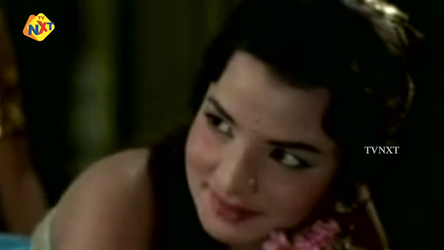
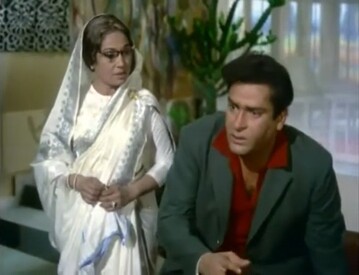
The story is set in Pataliputra during the heyday of the Gupta Empire. Aryaratan Samant Beejgupt (Pradeep Kumar), a high nobleman, has just returned to Pataliputra after a sojourn elsewhere. Beejgupt’s arrival in the city is greeted with anticipation: his fiancée Yashodhara (Shobhna) is shyly hopeful that this time he will marry her.
Continue reading

Tumse Achha Kaun Hai (1969)

Lalita Pawar plays an ageing and very wealthy woman who employs a man (played by Shammi Kapoor) to reform her granddaughters, who are getting too wild for her liking. The man, poor and in desperate need of money to pay for the treatment of an ailing family member, takes up the offer, even though it will require him to pretend to be someone he’s not. In the process, he ends up falling in love with one of the granddaughters—much to the annoyance of the indignant grandmother.

This was the gist of the story of Professor (1962), though with one qualification: Shammi Kapoor’s Preetam in that film is initially hired just as a tutor for the younger brothers of the granddaughters; it’s only a little later that he’s also given the task of tutoring the young women. It was, as I’ve said on more than one occasion—and of course in my review of the film—a delightfully entertaining film, romantic and fun and with absolutely fabulous music.

Seven years later, Shammi Kapoor acted in another film with a somewhat similar plot. Here, in Tumse Achha Kaun Hai, he is Ashok, a musician; and Lalita Pawar plays Sarojini Devi, the very wealthy woman who approaches him with a proposition: that he take on the task of setting to rights her granddaughters, all three of whom (she feels) are a disgrace to Sarojini Devi.

Continue reading

Zindagi (1964)

The main reason I watched this film was because of the songs, which include some very good ones. And Vyjyanthimala, whom I invariably enjoy watching. The two male leads, Rajendra Kumar and Raj Kumar, are not favourites of mine, but they aren’t absolutely unbearable either. And there was a star cast of several other people I like, such as Prithviraj Kapoor and Helen. Ramanand Sagar, who wrote and directed Zindagi, also has to his credit one film I really like (Aankhen) and some (Aarzoo, Ghoonghat, Charas) that I don’t mind too much. I figured there might be enough here for me to enjoy.

The story begins with Beena (Vyjyanthimala) coming home to her mother (Leela Chitnis) with the news that she has found a job, finally. Ma is happy, until Beena tells her what the job is: Beena is now a theatre actress. Ma is very upset and goes into a long harangue of how it’s better to be poor than to be in the theatre; their name will be mud, blah blah.

Continue reading

Sadhu aur Shaitan (1968)

Cinema looking at itself is not an uncommon feature; there have been several notable films, both in India (Kaagaz ke Phool, Sone ki Chidiya) as well as abroad (Cinema Paradiso, 8½, The Bad and the Beautiful, etc), which are about cinema and film-making. But this film, relatively obscure, really should be part of the annals, simply because of its sheer devotion to Hindi cinema. Not because it’s about film-making, not because there is even (as in Solvaan Saal), a single scene on the sets of a film. But because it celebrates Hindi cinema in so many ways, on so many levels.

Sadhu aur Shaitan begins by introducing us to the eponymous ‘sadhu’ of the story: Sadhuram (Om Prakash), a widower who lives with his two children Ganesh (Master Shahid) and Munni (Baby Fauzia), and the maid Ramdeyi (Dulari) who looks after home and the children. Sadhuram is a somewhat excessively ‘good and righteous’ man, the living image of piety (all a little over the top as far as I’m concerned, but at least he isn’t stuffy about his righteousness).

Continue reading

Nastik (1954)

A hundred years ago, on January 27, 1922, in Golconda (Hyderabad) was born Hamid Ali Khan, known to thousands of Hindi film viewers (and, even thousands more who have perhaps never watched any of his films) as Ajit. The man of ‘saara shahar mujhe loin ke naam se jaanta hai’. The iconic villain, suave and eerily soft-spoken though at the same time very oily and dangerous, of films like Zanjeer, Yaadon ki Baaraat, and Kalicharan. The baas of Raabert and Lilly (who was constantly being told not to be silly).

But long before he became the stuff of really bad jokes, before he attained the stature of one of Hindi cinema’s greatest onscreen villains, Ajit was a hero. Coming to Bombay in the face of parental opposition (having first sold his college books to finance the trip), Ajit had to struggle a lot to find work in the cinema industry. He began as an extra, and worked in several films until being noticed by the Gujarati-Hindi director Nanabhai Bhatt (Mahesh Bhatt’s father) who not only gave him the screen name Ajit, but also launched him in a leading role. Across the 50s and 60s, Ajit acted in a slew of films, both as leading man (Nastik, Dholak, Baradari, Marine Drive, Tower House, Opera House, etc) as well as in major supporting roles (of special note here are Naya Daur and Mughal-e-Azam, in both of which he appeared alongside Dilip Kumar).

Continue reading

Do Dil (1965)

Directed by Hrishikesh Mukherjee. Music by Hemant, lyrics by Kaifi Azmi.

That, by itself, would be enough to make me want to watch the film. But then, there was the fact I hadn’t known anything about Do Dil before other than its name. And that, for a Hrishikesh Mukherjee film, is odd. I guessed there must be something about it that was very forgettable.

There was only one way to find out: to watch the film for myself. With a crew like that, I figured that it would almost certainly not be outright awful.

Do Dil begins at a palace, with the death of the Maharaja (we are never shown this man). Some days later, though, a number of courtiers convene along with the Maharaja’s lawyer, who reads out the will. The Maharaja appoints his grand-nephew Kunwar Pratap Singh (Pran), who also happens to be the state’s senapati (commander) as his successor, though with Rani Indumati, the Maharaja’s sister (Durga Khote) as regent (this is all spelled out in very vague terms, so it’s not exactly clear what powers Ranima, as she’s known, will wield). Pratap Singh looks very pleased with himself…

The Maharaja's will is read out
Continue reading

Funtoosh (1956)

Today may (or may not) be the birth centenary of the film maker, writer, and actor Chetan Anand, eldest brother of Dev Anand and Vijay Anand. Different sources list different dates of birth: most sites (including IMDB) list his birth date as January 3, 1921; others, including Wikipedia (yes, I know not the most reliable of sources) say it’s January 3, 1915. (This article says it’s 1921, but then goes on to write that Chetan Anand was 27 years old in 1943, which is either dodgy maths or a suggestion that the year of birth was indeed 1915). The article, barring that slip, is a good, interesting introduction to the life and career of Chetan Anand.

Anyway. Even if I’m six years too late to the party, at least today is Chetan Anand’s birthday.

Continue reading

Jagriti (1954), Bedari (1956)

One review suffices for two films, really. Jagriti was an Indian film, Bedari a Pakistani one. Why I say one review suffices is because Bedari was a blatant copy of Jagriti: so blatant that when Pakistanis cottoned onto the fact that it was a copy, there was a furore which resulted in the Federal Board of Film Censor in Pakistan banning Bedari.

I’ll discuss the synopsis by looking at Jagriti, since Bedari used exactly the same plot, down to the scenes.

Jagriti begins by introducing us to the very wild teenager Ajay Mukherjee (Raj Kumar), who spends his after-school time gallivanting around the village with his gang of equally wild friends. They steal mangoes from an orchard and leave the irate gardener with a bump on his head; Ajay slips onto a ferry and deprives a banana-seller of an entire day’s worth of bananas.

By the time Ajay gets home, his uncle (Bipin Gupta) has been besieged by some very upset villagers. He’s had to soothe them, pay up their damages, and promise that the situation will be amended.

Continue reading

Dil Tera Deewaana (1962)

Shammi Kapoor plays a wealthy man who pretends to be poor while far away from home. He falls in love with the only daughter of a poor blind man. Pran comes along and throws a spanner in the works.

Kashmir ki Kali? Yes, but also Dil Tera Deewaana.

It’s been a long while since I reviewed a Shammi Kapoor film, and considering he happens to be my favourite actor, I decided it was high time I revisited one of his films. I’d watched Dil Tera Deewaana many years back and remembered just the bare bones plot (besides the title song, which I don’t really care for). I did remember, though, that it was fairly entertaining as a film.

Continue reading

Izzat (1968)

When I posted my ‘People with books’ list on World Book Day, I wrote that my favourite scene (in the context of the post) was the one from Izzat: Tanuja and Dharmendra, both holding books (he, Othello, she, The Tribal World of Verrier Elwin), standing in a fairly well-stocked library at her home, and discussing Othello. What more could a book lover like me want from a scene? Especially a scene starring two of my favourite actors.

To those readers who commented, saying that they should probably watch Izzat since it sounded tempting, I was quick to respond: it has been many, many years since I watched this film. My memories of it were very sketchy, with only a vague recollection of the basic plot.

So, for those who want to know what Izzat is all about, I put myself forward as the bali ka bakra. I have rewatched it, and I can safely assure you that despite presence of said library and said bibliophilic conversation (not to mention presence of dishy Dharmendra and gorgeous Tanuja), this is not—emphatically not—a film you want to watch. Unless you’re a Jayalalitha fan (this was her sole Hindi film). Or you love the Himalayas so much you will watch anything as long as there are plenty of snowcapped peaks and deodar woods and bubbling streams.

Continue reading