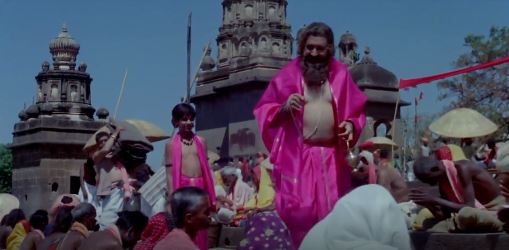
Udan Khatola (1955)    

Does Udan Khatola hold some sort of record for largest number of love/lust triangles?

Here’s a rough count:

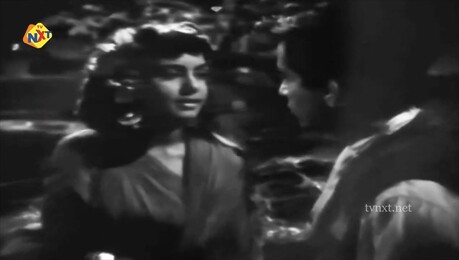
There’s the unnamed aviator, the pardesi (played by Dilip Kumar) who is in love with the local peshwa’s daughter Soni. Who, in turn, loves him back.

Continue reading

Mela (1948)

I have never really wanted to watch this film, the main reason behind that being a long-ago comment by my father, saying that it was a ‘serious’ film. Which meant, basically, that you shouldn’t expect a happy ending. Whatever may happen before that—starry-eyed romance, good songs, even some humour—is all the light-heartedness you could hope for. When tragedy came, it would pile up.

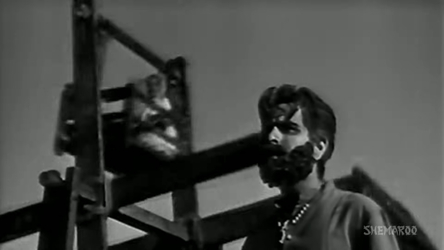
Mela (which I ended up watching mostly for the songs, and partly because I like both Dilip Kumar as well as Nargis) gets off to a bad start, because it begins with gloom and doom. Mohan (Dilip Kumar), old and sad-looking, is released from prison after what seems to be a long, long time in jail. He goes out into the wide world, and walking along, comes across someone singing Yeh zindagi ke mele, while—in the background—crowds of happy, laughing people throng a fair, whirling about on carousels, milling about stalls, enjoying themselves.

Continue reading

Sanjog (1943)

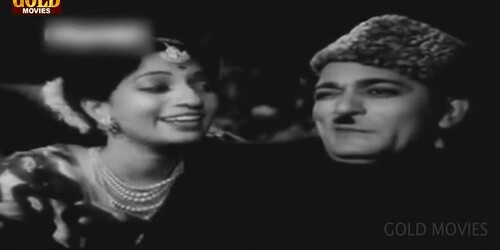
I came to this film quite by chance. Back in April, when I reviewed Jhansi ki Rani, blog reader Maitreyee Mishra, commenting on that review, asked if I’d watched any other films featuring its lead actress, Mehtab. I had had to admit that I hadn’t; in fact, it seemed that most of Mehtab’s films were nowhere to be found—at least not online. I did find one film, though: AR Kardar’s Sanjog (1943), which starred, alongside Mehtab, Noor Mohammad ‘Charlie’.

Continue reading

Sunghursh (1968)

This was the first film I watched after Dilip Kumar passed away on July 7 this year. The tributes and reminiscences were still in full flow two days later, on July 9, which marked what would have been the 83rd birthday of Sanjeev Kumar. On a Sanjeev Kumar tribute post on Facebook, I read a comment in which someone recalled Dilip Kumar’s remark about Sanjeev Kumar, who was his co-star in Sunghursh: “Is Gujarati ladke ne toh paseena nikaal diya!” (“This Gujarati boy made me sweat!”)

This, I thought, might be an interesting film to review by way of tribute to both Dilip Kumar as well as Sanjeev Kumar. But I had other Dilip Kumar films to also watch: Musafir and Sagina Mahato for the first time, Ram aur Shyam for a long-overdue rewatch. So, while I watched this and wrote the review, I decided the publishing of the review could wait for now.

Because today, August 21, 2021, marks the birth centenary of Harnam Singh Rawail, the director of Sunghursh.  HS Rawail, as he was usually billed, debuted in 1940 with the film Dorangia Daaku, but it wasn’t until 1949, with Patanga (of Mere piya gaye Rangoon fame) that he became famous. Rawail was to make several well-known films through the following decades, but his two best-known works are probably Mere Mehboob (1963) and Sunghursh.

The story, based on Mahashweta Devi’s Laayli Aashmaaner Aaina, begins in Banaras of the 19th century (the riverfront, sadly, looks very mid-20th century). Bhawani Prasad (Jayant), bearded and seemingly benevolent, walks back from the temple after pooja. At his heels follows his grandson Kundan (?). Bhawani Prasad is much venerated, and the way he hands out alms to the poor and blesses those bowing before him, one might be forgiven for thinking him a good man.

Continue reading

Ram aur Shyam (1967)

I wanted to watch a Dilip Kumar film to commemorate the life and career of this extraordinary actor. But which one? There are lots of iconic Dilip Kumar films that I have either seen long ago (Devdas, Footpath, Daag, Deedaar, Udan Khatola, Andaaz) and not reviewed on this blog, or which I’ve never seen (Tarana, Jugnu, Mela, Shaheed, Musaafir). I could watch a film I’d never seen before, but—knowing what a lot of Dilip Kumar’s early films are like—there was always a chance I’d run up against something depressing.

I finally decided to rewatch a film I’d seen years ago. A film that’s a good showcase of Dilip Kumar’s versatility, his ability to pull off comic roles as well as the tragic ones for which he was better known. Ram aur Shyam is an out-and-out entertainer, a film I’d watched and loved as a teenager, and which I knew for a fact would cheer me up.

Continue reading

Dillagi (1949)

A couple of months back, a blog reader had remarked that Hindi cinema, during the 1930s and 40s, seemed to have a fairly unimpressive-looking lot of leading men. The good-lookers, was the theory, were the ones that came later, though there had been a very few rare exceptions, like Shyam.

While I didn’t agree that most of the leading men of the 1930s and 40s were ugly (or at best, plain), I did agree about Shyam. Shyam was one of those very handsome actors who, with his impressive height and build added to his charisma, could have posed a serious threat to the triumvirate of Dilip Kumar, Raj Kapoor, and Dev Anand. Sadly, Shyam died tragically young, just 31 years old, after sustaining a head injury caused by a fall from a horse during the shooting of Shabistan in 1951.

Born in Sialkot on February 20, 1920, Shyam Sunder Chadha ‘Shyam’ debuted in a Punjabi film, Gowandhi (1942) and continued to work sporadically in cinema over the next few years. After Partition, Shyam shifted to Bombay, and that was when his career really took off. Over the next four years, he worked in a slew of films, including some big hits like Dillagi, Samadhi, and Patanga. One can only speculate on what trajectory his career might have taken had he lived into the 60s. (Interestingly, Shyam was a very dear friend of Sa’adat Hasan Manto: it was a friendship that outlasted Partition, and Manto was deeply affected when Shyam passed away).

I hadn’t realized, back in February this year, that it was Shyam’s hundredth birth anniversary. But the year is still the same, so in celebration of Shyam’s birth centenary year, a review of one of his biggest hit films. In Dillagi, Shyam acted the role of Swaroop, a dashing young man who falls in love with a village girl named Mala…

Continue reading

Jaadoo (1951)

There are several reasons why I decided to review this film, even though it’s not a particularly impressive one. For one, it’s one of the rare Indian films set outside India and the Middle East (more on this later). For another, its music by Naushad, who (I would have thought) would not have been the most obvious choice to compose music for a film that’s distinctly Latin in tone. And, because this is a film I’ve long been wanting to see—ever since I first watched Lo pyaar ki ho gayi jeet on Chitrahaar as a pre-teen.

Continue reading

Dil Diya Dard Liya (1966)

Despite its having a cast of several people whom I like a lot (Waheeda Rehman, Dilip Kumar, Pran, Rehman, Shyama), a music director whom I like a lot (Naushad) and being by no means an unknown film, Dil Diya Dard Liya is one I’d never got around to watching. Perhaps it is because I had been told by knowledgeable readers that it was based on Wuthering Heights—and I could imagine what a confluence of Wuthering Heights (dark, grim, with two thoroughly selfish and unlikeable leads) and typical Bollywood (melodramatic, with no lead capable of being anything but noble, even if it’s only in the final analysis)—would be like. Mishmash, hard to bear?

But when I posted a Naushad song list in tribute on Naushad’s birth centenary last year, several people mentioned the songs of Dil Diya Dard Liya, and I decided it was time to take the plunge. If for nothing else than Naushad’s music.

Continue reading

Ten of my favourite Naushad Songs

Happy Christmas!

Today marks the birthday of Jesus Christ, but also of a man who was pretty much regarded as little less than a god by thousands of music lovers in India between the 40s and the 60s. The one and only Naushad Ali, who was born on Christmas Day, 1919.

Continue reading