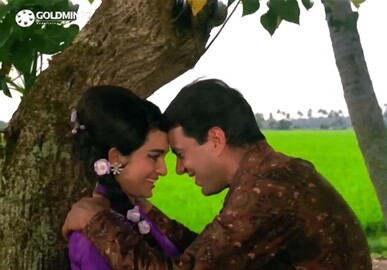
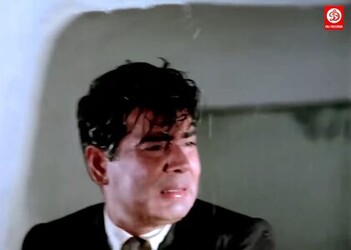
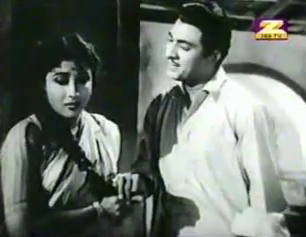
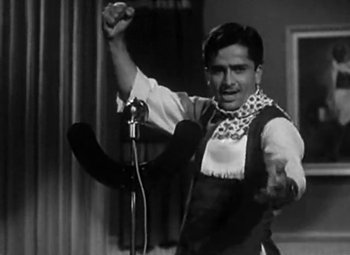
Jaal (1967)

I had first watched this film many, many years ago, probably as a young teen. It had been aired on Doordarshan, back in the good old days when our family used to watch pretty much every film that was shown (including some seriously grotty ones like Fauji).

I remembered little of Jaal: Mala Sinha and Biswajeet, yes; and that it was a suspense thriller set in a spooky mansion beside the sea. That was all.

While I don’t like Biswajeet, and the music of Jaal (by Laxmikant-Pyarelal) is forgettable enough to not want to watch it for the songs, I decided I should give this one another try. At least find out what it’s about.

The story begins on a stormy night at sea. A small boat is tossed about on the waves, and we catch glimpses of the lone man on board: Sunder Singh (Sujit Kumar) as he tries to control his vessel. In the distance can be seen (like the boat and the waves, looking patently artificial) a lighthouse. Sunder, however, cannot make it safely to shore; his boat crashes against the rocks and explodes in a great burst of fire.

Continue reading

Kangan (1959)

In which Iftekhar, playing against type, acts the part of a lecherous villain. And Chitragupta, composing against type, proves he was no one-trick pony.

But, to begin at the beginning (and Kangan gets into action right at the start, not dilly-dallying about with incidental stuff). Karuna (Nirupa Roy) is about to get married, and her widowed father (?) is giving her his blessings and wishing her mother were still around. Just then, Kamla (Purnima) comes in; she is not just Karuna’s bridegroom’s sister, but also a good friend of Karuna’s. Karuna’s father leaves the two women together and goes off.

Continue reading

Sadhu aur Shaitan (1968)

Cinema looking at itself is not an uncommon feature; there have been several notable films, both in India (Kaagaz ke Phool, Sone ki Chidiya) as well as abroad (Cinema Paradiso, 8½, The Bad and the Beautiful, etc), which are about cinema and film-making. But this film, relatively obscure, really should be part of the annals, simply because of its sheer devotion to Hindi cinema. Not because it’s about film-making, not because there is even (as in Solvaan Saal), a single scene on the sets of a film. But because it celebrates Hindi cinema in so many ways, on so many levels.

Sadhu aur Shaitan begins by introducing us to the eponymous ‘sadhu’ of the story: Sadhuram (Om Prakash), a widower who lives with his two children Ganesh (Master Shahid) and Munni (Baby Fauzia), and the maid Ramdeyi (Dulari) who looks after home and the children. Sadhuram is a somewhat excessively ‘good and righteous’ man, the living image of piety (all a little over the top as far as I’m concerned, but at least he isn’t stuffy about his righteousness).

Continue reading

Ram aur Shyam (1967)

I wanted to watch a Dilip Kumar film to commemorate the life and career of this extraordinary actor. But which one? There are lots of iconic Dilip Kumar films that I have either seen long ago (Devdas, Footpath, Daag, Deedaar, Udan Khatola, Andaaz) and not reviewed on this blog, or which I’ve never seen (Tarana, Jugnu, Mela, Shaheed, Musaafir). I could watch a film I’d never seen before, but—knowing what a lot of Dilip Kumar’s early films are like—there was always a chance I’d run up against something depressing.

I finally decided to rewatch a film I’d seen years ago. A film that’s a good showcase of Dilip Kumar’s versatility, his ability to pull off comic roles as well as the tragic ones for which he was better known. Ram aur Shyam is an out-and-out entertainer, a film I’d watched and loved as a teenager, and which I knew for a fact would cheer me up.

Continue reading

The Clerk and the Coat (1955)

Aka Garam Coat, though The Clerk and the Coat is the title as it appears in the credits of this film, and is also the title for which the Censor Certificate was issued.

This film had been among my bookmarks for a long time, but I’d been putting off watching it because I had a suspicion it would turn out to be very depressing. And I’ve not been in a state of mind conducive to being able to watch depressing cinema. But after having watched several rather ho-hum films (Kismat ka Khel, Passport) I figured I should take the plunge and watch something good, even if not exactly frothy and cheery. Garam Coat, after all, was written by Rajinder Singh Bedi, for whom I have a great deal of respect.

The story is set in an unspecified North Indian town, where Girdhari (Balraj Sahni) lives with his wife Geeta (Nirupa Roy) and their three children: two girls and a pampered toddler named Chanda. Girdhari is a clerk at the post office, where he handles money orders. His two best friends are his colleagues Munilal ‘Muni’ (Rashid Khan) and Sher Khan (Jayant). Girdhari’s salary is so meagre that he and Geeta have to carefully monitor every paisa. This for the rent, this for the milkman, this for the kiraane ki dukaan from where they buy their groceries. This much for the insurance premium, for the electricity bill, for the girls’ school fees.

Continue reading

Jigri Dost (1969)

Mostly, the films I review on this blog are either the ones I like so much I want more people to watch them; or films I hate so much I want to warn people off them. Or, sometimes, films which may not be otherwise exceptional but have, I think, something that sets them apart: they’re unusual, or they’re somehow of historic importance.

Now and then, along comes a film I decide I have to review because while I don’t find it dreadful, I wonder what it would have been like with a different cast. Even just one actor being replaced by another.

Jigri Dost begins in the palatial home of Chairman Neelkanth (KN Singh), who is a baddie of the first order. He summarily orders his henchmen to raze this bunch of poor people’s huts, extort money from that lot, and so on. He has no scruples, no mercy, no nothing… no inkling, either, that a maid (Aruna Irani) in his home eavesdrops on his every conversation.

Continue reading

Rani Rupmati (1959)

Considering this is a period film—a ‘raja-rani’ film, so to say—and it has some great music, I’ve not made much of an effort to watch it. I don’t mind Nirupa Roy in leading lady roles (she could look really pretty, and as long as she wasn’t playing the self-sacrificing and long suffering Sati Savitri, she was fine). But Bharat Bhushan isn’t my cup of tea. Along with Pradeep Kumar and Biswajeet, he is one of those actors whom I invariably see lip syncing to great songs, and wish the songs had been picturized on someone else.

But I finally decided it was high time I watched Rani Rupmati.

The story begins by introducing us to the town of Mandavgarh (now better known as Mandu), part of the kingdom of Malwa. Malwa is ruled by Pathans: its Sultan is Shujat Khan, whose elder son, Baazid Khan ‘Baaz Bahadur’ (Bharat Bhushan) seems to be an effeminate, music-loving hedonist who spends all his time doing riyaaz with his ustad.

Continue reading

Ek Gaon ki Kahaani (1957)

What is it about Bengali directors—Bimal Roy, for instance, or Hrishikesh Mukherjee, or (if one steps out of the realm of just Hindi cinema, Satyajit Ray)—that they manage to bring so vividly to life the everyday happenings in the lives of everyday people? Not the escapist fare that most people tend to equate Hindi cinema with, but stories about real people, people one can relate to? Films like Majhli Didi, Parivaar, Parakh, Sujata, Anand: not larger than life, not without a shred of reality. Not art films, not angst-riddled, songless films about the search for the meaning of life, but everyday stories. Songs and all, still very much commercial cinema, but easy to relate to.

Add to that list Dulal Guha, who while he also went on to make films like Mere Humsafar, began his career as a director in Hindi cinema with this charming little film about a sleepy village named Chandangaon, that’s jolted by the arrival of a new doctor…

Talat Mahmood and Mala Sinha in Ek Gaon ki Kahaani

Continue reading

Dharmputra (1961)

Several readers have told me, over the past couple of years, that I should watch this film. It is, if you go by just the details of cast, crew, and awards won, a promising film. Directed by Yash Chopra, starring Mala Sinha, Rehman, Ashok Kumar, Shashi Kapoor (in his first role as an adult), Nirupa Roy, Indrani Mukherjee, Manmohan Krishna—with guest appearances by Rajendra Kumar and Shashikala. The winner of the President’s Silver Medal for Best Feature Film in Hindi at the National Film Awards.
And with lyrics by Sahir Ludhianvi, set to music by N Dutta. I could well imagine Dharmputra would be a film worth watching. So when I finally managed to lay my hands on it, I didn’t waste much time getting around to seeing it.

Shashi Kapoor in Dharmputra Continue reading