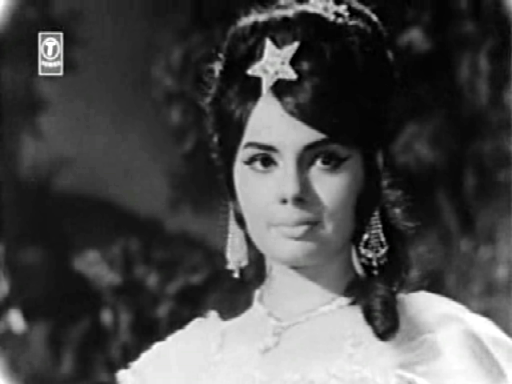
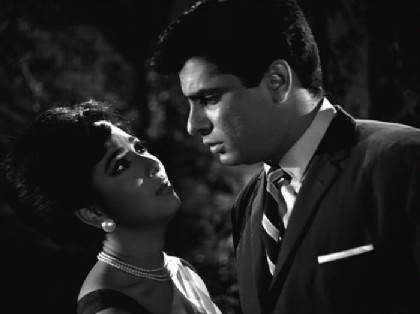
Kaala Paani (1958)

Today is the 100th birth anniversary of one of my favourite Hindi film directors, the suspense-specialist Raj Khosla (I hasten to add: I am well aware that that’s a generalization, since Khosla made a lot of films, too, that had nothing to do with the thriller/suspense genre: Mera Gaon Mera Desh, for example; Chirag, Main Tulsi Tere Aangan Ki, Do Badan, etc). But it is Khosla’s prowess with this particular genre that I especially admire, a skill and talent he showcased in classics of the genre such as Woh Kaun Thi? ((1964), Mera Saaya (1966), CID (1956) and Kaala Paani (1958). In each of these films, he managed to combine the classic elements of the Hindi masala film—a romance, a comedic side track, lots of fabulous songs—while making sure that the suspense remained (mostly) taut, the mystery a solid one.

To commemorate Khosla’s birth centenary, I wanted to review one of his suspense films. Several of these (CID, Mera Saaya, Ek Musaafir ek Haseena, Woh Kaun Thi?) I have already reviewed; I was torn between some of the others: Solva Saal, Kaala Paani, and Anita, all of which I have seen at some time or the other. I decided, eventually, that it was time to rewatch Kaala Paani, a film that I’ve watched several times, but too far back to have reviewed it on this blog.

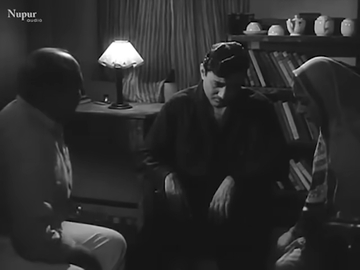
The story begins on a night in Bombay, with a woman (Mumtaz Begum) hurrying through the streets to the home of a family friend, Mr Kapoor (?). She is in great distress, and confides in Kapoor: Karan has discovered the truth. What this truth is we discover when Kapoor hurries to Karan’s home to find Karan (Dev Anand) sitting, looking bereft. He has found out (how, we aren’t told) that his father Shankar Lal has, for the past fifteen years, been incarcerated in Hyderabad jail for the murder of a tawaif named Mala. Not, as Karan has been led to believe all these years, dead.
Continue reading

Sapan Suhaane (1961)

Starring Balraj Sahni and Geeta Bali. With music by Salil Choudhary.

How could I—with a well-established reputation for watching films based on a single name I like among the crew and cast—pass up this one? Balraj Sahni is a favourite, as is Geeta Bali. And Salil Choudhary is one of those rare music directors for whom I’ll watch a film (even if I could just as well just listen to a playlist of the songs online).

These three were the reason I watched Sapan Suhaane, and I’ll admit that till more than midway through the film, I was congratulating myself on having stumbled on a hidden gem. Or, if not strictly a ‘gem’, at least a film that was watchable enough. After that…

But to start at the very beginning, when we are introduced to Shankar (Balraj Sahni) and his younger brother Dilip (Chandrashekhar). Shankar and Dilip are stepbrothers, but deeply devoted to each other. Shankar has given up his own comfort, his own prospects, in order to work so that he can finance Dilip’s studies.

Continue reading

Mr India (1961)

A simple-hearted—even outright simple, really—man turns out to be the look-alike of a much-wanted criminal. As a result, the police train him to impersonate the criminal so that they can get enough evidence to crack down on a web of crime.

I have no idea if Don (1978) was inspired by Mr India. Don is in many ways a very different film (the criminal, for one, dies fairly early on in the proceedings; for another, it’s a much more complex plot): but there is that fleeting resemblance.

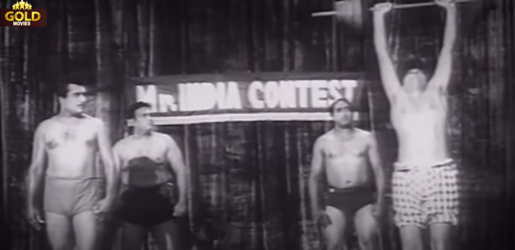
Mr India begins by introducing us to Gullu (IS Johar), naïve and simple, as he goes about job-hunting, and getting rejected at every office because he doesn’t fit the regional profiles demanded by the parochial employers of these places. Gullu gets briefly hired by someone who wants to rig a ‘Mr India’ weight-lifting competition, with Gullu pretending to hoist what is actually wooden dumbbells rather than iron.

Continue reading

Doli (1969)

The Hindi film industry has always been an upholder of patriarchy. Its male stars attract ridiculously high prices in comparison to their female colleagues, and have disproportionately longer careers than them (plus a much longer time as leads). Sexism is rampant, ranging all the way from sexual discrimination to violence. And, though more women directors, scriptwriters, lyricists etc are around now, it’s still pretty much a male-dominated industry.

Hardly surprising, then, that most of our films tend to look at things (at best) from a male point of view. At worst, they uphold patriarchy in its most virulent forms, reducing women to a cypher, expected to devote their lives to the service of men. Ever-forgiving Sati Savitris, wrapped in saris and simpering prettily every time their lord and master deigns to be kind. Or unkind, it doesn’t matter; he is still her devta.

Doli is one such film, steeped in patriarchy and regressive in the extreme.

It begins in a college, where Amar (Rajesh Khanna) and Prem (Prem Chopra) have just graduated. Amar is the star athlete, Prem the star pupil who has topped the college and won a scholarship for higher studies in America. Later, in their dorm, both Prem and Amar receive letters from home, informing them that their weddings have been fixed. On the same day, in the same town, Nasik. Neither of them is happy about this, but Prem, having known already that a match had been found for him, is rather more resigned.

Continue reading

Seema (1955)

Every now and then, I am reminded of a film which I’ve seen—often, many years ago—and which would be a good fit for this blog. Right time period, a cast I like, music I like. Some of these (like Pyaasa, Mughal-e-Azam or Kaagaz ke Phool) have been analyzed and reviewed so often and by so many stalwarts infinitely more knowledgeable than me that I feel a certain trepidation approaching them. Others are a little less in the ‘cult classic’ range, but good films nevertheless.

Like Seema. I remembered this film a few weeks back when I reviewed Naunihaal (also starring Balraj Sahni). At the end of that post, I’d inserted a very striking photo I’d found, of a young Balraj Sahni standing in front of a portrait of Pandit Nehru. Both on my blog and elsewhere on social media, some people remarked upon that photo: how young and handsome Balraj Sahni was looking in it. And I mentioned Seema, as an example of a film where Balraj Sahni appears as the hero. A hero of a different style than the type he played in Black Cat, but a hero nevertheless.

Continue reading

Vachan (1955)

I started my first draft of this post by writing that “I watch some films because of the people who made them”. Then it struck me that that, almost invariably, is the only reason I do watch a film. After all, everybody—the director, the music director, the lyricist, and of course the cast (besides the many hundreds of other, often unnamed, people) who work on a film are those who made them. Sometimes, it’s the cast that appeals to me: give me people like Shammi Kapoor, Dev Anand, Sadhana, Waheeda Rehman—oh, and many more—and I will happily begin watching any film they’re in (whether or not that experience will end up being as rewarding a one I’d hoped for is another matter). Sometimes, it’s just the name of a well-loved and much-respected director—Bimal Roy, Hrishikesh Mukherjee, Vijay Anand among them—that’s enough.

Sometimes, it’s the music. Sometimes, it’s just one song.

In this case, it was just one song. I was singing Chanda mama door ke to the LO the other day, and I thought: that’s a nice song, and Geeta Bali looks so pretty; I wonder what the film’s like.

Continue reading

Insaan Jaag Utha (1959)

The main reason I rented this film was that the credits were so absolutely mouthwatering. A cast that included Sunil Dutt, Madhubala, Minoo Mumtaz, Madan Puri and Nishi Kohli. Music by S D Burman. Shakti Samanta as director. A winner, I’d have thought.

Alas, no. While it’s not a dud, Insaan Jaag Utha isn’t more than the sum of its otherwise stellar parts.  The story is a mishmash of tropes. It doesn’t seem to know where it’s going, the plot has a lot of holes, and  it’s not really too interesting.

Continue reading

Rustom-e-Hind (1965)

Mumtaz, as I mentioned in my last post, was one of the best things that happened to Mere Sanam. She may not have had much screen time in the film, but she certainly left her mark – more than she’d been doing in the B-grade films she’d mostly appeared in till then.
Rustom-e-Hind, made in the same year as Mere Sanam, is an example of that type of film. It’s basically a Dara Singh showcase – so there’s lots of showing off of wrestling – but Mumtaz gets to smile prettily and flutter her eyelashes, if nothing else.

Continue reading

Dillagi (1966)

This was what I call a ‘shot in the dark’ film—I noticed it on Induna and decided I’d give it a try, even though I hadn’t heard of it before. The decision was arbitrary, and mainly because the picture of the DVD cover appealed to me. I should probably have had a look at the plot summary on imdb but I didn’t, and ended up with a film that I actually rather liked, even apart from the fact that the lead pair looked yum.

Sanjay Khan and Mala Sinha in Dillagi

Continue reading

Dekh Kabira Roya (1957)

Rewatching this film after donkey’s years, I was struck by the similarity in basics with How to Marry a Millionaire. Here too are three beautiful girls, each of whom falls in love with a man she meets—but doesn’t realise is not quite the sort of man she’d hoped to end up marrying.
That’s where the resemblance ends. Our girls, like good bharatiya naaris, aren’t mercenary gold-diggers. Which, of course, is good news for the three men whom they fall for, since their heroes aren’t exactly rolling in wealth either.

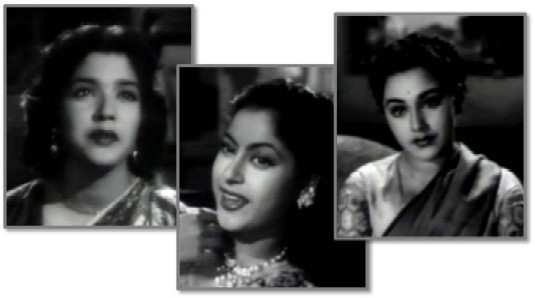
Shbuha Khote, Anita Guha and Ameeta in Dekh Kabira Roya

Continue reading