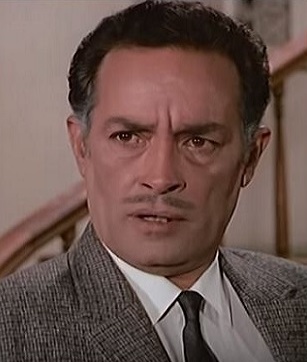
Anita (1967)

When, for May 31st this year (the 100th birth anniversary of film director Raj Khosla), I wanted to review one of his films, Anita was on my shortlist. Over the course of the years I’ve been writing this blog, I’ve reviewed several of Khosla’s films, including two of the three films (Woh Kaun Thi?, Mera Saaya and Anita) that comprise Khosla’s Sadhana suspense trilogy. Since Manoj Kumar had also passed away earlier this year, it seemed fitting to watch and review Anita, the last of the three films, and a film that starred Manoj Kumar opposite Sadhana.

For a tribute to Khosla, I ended up reviewing Kaala Paani instead. But I did watch Anita (a film that I’d last seen so long back, I remembered only the basics of it). And it seemed appropriate to review it too.

Therefore…

The film begins with a short, rather abrupt scene in which Seth Biharilal (Sajjan) visits a somewhat shady-looking pandit (Ulhas). Biharilal has brought along the horoscope of his 19-year-old daughter Anita for the pandit to have a look at, and to comment upon. The pandit has a peek, and says that this year is going to be really vile for Anita.

Continue reading

Aadhi Raat ke Baad (1965)

I dithered over this film for a long time after I’d finished watching it. Should I review it? Should I not? It wasn’t a great film, but it wasn’t terrible, either. It wasn’t as if a review was needed to warn potential viewers off it. Or vice-versa, to alert people to a film they must see.

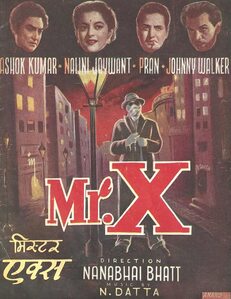
Eventually, I decided that at least a brief review was in order, because this film had an interesting connect to another film I’ve wanted to watch for a while: Mr X.

In 1957, Nanabhai Bhatt had directed a science fiction film (borrowing from HG Wells’s novel The Invisible Man) that starred Ashok Kumar and Nalini Jaywant. According to this web page on Mike Barnum’s blog, the film is about a man who ingests a drug that makes him invisible; he uses this invisibility to go on a Robin Hood-esque spree, helping the poor by robbing the rich. The cops, baffled by the invisible man, dub him Mr X.

I’ve long wanted to watch Mr X, mostly because it features one of my favourite N Dutta songs, Laal-laal gaal. The film isn’t available online, at least, or even on DVD, from what I can tell; perhaps there are carefully guarded prints deep in some archive…

Continue reading

Chalti ka Naam Gaadi (1958)

In response to that unwarranted comment about me ‘wasting my time watching silly Indian films’, I’ve done something (reviewed Bhabhi ki Chudiyaan and Devi) to uphold my contention that all Indian films are not silly. Now it’s time to look at Indian films which are silly, but where the silliness is intelligent, and deliberate.

What, after all, is wrong with silliness, or with humour? For me, the stuffy idea that humour is somehow low is very irritating. Some humour may be unpalatable to certain people (I, for one, find nothing humorous about sexist or racist jokes, or toilet humour), but humour can be sophisticated, it can be the result of a great intelligence.

As, I think, comes through in this delightful film about three brothers, all motor mechanics, who run a garage.

Brijmohan Sharma ‘Bade Bhaiya’ (Ashok Kumar), as he’s known, is the eldest of the three, and he rules with an iron fist in an iron gauntlet.  Bade Bhaiya is a hard taskmaster, and lords it over Jagmohan ‘Jaggu’ (Anoop Kumar) and Manmohan ‘Manu’ (Kishore Kumar), as also their apprentice Maujiya (Mohan Choti). One important aspect of Bade Bhaiya’s personality is his aversion to women: he sees red even when Maujiya hangs up a calendar with a painting of a woman on it.

Continue reading

Do Dulhe (1955)

Today is the birth centenary of one of a handful of Hindi film actors who managed to cross from one type of role to another—again and again. Like Ajit, Pran, and Premnath (though not in the same league as them, when it came to success and popularity), Sajjan Lal Purohit—better known simply as Sajjan—appeared in leading roles in several of his early films (including, notably, in Saiyyaan, where he acted opposite Madhubala), then drifted into supporting roles (as Dev Anand’s sculptor friend in Paying Guest; as Mini’s father in Kabuliwala; and more), and eventually into villainous roles (in April Fool, Aankhen, Farz, etc).

Continue reading

Dil Diya Dard Liya (1966)

Despite its having a cast of several people whom I like a lot (Waheeda Rehman, Dilip Kumar, Pran, Rehman, Shyama), a music director whom I like a lot (Naushad) and being by no means an unknown film, Dil Diya Dard Liya is one I’d never got around to watching. Perhaps it is because I had been told by knowledgeable readers that it was based on Wuthering Heights—and I could imagine what a confluence of Wuthering Heights (dark, grim, with two thoroughly selfish and unlikeable leads) and typical Bollywood (melodramatic, with no lead capable of being anything but noble, even if it’s only in the final analysis)—would be like. Mishmash, hard to bear?

But when I posted a Naushad song list in tribute on Naushad’s birth centenary last year, several people mentioned the songs of Dil Diya Dard Liya, and I decided it was time to take the plunge. If for nothing else than Naushad’s music.

Continue reading

Door Gagan ki Chhaaon Mein (1964)

Just ten days ago, this blog celebrated the birth centenary of an actor who pretty much came to exemplify the ‘Hindi film villain’ of the 50s and 60s: the inimitable Pran. Today, it’s time to celebrate the birth centenary of another actor who carved such a niche for himself that his name became nearly synonymous with a particular kind of role. Iftekhar, who brought so much dignity and intelligence to his usual role of police officer or lawyer—or army officer, or doctor…

Continue reading

Talaash (1969)

There are a bunch of films that I’ve read a plot synopsis of, found it interesting, thought I’d try and watch it—and then taken a look at the cast, only to discover it starred someone I didn’t like. It’s happened time and again; with Talaash, having discovered that the film starred Rajendra Kumar, I decided to put the film on the back burner, even though the synopsis sounded interesting.

Then, reading Anirudha Bhattacharjee and Balaji Vittal’s SD Burman: The Prince Musician, and seeing the list of songs (some of them truly lovely ones), I thought I may be able to sit through the film. Perhaps the rest of the cast, the interesting story, and the good music, would compensate for Rajendra Kumar.

Talaash begins with the graduation of Raj Kumar ‘Raju’ (Rajendra Kumar), who is being congratulated by all his classmates for having once again come first in the class. Raju goes off to meet his friend Lachhu (OP Ralhan, who also directed this film, which was produced by Rajendra Kumar). Lachhu has, after seven tries, finally managed to graduate too. They congratulate each other, and talk briefly of their futures. Lachhu will be roped in to work at his wealthy father’s cloth shop; Raju doesn’t know what he’ll do, but he’s certain: the wealth of his family will only be doubled. Yes, he’s not known want, ever, and he will continue to enjoy all that wealth, now through his own hard work.

Continue reading

Aankhen (1968)

I spent part of last week reading fellow blogger Todd Stadtman’s book, Funky Bollywood: The Wild World of 1970s Indian Action Cinema (more on that, along with a link to my review of it, at the end of this post). Todd’s book discusses, in affectionate detail, all the iconic action films—spy thrillers included—of the 70s. In a fit of enthusiasm, brought on by Todd’s book, I told my husband, “I want to see Gunmaster G-9”. To which he replied, “I didn’t like that. What I really liked was Aankhen. That was fun.”

Dharmendra in Aankhen Continue reading

Parivaar (1956)


Serendipity isn’t something I encounter too frequently while watching Hindi cinema. More often than not, it’s the other way round: I watch a film because I liked the cast, or because the story sounds appealing, or (and this happens with appalling frequency) because the music is wonderful. That I should watch a film about which I know next to nothing—on a whim, so to say—and find that it’s not just watchable but actually quite enjoyable is something to be grateful about. Which is why this review. Seriously speaking, I hadn’t expected much of Parivaar (the name itself conjures up one of those extremely melodramatic social dramas AVM used to specialise in).

Worse, I had my memories (I wish I could rid myself of them) of having watched the utterly execrable Nanda-Jeetendra starrer Parivaar, one of the worst films from the 60s I’ve ever wasted three hours upon. But, back to this Parivaar, which brought a smile of pleased anticipation to my face as soon as the credits began to roll. Directed by Asit Sen and produced by Bimal Roy, Parivaar is set completely within the large haveli of the Choudhary brothers, where all of them, with the exception of one brother, live as a joint family. Over the first hour or so of the film, we are introduced to these men, their families, and their servants. The parivaar, all together Continue reading

Rustom Sohrab (1963)

Who would’ve thought that the Ramsay Brothers’ first production was a historical worthy of a Sohrab Modi [granted, it does have two far-too-chubby leading men and its fair share of violence, but still; Rustom Sohrab is no horror film, not by a long shot]? But yes, Ramsay Productions—famous for its B grade horror films of the 80s and 90s—did make this rather surprising debut, a film based on the Persian epic poem Rostam and Sohrab (part of the famous Shahnameh).

Prithviraj Kapoor and Premnath in and as Rustom Sohrab. Continue reading