Ramat Ramade Ram (1964)

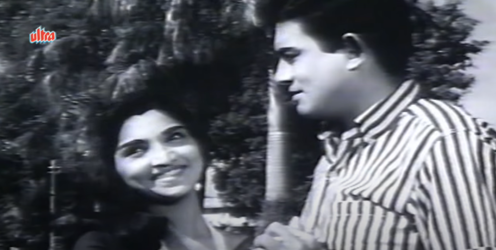
Which, since I’ve not been able to find out exactly what this means, I choose to interpret from the subtitles of its title song: ‘Ram Plays a Game’.

If you’ve been following this blog for a while, you’d probably know of my near-constant mission to find subtitled Indian films. Regional films, non-Hindi ones. Sadly, not very many old films (barring Bengali) seem to be subtitled, so when I do find one that has subs, I am pleased as punch.

Especially when it turns out that it stars one of my favourite actors (Sanjeev Kumar) and that pretty much all the videos on YouTube, even the ones featuring only certain songs or scenes tag the film as a romantic comedy. I am all for rom-coms, and rom-coms that feature Sanjeev Kumar? This I needed to see.

Continue reading

Insaaf ka Mandir (1969)

Insaaf ka Mandir is a relatively little-known film which I’d seen many years back, but had forgotten most of. It was fellow blogger Jitendra Mathur who reminded me of this, and my memories of the film were pleasant enough for me to want me to rewatch and review this.

The story begins with Sunil (Sanjeev Kumar), a student who’s just completed his law studies at college when he receives an urgent telegram: his father is very ill, Sunil should head home immediately. A classmate of Sunil’s, Sunita (Snehlata), comes by and, in a brief conversation, confesses to Sunil of her love for him; Sunil, embarrassed, tells her that he will not do anything against his father’s wishes.

Continue reading

Kalapi (1966)

A Gujarati film starring Sanjeev Kumar.

I am always keen to watch regional films starring people I’m familiar with from Hindi cinema. With (say) Bengali cinema, it’s not too difficult—so many Bengalis (Sharmila Tagore, Kishore Kumar, Biswajeet, Suchitra Sen, Mala Sinha, etc) were big names in Hindi cinema, and managed to do quite a bit of work in Bengali films too, many of which are subtitled. With Punjabi (which I understand enough of to be able to get the gist without having to rely on subtitles) it’s also satisfying, because Punjabi cinema seems to be pretty much completely populated by the same names one keeps running into in Hindi cinema: Nishi Kohli, IS Johar, Balraj Sahni, Prithviraj Kapoor, Indira Billi…

But to come to this: I stumbled upon Kalapi completely by accident, and immediately bookmarked it. Because a subtitled version is available on YouTube, here (though I must warn you, the subtitles are pretty bad), and because of Sanjeev Kumar, one of the greatest actors of Hindi cinema. Also, I am on an eternal quest to find old regional language films that are subtitled, and since I’d never watched a Gujarati film before, this would be a first for my blog.

Continue reading

Sunghursh (1968)

This was the first film I watched after Dilip Kumar passed away on July 7 this year. The tributes and reminiscences were still in full flow two days later, on July 9, which marked what would have been the 83rd birthday of Sanjeev Kumar. On a Sanjeev Kumar tribute post on Facebook, I read a comment in which someone recalled Dilip Kumar’s remark about Sanjeev Kumar, who was his co-star in Sunghursh: “Is Gujarati ladke ne toh paseena nikaal diya!” (“This Gujarati boy made me sweat!”)

This, I thought, might be an interesting film to review by way of tribute to both Dilip Kumar as well as Sanjeev Kumar. But I had other Dilip Kumar films to also watch: Musafir and Sagina Mahato for the first time, Ram aur Shyam for a long-overdue rewatch. So, while I watched this and wrote the review, I decided the publishing of the review could wait for now.

Because today, August 21, 2021, marks the birth centenary of Harnam Singh Rawail, the director of Sunghursh.  HS Rawail, as he was usually billed, debuted in 1940 with the film Dorangia Daaku, but it wasn’t until 1949, with Patanga (of Mere piya gaye Rangoon fame) that he became famous. Rawail was to make several well-known films through the following decades, but his two best-known works are probably Mere Mehboob (1963) and Sunghursh.

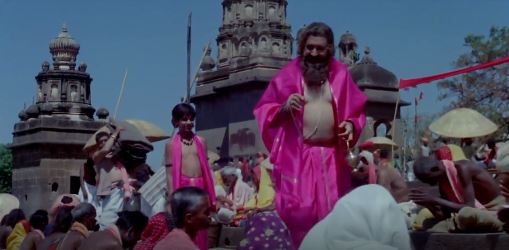
The story, based on Mahashweta Devi’s Laayli Aashmaaner Aaina, begins in Banaras of the 19th century (the riverfront, sadly, looks very mid-20th century). Bhawani Prasad (Jayant), bearded and seemingly benevolent, walks back from the temple after pooja. At his heels follows his grandson Kundan (?). Bhawani Prasad is much venerated, and the way he hands out alms to the poor and blesses those bowing before him, one might be forgiven for thinking him a good man.

Continue reading

Chanda aur Bijli (1969)

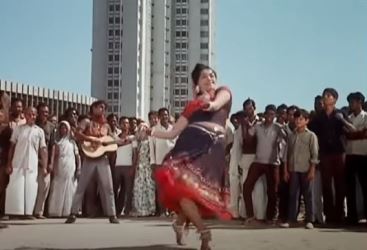
Chanda aur Bijli is one of those films I’ve known about for a long time—because of a family anecdote that is centred around a song from this film. My sister, a toddler when Chanda aur Bijli was released, quickly fell in love with Bijli hoon main toh bijli. Her version of it, though, was somewhat different (and suggests a mind that dwelt rather heavily on food):

Bijli hoon main toh bijli
Bun khaake jab bhi nikli
Logon ke dil mein machhli
(And here she’d add a little line completely off her own bat: ‘Wohi machhli jo Baby ne khaayi thhi!’)

For those who don’t understand Hindi, that means:

Lightning; I am lightning,
When I went out after eating a bun,
There was a fish in people’s hearts
That same fish that Baby ate!

The original, of course, is a rather more predictable Hindi film song:

Bijli hoon main toh bijli
Bal khaake jab bhi nikli
Logon ke dil mein machli

(Lightning; I am lightning,
Every time I went out, tripping along,
I made people’s hearts trip)

Continue reading

Naunihaal (1967)

Hindi cinema has its share of films in which children play an important part. And not just as the childhood version of the adult who plays the lead. Sometimes (Dhool ka Phool, Bandish) as unwanted. More often (Do Kaliyaan, Andaaz, Detective, Ek Hi Raasta, Laajwanti) as the means of bringing together two adults in a romantic relationship, or trying to hinder that relationship.

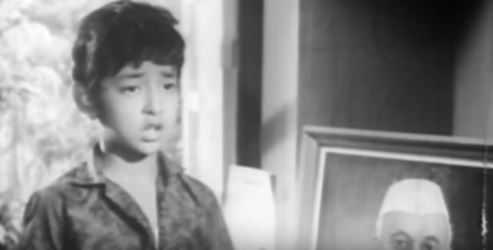
Less often, but I think often with more impact, children play the lead role: the film is about children, and the adults are mostly peripheral. Boot Polish and Diya aur Toofaan fall into this category. As does Naunihaal, about a little boy who sets off to meet Jawaharlal Nehru.

Continue reading

Nishaan (1965)

When I watched the 1949 Nishaan last week on Youtube, the topmost recommendation in the side panel was what was billed as another copy of the same film. Just for the heck of it, I clicked on the link, and arrived at a completely different film: Nishaan, yes; but a Nishaan made 16 years after the 1949 one, and a Nishaan too which is important for one major reason: it marks Sanjeev Kumar’s debut in a lead role (and that too a double role).

Sanjeev Kumar had already played small parts in two films—Hum Hindustani and Aao Pyaar Karein, but this film, with ‘Introducing Sanjeev Kumar’, was his first big role(s). He didn’t soar to success immediately, and most of his films over the next couple of years were fairly forgettable (as Nishaan is, to some extent). But despite the general unimpressiveness of this film, what stands out is the very natural acting of its leading man.

Continue reading

Baadal (1966)

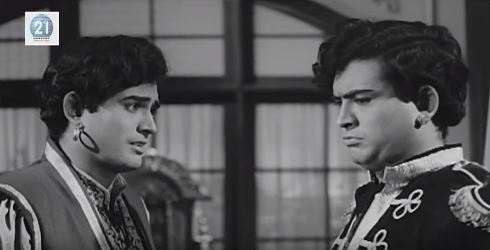
The Three Musketeers meets Hamlet meets Azaad meets general swashbuckling mayhem.

I will admit I watched this film mainly for two reasons: for Sanjeev Kumar, who is deliciously handsome in his early roles; and for the song Nain bedaardi chhalia ke sang lad gaye, which is total eye candy. [I am shallow, that way].

But then, ten minutes into the film, I sat up and began getting my hopes up. Because this was taking the route of one of those classic novels that I’ve always wished Hindi cinema had adapted for the screen: Dumas’s The Three Musketeers.

Continue reading

Dastak (1970)

In Rajinder Singh Bedi’s Dastak, there is a scene well into the film which offers a glimpse of both what this film is about and what its tone is like, how it conveys its messages.

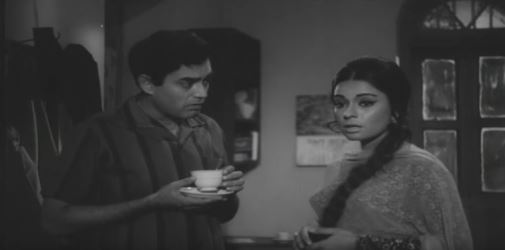
Hamid Ahmed (Sanjeev Kumar) is about to leave home for office. His wife Salma (Rehana Sultan) brings him a cup of tea. In a large cage that sits in their room is a mynah which has been mimicking Salma’s voice so perfectly that Hamid has mistaken something it’s said for his wife’s words. Salma, smiling mischievously, points out his error and tells Hamid about a so-called brother of hers from her village.

Salma: ‘… woh kaha karte thhe, “Pinjre mein panchhi ko band karne se bada paap lagta hai”.’ (He used to say, ‘It is a great sin to imprison a bird in a cage.’)
Hamid (smiling): ‘Chhod dene se bhi toh lagta hai.’ (‘Releasing it too can be a sin.’)
Salma: ‘Woh kaise?’ (‘How is that?’)
Hamid: ‘Baahar sainkaron baaz, shikre… koi bhi khaa jaaye.’ (‘There are so many birds of prey outside. Any of them might eat this one up.’)

Continue reading

Priya (1970)

This week’s film came about after several false starts. A new blog reader and I have been waxing eloquent about our shared love for Sanjeev Kumar, not just one of Hindi cinema’s finest actors, but also, in his younger days (as far as I am concerned), also exceptionally dishy. After some false starts—Husn aur Ishq, Gunehgaar, Insaan aur Shaitaan—I ended up watching Priya, one of several films in which Sanjeev Kumar co-starred with Tanuja.

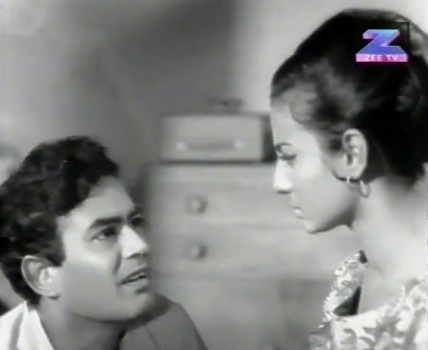
Sanjeev Kumar and Tanuja in Priya

Continue reading