Ekti Raat (1956)

This, actually, was not the film review I was intending to post this week. But then, over the weekend gone by, I met Moon Moon Sen, and I was reminded (of course I would be!) of her mother, Suchitra Sen.

I was in Dehradun on October 11 and 12, attending an arts and literature festival. The guest of honour was Moon Moon Sen, still beautiful, and with a serene calmness to her that was—as someone mentioned—very ‘peaceful’ (to which Ms Sen replied that she has a horrible temper!) Moon Moon Sen was mostly involved in graciously felicitating those who participated in panel discussions and so on; I was thrilled to have her place a scarf around my neck. But the last session of the festival was a conversation with her, and it was very interesting. She answered questions about herself, of course, but also about her mother (“always, ‘Madam’, never ‘Mrs Sen’ or ‘Suchitra’” she recalled). Not just a star, but a mother (“I only knew her as Mummy”), and one whom young Moon Moon was obviously very protective about: she said she shielded her mother when Suchitra Sen had to make her way through a crowd. She had no qualms even about punching anyone who tried to get fresh with her Mummy.

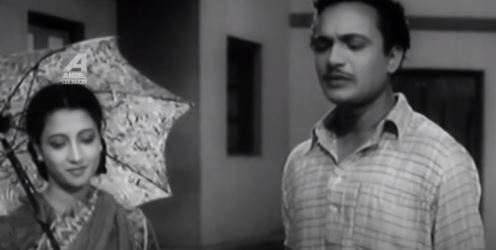
I remembered, then, that I had a Suchitra Sen film review ready to be published. Here it is, a light-hearted comedy, directed by Chitta Bose, based on a story by Balaichand Mukherjee ‘Banaphool’ and with a screenplay by Nipendrakrishna Chatterjee.

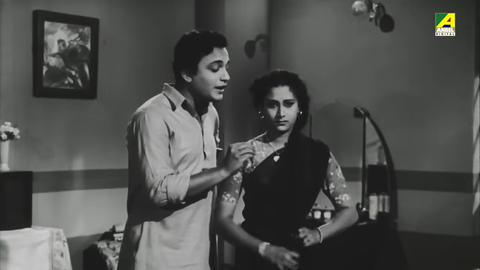
The story begins in the Calcutta home of Shushubhon Dutta (Uttam Kumar) and his wife Anita (Sabita Chatterjee), who have been married a few months. The two are constantly bickering, and we see them in the middle of an argument even as the film starts. Anita is hot-tempered, Shushubhon likes to needle her.
Continue reading

Deya Neya (1963)

In English, ‘Give and Take’.

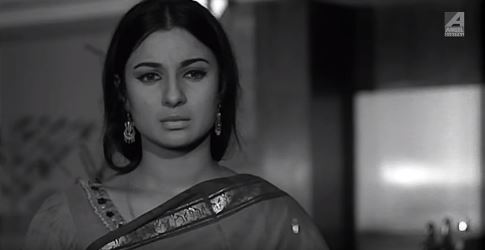
I read a review of this Uttam Kumar-Tanuja starrer many years ago, and, ever since, I’ve been wanting to watch Deya Neya. All this time, I had never been able to get a subtitled version of it, but now there’s one (thank you, Angel), and I wasted no time in watching it.

The story begins in Lucknow, where Proshanto Roy (Uttam Kumar) lives with his parents: his very successful and wealthy industrialist father BK Roy (Kamal Mitra) and doting mother (Chhaya Devi). Mr Roy has Proshanto working at the office, doing accounts; but Proshanto is never to be found at work, and it riles his father up no end.

Continue reading

Thana Theke Aschi (1965)

When I reviewed An Inspector Calls a couple of weeks back, blog reader AS, in a comment, mentioned that a Bengali version of the film (or rather of the play by JB Priestly, on which it was based) was also made, starring Uttam Kumar: Thana Theke Aschi. This was a film that had been recommended to me earlier as well, so I had it bookmarked; but I hadn’t known it was a version of An Inspector Calls.

Now, fresh from my viewing of (and gushing over) An Inspector Calls, I decided I had to watch Thana Theke Aschi while the story was still fresh in my mind.

The story begins with a brief glimpse of a faceless woman, lying dead on the floor of a dingy little hut, an empty bottle of carbolic acid near her hand. The corpse is found by another woman, who starts to scream.

The scene then shifts to the home of the wealthy Chandramadhav Sen (Kamal Mitra), where an engagement party is in full swing. Mr Sen’s daughter Sheila (Anjana Bhowmick) has just gotten betrothed to Amiya (?), the son of one of Mr Sen’s business associates. It’s a grand party, and once it’s over, Amiya stays on, chatting with the Sens.

Continue reading

Regional Star, Hindi Also-Ran: Ten Actors, Ten Songs

(With much thanks to blog reader Dr TN Subramaniam, who suggested the theme for this post, and who also supplied the first three examples of the actors that appear on this list).

I did not watch too many regional Indian films until fairly recently. True, Doordarshan did show regional cinema back when I was a child, but I was never tempted to watch (now that I think about it, I’m not even sure those films were subtitled). But in recent years, ever since I began to make a concerted effort to watch more non-Hindi films, I’ve been struck by the gap between regional cinema and Hindi cinema. A gap in many ways. For one, in the types of films made; in the production values; in the standard of acting and directing (note: I do not at all think that Bombay’s Hindi film industry outdid its regional counterparts in these areas. In a lot of cases, it was the opposite: regional cinema turned out a lot of films that were more original and generally of a higher standard than Hindi cinema, enough for Hindi remakes to be churned out).

And then there were the people who acted in these films. On the one hand, there were the many actors who confined themselves to the cinema of the region they belonged to. These were the majority, some of them even very fine, well-respected actors (think Tulsi Chakraborty, for instance) who were never seen in Hindi cinema. On the other hand, there were actors, big stars of regional cinema, who were also fairly successful in Hindi cinema. Bengalis like Suchitra Sen and Utpal Dutt; stars of Tamil, Telugu, Malayalam and Kannada cinema like Padmini, Vyjyanthimala, and Waheeda Rehman: stars in their own regions, and stars familiar to Hindi filmgoers as well.

But there were some regional stars who, for some reason or the other, never could make it big in Hindi cinema. Perhaps they never felt the need to pursue a career in Hindi cinema (Soumitra Chatterjee, I know, was one of these), and never had the time; perhaps they could not be bothered with the language skills needed (though I can think of several people who did make names for themselves in Hindi cinema without being too good at Hindi). Perhaps they just didn’t have what it took to make them popular with a Hindi-speaking audience. Perhaps they were pure unlucky.

B Saroja Devi
Continue reading

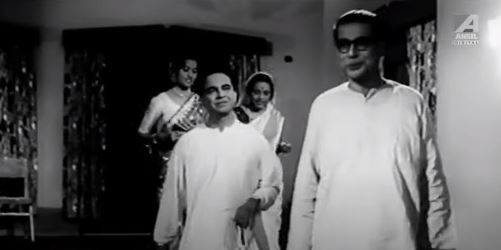
Shaarey Chuattar (1953)

Bengali cinema is one of the few regional language cinema industries for which it’s relatively easy to find subtitled copies. Even when the film in question is an old one.

Over the years, several Bengali readers have recommended Shaarey Chuattar to me. I had been under the impression that I should watch this film for the Uttam Kumar-Suchitra Sen pairing (it was the their first film together, the first of many films in which they were co-stars). But, now that I’ve seen it, I can safely say that this is a film you should watch not for these two, but for the film itself. True, Suchitra Sen and Uttam Kumar provide some eye candy and are a likable romantic couple, but the romance in Shaarey Chuattar is not the main thing.

Continue reading

Rajkumari (1970)

Here is the answer to the question I set a couple of days back. What do Aapke kamre mein koi rehta hai, Yeh jawaani hai deewaani, Pyaar deewaana hota hai and Yeh kya hua have in common, I had asked (besides the obvious: that Kishore had sung all four, and RD Burman had composed all four). Some people got the answer correct, and some came close to guessing. Yes, these songs were all copied by Burman from tunes he had composed for one film. That was a Bengali film named Rajkumari, released in 1970.

Rajkumari, starring Tanuja as the eponymous princess, is a film I came across thanks to friend and erstwhile fellow blogger, Harvey. Some weeks back, Harvey shared a link to one of the songs of Rajkumari (more about these songs, later). I liked it so much that I made up my mind I had to see it. And it turned out to be quite entertaining.

Continue reading

Jhinder Bondi (1961)

Considering I’ve recently reviewed two Hindi swashbucklers (Baadal and Baadal), both obviously—in one case even with credit accorded—inspired by European sources, I thought it appropriate to continue in the genre for another film. Also a swashbuckler, also inspired by a work from European literature. The Bengali film Jhinder Bondi (‘The Prisoner of Jhind’), based on Anthony Hope’s classic The Prisoner of Zenda (and the novel which Saradindu Bandyopadhyay—of Byomkesh  Bakshi fame—based on The Prisoner of Zenda).

Continue reading

Sagarika (1956)

Every now and then, when I’ve reviewed a Hindi film (Mamta, Sahib Bibi aur Ghulam, Kabuliwaalah, Khamoshi) or even mentioned one (Devdas, Chori Chori), someone or the other has popped up and either informed me (or reminded me) that this film was originally made in Bengali.

It was a little different with Sagarika. This film nobody told me about. I happened to be trawling IMDB checking out the synopses of all of Suchitra Sen and Uttam Kumar’s films, and realized—even as I read the plot of Sagarika—that this was exactly the same story as one of my favourite Hindi films, Bimal Roy’s lovely Prem Patra. Could I resist the temptation to watch it? No.

Uttam Kumar and Suchitra Sen in Sagarika Continue reading

Chaowa-Pawa (1959)

Serendipity: noun. plural: serendipities. The faculty of making fortunate discoveries by accident; the occurrence of such a discovery. Coined by Horace Walpole in 1754, based on a fairy tale called The Three Princes of Serendib (‘Serendib’ being present-day Sri Lanka)—the three princes in question often making such lucky discoveries.

And what does this have to do with Chaowa-Pawa (‘To Want and To Have’)? Simply that, while I had set about watching this film because I really, really like the lead pair—Uttam Kumar and Suchitra Sen—I realized, within the first half hour of the film, that it was a remake of one of my favourite old Hindi films, Chori-Chori (which, as many of you would know, was a remake of It Happened One Night). Serendipity? Absolutely.

Uttam Kumar and Suchitra Sen in Chaowa-Pawa

Continue reading

Chiriakhana (1967)

Sharmi has been reviewing one brilliant Bengali film after the other over at her blog. I ended up begging her to slow down, because I can’t possibly keep pace when it comes to obtaining—with subtitles, mind you—and watching so many great films. So what do I do? I watch and review a Bengali film of my own.

Chiriakhana (‘The Zoo’) is based on the famous crime novel of the same name by Saradindu Bandopadhyay. It features the detective Byomkesh Bakshi (which those of you who watched Doordarshan during the early 1990’s might remember from the superb TV series starring Rajit Kapur). The film was directed by Satyajit Ray, and though most feel that this is Ray’s worst film, it isn’t as bad as all that. It even won Ray a Golden Lotus at the National Film Awards.

Continue reading