Mera Gaon Mera Desh (1971)

This blog focuses almost exclusively on films from before the 1970s. Very occasionally, though, I make exceptions. For films that are pretty much on the cusp, and which evoke more a sense of 60s cinema than 70s, which were made mostly during the 60s (or even earlier, as in the case of Pakeezah) but were released only later, but basically for films that, when I watch them, seem as if they were made in the 60s. Because of the people who star in them, because of the costumes, the songs, the feel of them.

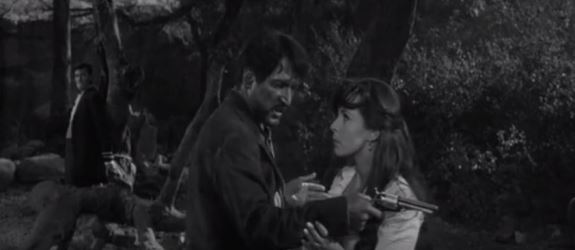
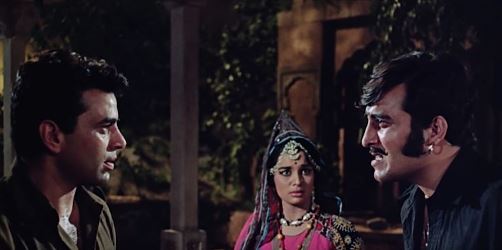
When Vinod Khanna passed away last week, I wanted very much to review one of his films as a way of paying tribute. There are a couple of 60s’ films of Vinod Khanna’s that I’ve seen—the forgettable Man ka Meet, for instance—but I settled on a rewatch of Mera Gaon Mera Desh, not just because it features Vinod Khanna in one of his most memorable outings as a villain, but also because it is an interesting example of a film that may have only been moderately successful, but is the very obvious inspiration for one of the biggest hits ever in the history of Hindi cinema: Sholay.

Vinod Khanna, Asha Parekh and Dharmendra in Mera Gaon Mera Desh

Continue reading

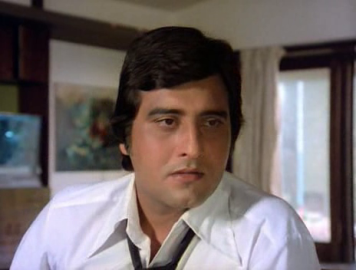
In Tribute: Vinod Khanna (1946-2017)

This post may come as a surprise to those who are familiar with my blog, and with its chronological area of interest: Vinod Khanna, after all, debuted in a film that released in 1969, and this blog focuses on cinema from before the 1970s. His was not even, unlike Rajesh Khanna, a meteoric rise that saw one blockbuster hit after the other. No; Vinod Khanna’s star ascended relatively slowly, and he came into his own only a few years down the line. Well into the 70s, in fact.

But how could I not pay tribute to the one actor who really defines the 70s for me? Even though I most like the cinema of the 50s and 60s, the 70s too had some fine films, some fine film makers. Chupke-Chupke, Sholay, Golmaal, Blackmail, Manchali. Inkaar, Gaddaar, Amar Akbar Anthony. The Burning Train, Lahu ke Do Rang… and there was Vinod Khanna, my favourite actor of that decade.

Continue reading

Naukri (1954)

I have a confession to make: I am not especially fond of Kishore Kumar as an actor. He’s a brilliant singer, and he can be pretty funny in films like Chalti ka Naam Gaadi or Pyaar Kiye Jaa or Padosan—but that, as far as I am concerned, is about it. Asha, Rangoli, Naughty Boy, Half Ticket, Jhumroo, Ek Raaz, Naya Andaaz, Bandi, Manmauji: I have lost count of the number of films I’ve seen because of good songs, or a cast that appeals to me, but have ended up regretting because Kishore Kumar’s antics were so very over the top as to be unfunny.

But then there are films like New Delhi and Naukri, where there isn’t a concerted effort to make Kishore’s a comic character. Films about young men who are like most other young men: trying to go from being boys to men, facing trials and tribulations, trying to laugh through them when they can, caving in occasionally. Not heroes, not comedians, just normal men.

Continue reading

Brilliantovaya Ruka (1969)

Some of my favourite films are those that cleverly combine crime with humour. Hitchcock’s The Trouble with Harry, for instance, a witty story about a man whom everybody seems to have been wanting to get rid of. Or—one of my favourite films, regardless of time and language and genre—I Soliti Ignoti, about a bunch of horribly inept thieves. Charade, How to Steal a Million… and, the latest to join the ranks, the Russian film Brilliantovaya Ruka (The Diamond Arm), which is about a man with an arm wrapped about with diamonds. And other gemstones, and gold.

This work calls itself a ‘screen novel’ and consists, as do so many novels, of not just the main body of the novel, but a prologue and an epilogue as well.

The prologue is a brief one. In a narrow street in Istanbul, two dodgy-looking guys stand in the doorway of an apothecary, and hand over a cane with an ornate handle to a man in a car. This man we see next sitting down in a public area, placing the cane carefully beside him—from where it is swiftly and surreptitiously switched for a replica by another, who rushes off with it.

A valuable cane changes hands

Continue reading

Ten of my favourite ‘not-quite-duet’ songs

Sometime back, blog reader Anup remarked that some songs had a major singer not really doing much singing. Duets, he pointed out, where one singer does almost all the singing, while the other one just does a supportive ‘la-la-la-la’, or something along those lines. Anup suggested I compile a song list of duets like that. Of what I call ‘technically duets’: not songs in which both singers play an equal part in making the song what it is, but in which the ratio is somewhat skewed.

Then, only about a week after Anup made this suggestion, yet another blog reader, Bhagwan Thavrani, sent me an e-mail with pretty much the same suggestion. He was rather more precise: songs in which one singer only hummed, while the other did the singing.

Two readers, both requesting songs of the same basic type? I decided I had to take up the challenge. Especially as, offhand, I couldn’t think of many songs that would fit the bill. This would require a good deal of research, and a lot of listening to songs. I decided, however, to make this a little more wide-ranging: not necessarily one singer humming, but definitely one singer dominating the song.

Continue reading

Under Capricorn (1949)

Alfred Hitchcock is, for me, the cinematic equivalent of writers like PG Wodehouse or Georgette Heyer or Agatha Christie: I see their names on a work, and I know that this is something I can read (or watch, in Hitchcock’s case) and almost certainly not end up finding it a waste of time. The other day, trawling Youtube for something to watch, I came across Under Capricorn. I had heard of this one before, but besides being aware that it had been directed by Hitchcock, I knew nothing of the film. A good opportunity to watch a Hitch film I hadn’t seen.

This story begins in an unusual location (for Hollywood, that is): below the Tropic of Capricorn, in Australia. Set in 1831, Under Capricorn begins one day in Sydney, where the new Governor (Cecil Parker) of New South Wales, having just arrived on the continent from Ireland, is addressing the people. His welcome, while all gleaming brass and starched uniforms on the official side, is lukewarm when it comes to the general public. They aren’t especially impressed.

Continue reading

Afrita Hanem (1949)

Aka Little Miss Devil.

This is a first for my blog: an Egyptian film. I have known about classic Egyptian cinema for a while now (the very first recommendation that came my way was from fellow blogger Richard, who had written this interesting post on an early Omar Sharif film)—but it’s taken me a while to get around to watching anything Egyptian. I haven’t yet got around to watching Seraa Fil Nil, but Afrita Hanem, a frothy musical about a female genie who pops into the life of a down-on-his-luck singer is probably a good introduction to Egyptian cinema, for one who’s been pretty much brought up on Hindi cinema.

Continue reading

Dastak (1970)

In Rajinder Singh Bedi’s Dastak, there is a scene well into the film which offers a glimpse of both what this film is about and what its tone is like, how it conveys its messages.

Hamid Ahmed (Sanjeev Kumar) is about to leave home for office. His wife Salma (Rehana Sultan) brings him a cup of tea. In a large cage that sits in their room is a mynah which has been mimicking Salma’s voice so perfectly that Hamid has mistaken something it’s said for his wife’s words. Salma, smiling mischievously, points out his error and tells Hamid about a so-called brother of hers from her village.

Salma: ‘… woh kaha karte thhe, “Pinjre mein panchhi ko band karne se bada paap lagta hai”.’ (He used to say, ‘It is a great sin to imprison a bird in a cage.’)
Hamid (smiling): ‘Chhod dene se bhi toh lagta hai.’ (‘Releasing it too can be a sin.’)
Salma: ‘Woh kaise?’ (‘How is that?’)
Hamid: ‘Baahar sainkaron baaz, shikre… koi bhi khaa jaaye.’ (‘There are so many birds of prey outside. Any of them might eat this one up.’)

Continue reading

Guest Post: Rajinder Singh Bedi – My Uncle as I remember him

It is sad that among the people responsible for making cinema what it is, the spotlight is invariably only on the ones whom the audience sees and hears. Actors, singers. Composers and directors, by dint of their work being most visible (or audible). We know these, we are familiar with them. We watch films for them. But how often do we stop to think who wrote the story for a film? Who wrote this dialogue that we have exulted over, who wrote this screenplay that fits so perfectly?

Rajinder Singh Bedi, the man who wrote the dialogues for so many of Hrishikesh Mukherjee’s films—from Mem-Didi to the hilarious Biwi aur Makaan, from the sensitive Anupama to Satyakam, is perhaps one of the exceptions. Not because people pay attention to who wrote the dialogues for a film (or even the story), but because his name is known as that of a literary stalwart. The man who wrote Ek Chaadar Maili Si; a winner of the Sahitya Akademi Award, the Ghalib Award, and the Padmashri. The director (and writer) of Dastak. The man on whose death Pakistani President Zia-ul-Haq offered condolences, saying that it was a loss not just for India, but for Pakistan as well.

Some days back, Nischint ‘Nishi’, who is Mr Bedi’s niece (his younger brother’s daughter) left a comment on my blog about her illustrious uncle. Me, being what I am (always eager to know more about the cinema of yesteryears) asked if she would be kind enough to write a guest post for this blog. She agreed. Click this link: Rajinder Singh Bedi – Biography to read a brief biography that she provided for her uncle, and read on for a heart-warming little insight into the man Rajinder Singh Bedi was.

Over to Nishi:

Continue reading

Ten of my favourite songs featuring colours

Happy Holi!


I don’t celebrate Holi—ever since I was a little girl, I’ve had a horror of being wet and dirty, and come Holi, I used to insist on locking myself in. I was in good company; though my father was obliged to go and play Holi with his colleagues, Mummy and my sister were as intent on staying clean as I was. Come Holi, we’d happily feast on gujiyas and whatever other goodies came our way, but pichkaris, gulaal, and the rest? No, thank you.

Not so with Hindi cinema, where Holi has been a big thing all along: the perfect situation for displays of affection, camaraderie, general love towards one and all. And I don’t think I have ever seen Holi depicted in a film without there being an accompanying song. That was what I’d first thought I’d do to mark Holi on this blog: a post of Holi songs. Then, looking back at the number of non-Holi songs that are about colours, I thought, Let’s give it a twist. Let’s talk about blue and pink and green and yellow. Let’s talk sky and trees and eyes and whatnot. Neeli aankhein, peeli sarson. Hariyali aur raasta.

Continue reading