Mohabbat Isko Kehte Hain (1965)

A little less than a week ago, on December 4, I received news that a very dear aunt had passed away. My parents, my sister and I made arrangements to travel to Kolkata for the funeral, the next day. Early in the morning, just as I was about to leave for the airport, the newspaper was delivered, and one headline sprang out at me: Shashi Kapoor had passed away, too. On the very same day as my aunt.

I suppose if Shashi Kapoor had passed away on any other day, on a day when I was not quite so swamped in sorrow of my own, I would have posted a tribute to him earlier. Later, I thought. When I am a little less distraught. My father, reading the newspaper, remarked that he and Shashi Kapoor had been born in the same year, just 6 months apart (my father in September 1938, Shashi in March 1938). My mother, looking at a lovely photo of a smiling and very handsome young Shashi, remarked that he looked uncannily like a cousin of mine (which I have to agree with; I have thought so many times). In our own ways, all of us remembered Shashi Kapoor.

Continue reading

The Secret of Santa Vittoria (1969)

I have said, time and again, that I have a lot to be grateful for to the readers of this blog. Not only do all of you keep me going by reading my posts, commenting on them and discussing them (even going off on tangents!), you also educate me, enlighten me, entertain me—and, importantly, give me recommendations now and then.

Especially over the past few months, I have seen several memorable (and, at least to me, obscure) films that came to my notice simply because readers recommended them to me. The Outrage was recommended by Hurdy Gurdy Man; Neeru told me about Leave Her to Heaven; and CP Rajagopalan mentioned The Secret of Santa Vittoria. Not once, but in two separate comments, which prompted me to hurry up and watch it. And yes, what a film this turned out to be.

The eponymous Santa Vittoria is a small town in Italy where the story opens just before dawn sometime near the end of World War II. The earnest and excited Fabio (Giancarlo Giannini) comes racing to the church, waking up the priest and insisting on ringing the church bells, because there’s such momentous news… when the dazed, sleepy and generally stoic-looking residents of Santa Vittoria gather around in the square, Fabio shares his news: Mussolini is gone.  Fascism has ended!

Continue reading

Do Behnen (1959)

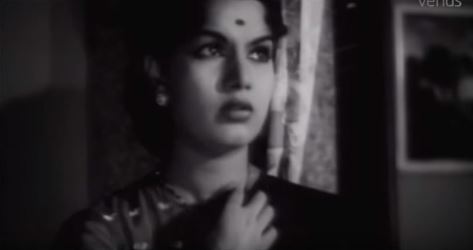
RIP, Shyama.

Yes, Shyama, of the dancing eyes and the gorgeous smile, passed away almost a week ago, on November 14, 2017. I could not possibly let the death of one of my favourite actresses go unmentioned on this blog, but I’d already done, some years back, a post of my favourite Shyama songs. A film review, therefore, seemed in order. But which one?

Continue reading

Rajkumari (1970)

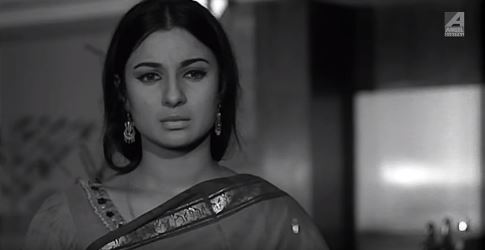
Here is the answer to the question I set a couple of days back. What do Aapke kamre mein koi rehta hai, Yeh jawaani hai deewaani, Pyaar deewaana hota hai and Yeh kya hua have in common, I had asked (besides the obvious: that Kishore had sung all four, and RD Burman had composed all four). Some people got the answer correct, and some came close to guessing. Yes, these songs were all copied by Burman from tunes he had composed for one film. That was a Bengali film named Rajkumari, released in 1970.

Rajkumari, starring Tanuja as the eponymous princess, is a film I came across thanks to friend and erstwhile fellow blogger, Harvey. Some weeks back, Harvey shared a link to one of the songs of Rajkumari (more about these songs, later). I liked it so much that I made up my mind I had to see it. And it turned out to be quite entertaining.

Continue reading

Shart (1969)

Some weeks back, I and a blog reader were reminiscing about the good old days of Doordarshan, and ended up agreeing that Doordarshan and its penchant for old Hindi cinema had an important part to play in our love for this period of cinema. For me, at least, Doordarshan was the introduction to the cinema of the 50s and 60s: by the time I was old enough to be able to really make sense of cinema, my father had been posted to Srinagar, and the sole movie hall there was too dangerous to visit: it stood in Laal Chowk, in the heart of town, where every other day there was violence of some sort or the other.

So we stayed at home and watched just about everything Doordarshan cared to show. And a lot of it was old cinema.

Shart was one of those films I first began watching on Doordarshan. Barely a few minutes into the film, the electricity went kaput, but by then something sufficiently intriguing had happened for me to want to watch it again. I remember waiting for years before this film appeared again—this time on one of those many channels that had emerged sometime during the early 90s.

I liked the film back then, but over the years I’d forgotten much of it. Time for a rewatch, I decided, if only to see whether it merited a rewatch.

Shart is aptly named, because it centres around Raj (Sanjay Khan), who is always eager to bet on just about anything. He goes about with a bunch of friends, one of whom, Kailash, is always on the lookout for opportunities to have a wager with Raj [Kailash keeps losing, so I cannot see why he continues to bet]. For instance, when the film starts, Kailash bets that Raj won’t be able to walk up to a passing girl and hug her without getting slapped in return.

Continue reading

Suspicion (1941)

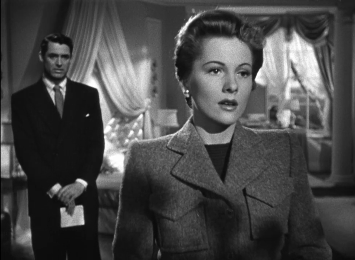
Just a little over a week back, I was paying tribute to a cinema personality who played a major role in defining Hindi film music in the 1950s and 60s: Roshan. 1917 was the year Roshan was born, and in the same year, also in Asia (in Tokyo), a few months later, was born a girl who was to go on to become one of the most prominent stars of British cinema as well as Hollywood. Joan Fontaine, award-winning actress, sister to Olivia de Havilland, licensed pilot, Cordon Bleu chef, rider, champion balloonist, licensed interior designer—and scorer of 160 on an infant IQ test.

Most importantly, though, a fine very actress, and one who starred in some memorable films, in memorable roles: Rebecca, Suspicion, Jane Eyre, Ivanhoe, This Above All… her characters were often, in keeping with Ms Fontaine’s features, women of genteel fragility. Sometimes, that fragility teetered over the edge into terror (Mrs de Winter’s character in Rebecca is a fine example of this) before pulling herself together and showing the steel in her.

Rebecca I have already reviewed on this blog, but to celebrate the 100th birth anniversary of an actress I have liked since I was quite young, I decided to review another Joan Fontaine film directed by Alfred Hitchcock. Like Rebecca, this one too is about a naïve young woman who ends up married to a man who is perhaps not all he had seemed to be at first glance. Joan Fontaine’s portrayal of Lina McLaidlaw won her her only Academy Award for Best Actress.

Continue reading

Ten of my favourite Roshan songs

Sometime last month, I discovered that one of my favourite music directors would have celebrated his birthday centenary this year. Born Roshanlal Nagrath on July 14, 1917, in Gujranwala (now in Pakistan), Roshan played the esraj for All India Radio, Delhi for about 10 years (during which he also composed music for various programmes) before moving to Bombay to try his luck in the world of cinema. Roshan’s career as a music director took off fairly soon afterwards, with the resounding success of the score of Baawre Nain (1950); he went on to compose music for over 50 films until his death in 1967.

Continue reading

Chakrapani (1954)

Every few months, I go on a rampage, looking for old regional language films with English subtitles.

One of the saddest facts I’ve realized over the past few years—since I became interested in films in languages other than Hindi and English—is that while a considerable number of good foreign language films can be found with subtitles, the same cannot be said for Indian cinema. More modern films can be found subbed (though the quality of subbing is often questionable); but old cinema? Not much hope. About the only Indian language, other than Hindi, for which I have often been able to find English-subbed films, is Bengali. Perhaps the fact that stalwarts like Satyajit Ray and Ritwik Ghatak are so popular outside India has had a ripple effect on films by other directors of the same era as well.

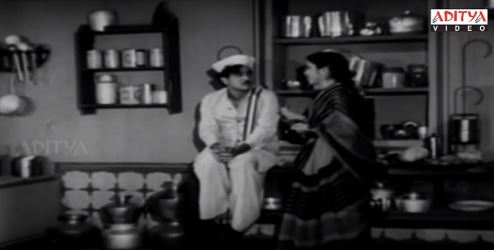
Anyway, without further ado: my latest find. A few weeks back, trawling Youtube for subbed films, I came across the Telugu comedy Chakrapani. I’d never heard of this before, but comedy is a genre I am always eager to dive into (perhaps because Hindi cinema itself was so short of outright comedies?). And guess what? This was quite an entertainer.

Continue reading

Ten of my favourite come-hither songs

… sung to a single person, not an audience.

Let me explain that a bit.

Hindi cinema, especially in the glamorous and colourful world of the 60s, is full of songs inviting love (or lust, or whatever interpretation one might want to put on it). Whether it’s a Helen with bizarre eye makeup singing Aa jaan-e-jaan to a caged lover in a floor show or a floral-shirted Joy Mukherji openly serenading Asha Parekh in a Tokyo party, there’s a good bit of sizzle, lots of “Come on and give us some love”.

Continue reading

Hatim Tai (1956)

RIP, Shakila.

Yes, this post is a little late as a tribute to one of Hindi cinema’s loveliest actresses—Shakila passed away, aged 82, on September 21—but that was because I was travelling. I heard the news, was saddened and upset, and vowed that as soon as I got back, I’d post something about Shakila. Not a songs list, because I’d already done that. A review of one of her more popular films, then, I decided.

Continue reading