When friend and fellow blogger Harini reviewed The One and Lonely Kidar Sharma: An Anecdotal Autobiography on her blog, I was intrigued enough to express an interest in reading the book—and Harini was kind enough to lend it to me.
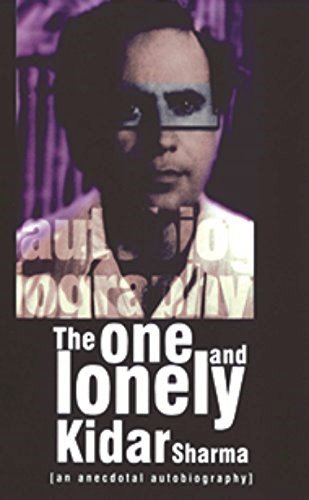

When friend and fellow blogger Harini reviewed The One and Lonely Kidar Sharma: An Anecdotal Autobiography on her blog, I was intrigued enough to express an interest in reading the book—and Harini was kind enough to lend it to me.
RIP, Neil Simon.
I read about the death of Neil Simon, playwright and scriptwriter (among other roles—including producer and director) on August 26th, admittedly with some level of blankness. The name sounded familiar (or was I simply mixing him up with Neil Diamond?) but I couldn’t, without help, associate Neil Simon with any film.

Or, in English, The Baker’s Wife.
Recently, across a period of about three months, I’ve had to watch a slew of films from across the world (for an article I needed to research). While making my way through films from the US, Brazil, Spain, France, Mexico, Japan, China, Taiwan, Vietnam… and of course, closer home, Hindi cinema—it came home to me rather forcibly just how much of a gap there often is (and has been, for many years) between Hollywood and much of the rest of the world.
The Hays Code, applied to Hollywood productions between 1930 and 1968, imposed restrictions on the scenes shown—the sex, the violence, etc—as well as the language, the themes, the messages and more. But even later, after the Hays Code was no longer applicable, I’ve realized how much more tame Hollywood is when compared to other cinema (for instance, from France, Spain, or Mexico, to name just three countries, recently-watched films of which were far removed from what Hollywood would make). Hollywood’s risqué is often tame for Europe. (And Indian cinema, across regions, seems to faithfully follow Hollywood in this matter, though it’s much tamer even than Hollywood).
Anyway, on to one of the films that highlighted this point for me. La Femme du Boulanger is a French film about a middle-aged baker who sets up a bakery and patisserie in a sleepy village in the French countryside, along with his pretty wife to help him out—and within a couple of days, the wife has run off with a local buck. In Hollywood, this would have been probably treated quite seriously; in France, it becomes more a comedy than anything else. All anybody is really worried about is that their baker has gone off his desire to bake, so they’re not getting bread any more…

In the nearly ten years this blog has been in existence, I’ve reviewed hundreds of films. Including many, many Hindi films. Some have been big hits, others so obscure that even fairly faithful followers of my blog, seeing the name of the film in their RSS feed, have probably decided my review didn’t even merit a visit.
But there are also the (to some) glaring omissions. Every now and then, someone wonders why I’ve never got around to reviewing some of the most iconic Hindi films of the pre-70s period. Mother India. Guide. Pyaasa. Devdas. To them I say that I fear I will not have anything to say that somebody or the other hasn’t already said, and probably in a far better and more informed way than I could.
Among the films about which I’m asked, again and again, is Mughal-e-Azam.
This one is a somewhat more puzzling omission from my list of reviews, given that I am deeply interested in Mughal history, I am very fond of Madhubala, and that the film really does have near-cult status. So much so that it was even the first full-length film anywhere in the world to be digitally coloured for a theatrical re-release (in 2004). But what would be the point of me writing about Mughal-e-Azam? Almost anybody who’d be interested enough in the film to read my review of it would almost certainly have already seen the film, and chances are, would know not just the story, but would have decided and definite views about much of the rest of the film, too: the characters, the songs, the dialogue, the historicity (or lack of it).
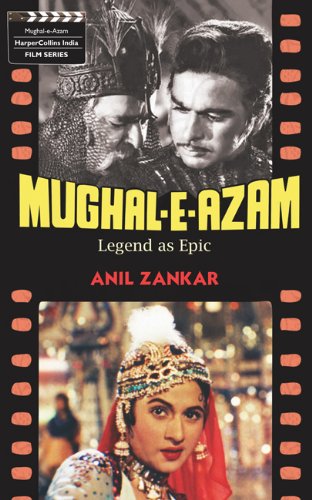
All of this, too, was in my mind when I began reading Anil Zankar’s Mughal-e-Azam: Legend as Epic (Harper Collins Publishers India, 2013; 200 pages; Rs 250). I was intrigued: what would Zankar have to say about a film so well-known?
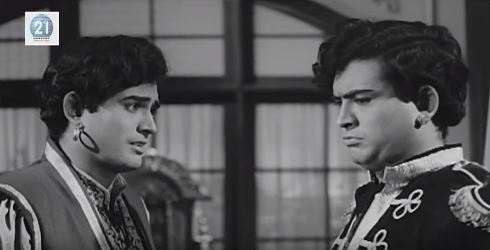
When I watched the 1949 Nishaan last week on Youtube, the topmost recommendation in the side panel was what was billed as another copy of the same film. Just for the heck of it, I clicked on the link, and arrived at a completely different film: Nishaan, yes; but a Nishaan made 16 years after the 1949 one, and a Nishaan too which is important for one major reason: it marks Sanjeev Kumar’s debut in a lead role (and that too a double role).
Sanjeev Kumar had already played small parts in two films—Hum Hindustani and Aao Pyaar Karein, but this film, with ‘Introducing Sanjeev Kumar’, was his first big role(s). He didn’t soar to success immediately, and most of his films over the next couple of years were fairly forgettable (as Nishaan is, to some extent). But despite the general unimpressiveness of this film, what stands out is the very natural acting of its leading man.
I came to this film by way of a song (that happens with unsettling frequency to me).
Five years ago, when Shamshad Begum passed away and I was researching a song list featuring her voice, I came across Jaiyo jaiyo sipahiya bazaar, and was blown away. Not just by Shamshad Begum’s ability to sing in multiple languages, but by the general appearance of the song. There was apparently something fun going on here. So I made a mental note that if I came across Nishaan on Youtube, I’d watch it.
Well, I did. And, in a refreshing change from a lot of those films I’ve seen because of songs, this one turned out to be pretty good. It’s a classic raja-rani film, with feuding families, a really black-hearted villain, twin brothers as heroes, and an enterprising heroine.

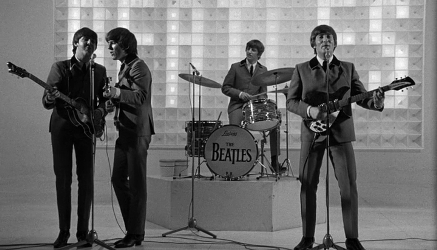
Blog reader Hurdy Gurdy Man gave me a slew of Beatles-related information some weeks back. More specifically, information related to a film—A Hard Day’s Night—which starred the Beatles and was about them. Not a bio-pic, not a completely fictitious story (as many of Elvis’s films were, with him playing characters in no way related to his real self). But something in between. Fact and fiction.
Hurdy Gurdy Man informed me that the Beatles’ album A Hard Day’s Night had released in the UK on July 10th, 1964. Just four days earlier, on July 6th, 1964, the film of the same name had also been released in the UK (it was released in August in the US). Also, other than Paul McCartney (whose 76th birthday was on June 18th), the only other surviving Beatle—Ringo Starr—has his birthday today.
In celebration, therefore, a review of this very watchable little film about four wildly successful young men who—in the course of a mere decade (they teamed up as a quartet in 1960, and fell apart in 1970)—changed the way pop music sounded and was perceived. The legendary Beatles, acting as themselves, in a film about themselves.
The monsoon has arrived here, in Delhi and around. We’d had a parched and hellish June, the heat seeming to grow more unbearable—and then, suddenly, one morning we woke to an overcast sky. Grey clouds looming, and soon, rain. Except in my childhood (when I remember going out in the rain to play, with the express purpose of getting thoroughly soaked), I’ve never really liked getting wet in the rain. Come the monsoon, I don’t venture out without an umbrella. In our car, we always have an umbrella or two to spare (our latest acquisition in that department is a golf umbrella, large enough to accommodate two adults). If I should by some chance get caught in the rain—a rare chance, indeed, given the precautions I take—I will bolt for the nearest shelter, even if it consists of six inches of overhang.
The last thing that occurs to me is to sing.
Not so in Hindi cinema, where getting wet (almost always in pouring, roaring thunderstorms that come out of a clear blue sky) is invariably a precursor to bursting into song. For various reasons.
This wasn’t the film I’d been meaning to watch last weekend. That was the Humphrey Bogart-starrer, The Treasure of the Sierra Madre. But ten minutes into that, and I realized my mind was wandering. It’s probably a good film (it won several Oscars), but right then, I wasn’t in the mood to watch it. So I scrolled through my list of bookmarked videos, and came across a Cary Grant film, People Will Talk.
Cary Grant, I will have you know, is one of those rare actors for whom I will watch any film (and I have watched some less-than-enjoyable ones, simply because he happened to star in them). Mostly, though, his films range from good to excellent, so I decided I’d watch this one, dedicated to “… one who has inspired man’s unending battle against Death, and without whom that battle is never won… the patient.”

When I posted my ‘People with books’ list on World Book Day, I wrote that my favourite scene (in the context of the post) was the one from Izzat: Tanuja and Dharmendra, both holding books (he, Othello, she, The Tribal World of Verrier Elwin), standing in a fairly well-stocked library at her home, and discussing Othello. What more could a book lover like me want from a scene? Especially a scene starring two of my favourite actors.
To those readers who commented, saying that they should probably watch Izzat since it sounded tempting, I was quick to respond: it has been many, many years since I watched this film. My memories of it were very sketchy, with only a vague recollection of the basic plot.
So, for those who want to know what Izzat is all about, I put myself forward as the bali ka bakra. I have rewatched it, and I can safely assure you that despite presence of said library and said bibliophilic conversation (not to mention presence of dishy Dharmendra and gorgeous Tanuja), this is not—emphatically not—a film you want to watch. Unless you’re a Jayalalitha fan (this was her sole Hindi film). Or you love the Himalayas so much you will watch anything as long as there are plenty of snowcapped peaks and deodar woods and bubbling streams.


