One post often leads to another on this blog. When I posted my list of jewellery songs, blog reader Afsal posted a song from the 1965 Mahabharat—so I went and watched Mahabharat, and reviewed it. And, when I mentioned in that review that I found the reduced-to-almost-nothing character of Karna very disappointing (since I think of Karna as one of the most intriguing characters of the epic), another blog reader—kayyessee—recommended a film that might be of interest, since it focused on Karna. The 1964 Tamil film, Karnan, with Sivaji Ganesan in the lead role. Kayyessee reminded me, too, that it had been a long time since I’d reviewed a regional language film.
Category Archives: Dusted Off
Baat ek Raat ki (1962)
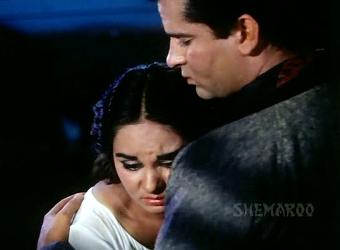
Anu had started this month with a Dev Anand film—and I, following suit, decided I would review a relatively little-known Dev Anand film too, to begin August. But, while Anu’s kept up the Dev Anand theme all through August, I’ve meandered off in different directions, all the way from The Rickshaw Man to jeep songs. But solidarity among friends counts for something, doesn’t it? So here I am back again, with another Dev Anand film. The sort of film that, on the surface, looks like it’s got everything going for it: a suave Dev Anand opposite a very beautiful Waheeda Rehman (who, along with Nutan, was, I feel, one of Dev Anand’s best co-stars as far as chemistry is concerned). SD Burman’s music. Suspense. Some good cinematography.
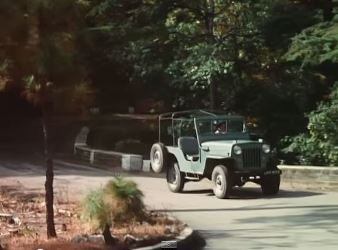
Ten of my favourite jeep songs
This post has been floating about in my head for a long time—at least, ever since I did a post on car songs (in which I’d mentioned pretty clearly that I meant only cars, not jeeps). When some readers began putting in jeep songs in the comments too, I figured I had to do a jeep songs list sometime. So here it is, after a long wait.
Unlike cars, which seem to be all over the place in Hindi cinema, being driven both through the countryside and in cities, jeeps are a little less ubiquitous. And there seem to be unwritten rules about who drives them (invariably men). And, more often than not, men in the countryside—preferably a hilly countryside. There’s that perception, I suppose, of the jeep being a rugged vehicle, one suited for rough roads and steep inclines: not the sort of thing a swanky imported car in 50s or 60s cinema would be able to handle.
Muhomatsu no Issho (1958)
Or, The Rickshaw Man.
I hadn’t heard of this film till a couple of months back. Around that time, looking at Toshirô Mifune’s filmography on IMDB, I came across The Rickshaw Man, and was intrigued enough to decide I must look out for the DVD. Then, as if destiny too wanted to help me along, I happened to read Ryūnosuke Akutagawa’s Rashōmon and Seventeen Other Stories. The stories—and Akutagawa’s biography at the start of the book—fascinated me. And when I read that one of Akutagawa’s sons grew up to be an actor, I went back to IMDB to see which films he acted in. And The Rickshaw Man was there.
As it turned out, Hiroshi Akutagawa doesn’t have a large role (though it is an important one) in The Rickshaw Man. But it was interesting to see this actor, whose father had written the two stories (Rashōmon and In the Bamboo Grove) on which Kurosawa based one of his best-loved films. And, of course, to see Mifune, who appears here as the epoymous rickshaw man, a poor rickshaw-puller named Matsu.
Mahal (1969)
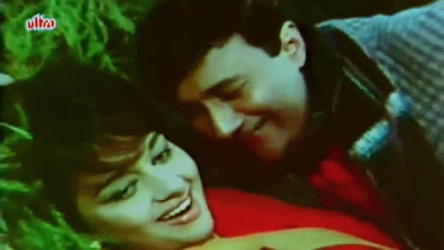
I had no particular film review or song list in mind for this week, but when Anu declared August Dev Anand month over at her blog, and Harini reviewed Duniya, I saw a bandwagon that I liked—and decided to jump on to it. With a film that reminds me of Duniya in some ways: Dev Anand, late 60s, suspense.
Ten of my favourite ‘Give us a hug’ songs
The other day, I was thinking about some of those songs that end up featuring on every other list I make. Songs that are perennial favourites of mine, because they are those rare combinations of brilliant music and equally brilliant lyrics, singing, picturisation—everything. Songs like Aage bhi jaane na tu, Yeh duniya agar mil bhi jaaye toh kya hai, and Lag jaa gale ke phir yeh.
Lag jaa gale ke phir yeh made a thought pop into my mind: that a fair number of Hindi songs are an invitation to be hugged. That might seem fairly innocuous, but in the good old days of nodding flowers and birds putting their beaks together onscreen, an embrace was a daring enough statement: it meant you did love someone; you weren’t being frivolous. No heroine (or hero, even) worth their salt actually hugged anybody—in a romantic way—other than the love of their life. So telling someone to come on and give you a hug meant you were serious (even if the way it was said—as it is in some of the songs in this list—in a light-hearted way).
Book Review: Anirudha Bhattacharjee and Balaji Vittal’s Gaata Rahe Mera Dil: 50 Classic Hindi Film Songs
I know I’m a bit late to the party here; Anu had already written about Bhattacharjee and Vittal’s latest book over at her blog, and Harini reviewed it recently on her blog—but better late than never, I guess.
Bhattacharjee and Vittal’s book’s subtitle says it all: 50 Classic Hindi Film Songs. They define ‘classic’ too, in the prologue to the book, where they discuss what is for me truly a classic, the brilliant Baabul mora, by KL Saigal. A timeless song, a song as capable today as it was in the 30s of touching hearts, of making people catch their breath in sheer awe at the music, the lyrics, the rendition—and a song with a story behind it: the story of the exiled Nawab Wajid Ali Shah, ousted from his Awadh and sent away to Calcutta. A song rendered repeatedly by different singers, including some of the greatest voices. And the story, too, of its filming in Street Singer.
Mahabharat (1965)
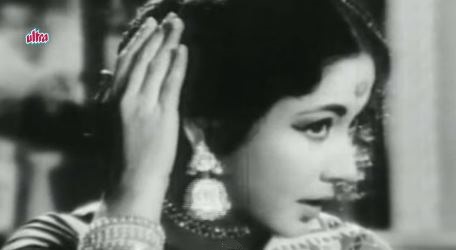
I hadn’t heard of this version of the Mahabharat till a few days back (not, of course, that the existence of this film is surprising; given Hindi cinema’s love for mythology, there was bound to be at least one version of this epic floating about). Then, commenting on my jewellery songs post, blog reader Afsal posted a song from Mahabharat, and mentioned part of the cast: Pradeep Kumar as Arjun. Dara Singh as Bheem. Padmini as Draupadi.
And good songs.
That sounded deliciously unlike the usual B grade Hindi mythological, so I went looking for it on YouTube, and watched it.
I won’t narrate the complete story here; the Mahabharat is too well-known for that (and if you aren’t familiar with it, I’d advise checking it out first before watching the film). Suffice to say that the film begins right in the middle of some action, without setting any preliminary background in place. At the court of the blind King Dhritrashtra in Hastinapur, the entire court is watching the two cousins Bheem (Dara Singh) and Suyodhan/Duryodhan (Tiwari) engage in a wrestling match.
More Than a Miracle (1967)
The first Omar Sharif film I remember watching was Mackenna’s Gold. As the bandit John Colorado, Sharif made a very young me (I was a child) feel that, my goodness, how could someone be so cruel and nasty and not at all nice? Then, a couple of years later, I saw The Night of the Generals and refused to believe that the upright Major Grau could be played by the same man who played the evil Colorado.
In the many years since my teens, I have seen many more of Omar Sharif’s films. I’ve seen him play everyone from a Mongol warrior (Genghis Khan) to a Russian doctor (Dr Zhivago), an Armenian king (The Fall of the Roman Empire), a German officer (The Night of the Generals), an Arab tribal leader (Lawrence of Arabia)… and a Spanish prince.
Ten of my favourite jewellery songs
This is one topic I’ve been toying with for a long, long time: Hindi film songs that mention jewellery. Given that romantic songs are so common in old Hindi cinema—and that shringaar ras, which includes the ‘adornment of the self’—is so very integral a part of romantic love, it’s no surprise that jewellery finds a mention in so many songs. From a fleeting Pag mein ghoonghar baandhke to an entire song about a lost earring, there are so many ornaments mentioned in Hindi film songs, one could actually create an entire list of jewellery songs without repeating an ornament.
So, why not? A list in which each song mentions—and prominently, in the first two lines of the song—an ornament of some sort. And, to make life somewhat less easy for myself (why am I always doing this?!), no two songs feature the same ornament. In addition, one condition for each song I’ve chosen is that it must literally be about an ornament; allegories, metaphors, and symbols don’t count (which is why you won’t see in this list Mila hai kisi ka jhumka—which refers to a flower as a earring, or Chhoti si mulaaqat pyaar ban gayi pyaar banke gale ka haar ban gayi—which uses an idiom: the gale ka haar, or necklace, meaning something very dear).