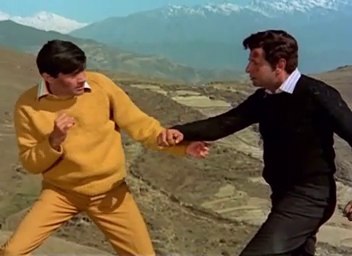
…which could probably have been more appropriately titled How to Jump to Conclusions and Mess up Lives. Or Never Trust a Sinister Mamu. This is one Muslim social – a genre I have long admitted to being very fond of – which has been recommended to me so often, I’ve lost track of the recommendations. On the one hand, I wanted to see it because it has some lovely songs; on the other, the thought of watching Meena Kumari in one of her last few films – well, that wasn’t something I was really looking forward to with anticipation. But all those recommendations tilted the balance.
Category Archives: Dusted Off
Ten of my favourite ‘male pianist’ songs
Some time back, I received a request from a blog reader and long-ago professor of mine: would I do a post on songs sung at pianos? Hindi cinema, back in the good old days, invariably had a song at a piano per film, often more. I had to inform my ex-prof: I had already compiled, some time back, a post on piano songs: specifically, women pianists. But this gave me an idea: how about a post on male pianists? After all, there has been no shortage of songs picturised on men sitting at pianos.
Rear Window (1954)
Friend, blog reader and sometime fellow blogger Harvey nudged me gently last week with a bit of information I hadn’t remembered. August 13th, 2014 was the 115th birth anniversary of Alfred Hitchcock. Was I planning to post something Hitchcock-related to mark the occasion?
And how could I not? Hitchcock – in my opinion, one of the best directors cinema has ever seen, regardless of time and place – is a firm favourite of mine. I’ve reviewed several of his films; in fact, one of the first films I reviewed on this blog (The 39 Steps) dates from Hitchcock’s early British period. I’ve reviewed a hilariously black comedy (The Trouble with Harry); I’ve reviewed classics like Rebecca, and relatively little-known ones (among those not Hitchcock aficionados, I hasten to add) like Strangers on a Train or Lifeboat.
Time (and occasion) therefore, I concluded, to review one of my favourite of Hitchcock’s colour films, in the classic suspense mould. Rear Window, about a photographer stuck in his tiny apartment with a broken leg…
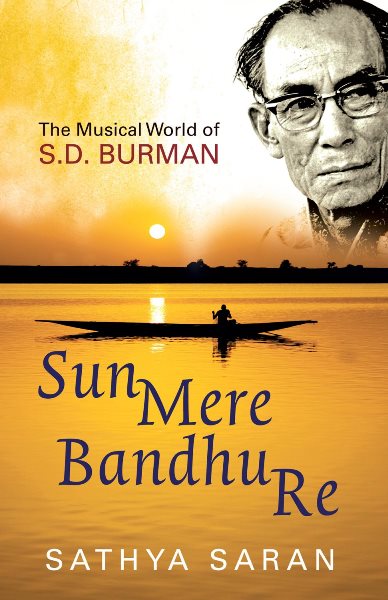
Book Review: Sathya Saran’s ‘Sun Mere Bandhu Re: The Musical World of SD Burman’
To say that I am fond of Sachin Dev Burman is to put it mildly. Along with OP Nayyar, SD Burman was one of the first music directors I heard of—thanks to my father, who is a devoted fan of the music of these two very different composers. It was my father who, when I was still a pre-teen, first drew my attention to the beauty of Thandi hawaayein lehraake aayein, Hum bekhudi mein tumko pukaare chale gaye, O re maajhi, Dekhi zamaane ki yaari, Yeh mahalon yeh takhton yeh taajon ki duniya, and dozens of other songs, each more wonderful than the last.
That love for SD Burman has, instead of abating, increased over the years. With that love has arisen a deep admiration for the sheer versatility and genius of this man, without whom the face (or should that be ‘sound’?) of Hindi film music might have been very different. And much, much the poorer.
Not a surprise, then, that I should get so excited when I discovered that a biography of SD Burman had been published: Sathya Saran’s Sun Mere Bandhu Re: The Musical Journey of SD Burman (Harper Collins Publishers India, P-ISBN: 978-93-5029-849-7, E-ISBN: 978-93-5029-850-3, Rs 499, 258 pages). I had read about and heard various anecdotes about SD Burman over the years: that he was a prince of Tripura, of his love for paan and football, and how he skilfully drew inspiration from just about every type of music: Baul, Bhatiali, Rabindra Sangeet… to actually read a biography of the man himself was something I looked forward to with great anticipation.
Mamta (1966)
While watching Pakeezah some months back (and reading Meghnad Desai’s book about the film), I was struck by how fond old Hindi cinema used to be of the motif of the ‘chaste tawaif’. A paradox, seemingly, because how could a woman be a tawaif – a prostitute, to put it bluntly – and be chaste? But films like Pakeezah and Adalat did just that: they portrayed women who lived in kothas, sang (in Adalat) and danced (in Pakeezah) but were ‘good’ women, chaste and pure, women who may have been lusted after by bad men, but who – thanks to fate, good friends and relatives, kind strangers (both human and animal) – were always able to avoid the fate worse than death: of yielding their chastity to a man they were not married to, or weren’t going to eventually marry, even if only in secret.
Lilies of the Field (1963)
And why take ye thought for raiment? Consider the lilies of the field, how they grow; they toil not, neither do they spin:
And yet I say unto you, That even Solomon in all his glory was not arrayed like one of these.
-Matthew 6: 28-29, King James Version
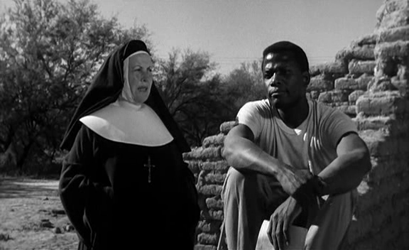
I am very familiar with this passage from the Bible (part of the Sermon on the Mount, this passage is part of one of my favourites—a beautiful little piece of scripture on how futile it is to worry), but when I first heard of the name of this film, the relevance of its title didn’t strike me. When I started watching it, I realized: yes, the lilies of the field are impermanent, evanescent, depending on no-one and yet not even doing anything very visible to keep themselves alive. But they—like all the flowers of this world, especially the wild ones, with no-one to care for them—are amongst the most beautiful of God’s creations.
Not an exact parallel with the protagonists of this heart-warming and sweet little tale, but close. And with some subtly-put messages about being content with one’s lot, yet pushing on, working hard.
Chor Bazaar (1954)
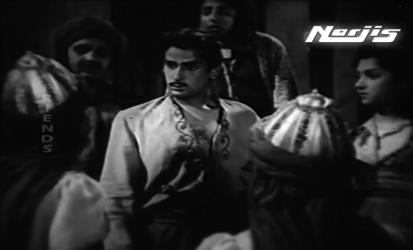
There were various reasons for my wanting to see this film. One was that it’s a historical (okay, faux historical, considering it’s set in some undefined supposedly Middle Eastern land named Sherqand). The other was that its music was scored by Sardar Malik, one of—in my opinion—Hindi cinema’s very underrated music directors. The main reason, however, was Shammi Kapoor. Though still in his moustached pre-Tumsa Nahin Dekha days, he is one of my favourite actors. So just about anything starring Shammi Kapoor is, for me, worth watching at least once.
Ten of my favourite Madan Mohan songs
I have never—in all the years this blog has been in existence—compiled a list of my favourite Madan Mohan songs. An oversight, and one for which I have no explanation to offer: just reparation.
Born Madan Mohan Kohli in Erbil (Iraqi Kurdistan) on June 25, 1924, the young Madan Mohan returned with his family to their home town of Chakwal (in Punjab) when he was 8 years old. His parents went on to Bombay, where his father, Rai Bahadur Chunilal, entered the cinema industry: as a partner at Bombay Talkies Studio, and then at Filmistan Studio. Madan Mohan too moved to Bombay, where he finished school and eventually joined the army—only to finally leave soldiering to become a music director. The first film for which he provided the score, at the age of 26, was Aankhen (1950).
Ghazal (1964)
Those who frequent this blog have probably figured out by now that I have a soft spot (a very soft spot) for Muslim socials. So much so that I will watch just about any Muslim social out there, even if it features people who aren’t among my favourites. Even if it has a fairly regressive theme, and even if I end up not agreeing with half the things in the film. So, when I come across a Muslim social that stars some of my favourite actors (Sunil Dutt? Meena Kumari? Rehman? Prithviraj Kapoor? Rajendra Nath? Check, check, check), has lyrics by my favourite lyricist (Sahir Ludhianvi), and had its songs composed by one of my favourite music directors (Madan Mohan—and how appropriate, too, for a film called Ghazal to be scored by the Ghazalon ka Shahzaada): to not watch this would be a crime, I thought.
Ten of my favourite Sunil Dutt songs
A couple of months back, amidst a discussion on one of my posts, fellow writer (and fellow Sahir Ludhianvi fan) Karthika Nair and I got involved—as we are apt to do—in talking about Sunil Dutt (who, coincidentally, has appeared in a number of songs written by Sahir). I realized then that I’d never compiled a list of my favourite Sunil Dutt songs. This, despite the fact that he is one of my favourite actors.