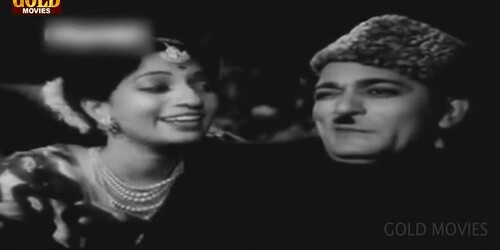
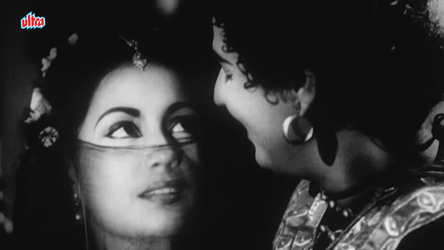
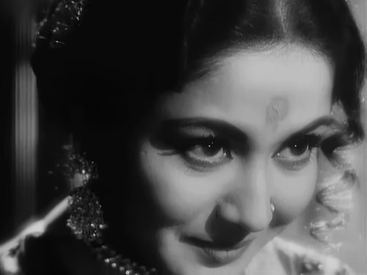
Aladdin aur Jaadui Chiraagh (1952)

Some weeks back, when I reviewed Police (1958), the thought that had stayed in my mind regarding Madhubala’s character—and her acting—in that film and otherwise, in the larger context of her career, was that she got sadly stereotyped. Too many people, film-makers most of all, ended up slotting her as the ravishingly beautiful woman who need only be cast for the fact that she could light up a screen like few others could. Her acting ability (which was actually very good) got overlooked far too often.

Something similar, though in a different way, happened to Meena Kumari. In Meena Kumari’s case, the ‘Tragedy Queen’ label got affixed fairly early in the actress’s career and branded her forever as the Main Chup Rahoongi type: the weepy, self-sacrificing, stoic Bhartiya naari. Despite films like Kohinoor, Azaad, Majhli Didi, Tamasha and Bandish, most people today associate Meena Kumari with ‘serious’ roles.

So, this film, which starred Meena Kumari in one of her lighter roles.

Continue reading

Ten of my favourite title songs

Given that I’ve done so many song lists, it surprises me, too, that I’ve so far never done a list of my favourite title songs. Blog reader Naghma (who has suggested some great themes for song lists over the years) suggested this one too, and I was a little taken aback to realize that—though I’d done a credits songs list, and had another noted down for climax songs or songs that end a film—I’d never even thought of doing a title songs list.

Continue reading

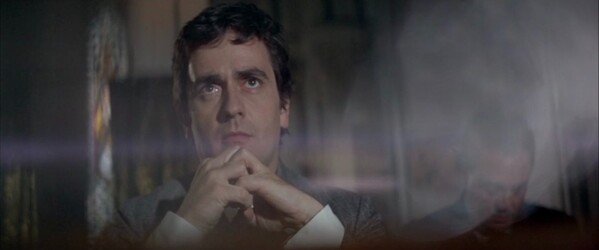
Bedazzled (1967)

If, like me, you were old enough to be watching films in 2000—and you watched Hollywood films—you might have come across the Brendan Fraser-Elizabeth Hurley comedy Bedazzled. It was about a geeky, socially inept but otherwise sweet fellow (Fraser) who makes a pact with the Devil (Hurley), who promises to grant him seven wishes in return for his soul. Unfortunately for our hero, all his wishes come to nought, leaving him even more distressed than he was originally. It was a funny film, and Brendan Fraser, in my opinion, shone as a comic actor.

I discovered, a few weeks ago, that the 2000 Bedazzled, directed by Harold Ramis, was actually a remake of a 1967 British film of the same name. Directed by Stanley Donen, Bedazzled was based on a story by Peter Cook and Dudley Moore, who also acted as the leads in the film: Dudley as Stanley Moon, Peter as the Devil.

The story begins in a church, where Stanley is praying very hard that God give him a sign. Something to assure a despondent Stanley that there is someone listening.

Continue reading

Ten of my favourite cosmetics songs

This song list actually had its genesis many years ago, when I posted my list of jewellery songs. Back then, it had occurred to me that there were also songs that celebrated other ways (less expensive ways!) of adorning oneself. Cosmetics, most of them the ‘traditional’ ones, rather than those that came to us, along with their names, from the West, are not all that uncommon in Hindi film songs. And with reason: after all, romance plays a major part in old Hindi cinema, and where there is romance, there is shringaar ras: the very essence of attraction. A woman (mostly, though there are instances of men too) is often praised for her beauty, and that beauty is accentuated by cosmetics: by kaajal (kohl) in the eyes, mehendi on the hands, sindoor in the parting of the hair, and so on.

Continue reading

Announcing a New Book: Gardens of Delhi

This is a once-in-a-lifetime occasion for me: two books being launched in the same month. For someone who usually only has a new book coming out every two years (if that), it’s a very unusual thing to have not one, but two, books being released within a couple of weeks of each other.

Some of you might know that I have an elder sister, Swapna Liddle, who (like me) is an author. Like me, too, Swapna is deeply interested in history. That, however, is where the resemblance ends. Swapna is a much-respected historian and all her books have been well-researched, immensely insightful works on the history of Delhi (her field of specialization is Delhi of the 19th century). I, of course, primarily write fiction, when I’m writing in the long form: non-fiction, in the form of travelogues, book reviews and film writing, are reserved for short form articles.

This is where we finally come together: in a book about the gardens of Delhi.

Continue reading

Police (1958)

If you’ve been reading this blog some years, you probably know by now that I am a fan of Madhubala’s. I’ve watched most of her films (several of which I have not got around to reviewing on this blog), I’ve done lists of my favourite songs of hers, and I have waxed eloquent every now and then about how much I like her.

One of the things I dislike about much of the online (at least) raving about Madhubala is that the praise is invariably just about her beauty. How gorgeous, how exquisite. Yes, indeed; but Madhubala’s beauty, I think, often comes in the way of people appreciating what a good actress she was, too. Watch her performances in films like Mughal-e-Azam and Amar, for instance, and if you can look past her face, you will see how well she holds her own against heavyweight thespians like Dilip Kumar and Prithviraj Kapoor.

And she was a fantastic comedienne too. The madcap way she matches Kishore Kumar in Chalti ka Naam Gaadi, for example. Or her airhead character in Mr & Mrs 55. Interestingly, Madhubala is often compared to Marilyn Monroe, almost entirely on the basis of their beauty and popularity; but I think the two stars had one more thing in common: both could portray the ditzy beauty very well. This, in fact, is just the type of woman Manju, of Police, is: nutty, silly, a clown. But so endearing too (and, it goes without saying, so gorgeous).

Continue reading

What’s named after Dara Singh?

A reblog of an old post, from when my blog was only a couple of months old.

Reblogged, because there’s an addition to this list.

After many years of thinking I knew all the obscure (and not) ways in which popular actors are immortalised in everyday objects, I had a moment of serendipity—an unexpected addition to this all-too-short list.

The other day, our gardener turned up, bringing with him a rather nice-looking plant with glossy striped green leaves. Would we like to keep it, he asked my husband. It’s a good indoor plant. We really don’t need any more indoor plants (we have plenty as it is), so we declined, but my husband asked him, out of curiosity, what it was called.

Dara Singh ka paudha,” he said. Dara Singh’s plant.
Why on earth?
Bahut shaktishaali hai,” he explained. “Marta nahin hai.” It’s very hardy, doesn’t die.

Later, when I had some time, I checked the plant out on Google Lens, and the penny dropped. This, to give it its botanical name, is Dracaena fragrans. Dra-caena, which has a similar set of syllables to ‘Dara Singh’, barring that g at the end. In a country where we have gardeners mangling names of plants left, right and centre (a friend has ‘begum bailiya’ flowering profusely in her home, another looks forward to pansotia at Christmastime), this is hardly unexpected.

Anyway, so we’ve said no to Dara Singh’s plant. But I’ve learnt something new in the process.

Announcing a New Book: An Unholy Drought (The Delhi Quartet, Book #2)

Back in November 2021, my publisher, Speaking Tiger, released the first novel in my four-book The Delhi Quartet, a series of novels that will tell the stories of a group of interconnected families against a backdrop of 800 years of Delhi’s history. That book, The Garden of Heaven, was set in the early years of the Delhi Sultanat, beginning four years before Mohammad of Ghur attacked Delhi and wrested power from the ruling Rajputs. The Garden of Heaven spanned around 200 years, and its story was narrated by a woman, Shagufta. Shagufta, who tells the story of her ancestors to a wounded enemy soldier (one of the attacking army of Taimur), whom she has (against her better judgment) saved and succored.

Cut to 150 years later. 1556. A terrible drought grips the north Indian plains, even as a thirteen-year-old Jalaluddin Mohammad Akbar tries to maintain a grip on the throne he has inherited after the sudden death of his father Humayun. There is uncertainty, instability—and death could be right round the corner.

In Delhi, an old calligrapher named Nadeem sets out to document the story of his family. Along with his teenaged grandson Mohsin, Nadeem chronicles their history, beginning with the tale of Daanish, the son of Shagufta (from The Garden of Heaven).

Continue reading

Paigham (1959)

This is a film that’s been on my radar for a while now. Dilip Kumar, Vyjyanthimala. A cast also boasting of Motilal and Johnny Walker. Some good songs. Paigham, I thought, might be worth a watch.

I will admit, though, that my heart sank a bit when I saw the opening credits and discovered that this is a Gemini Studios release. Like AVM, I now approach Gemini with trepidation: while their films often had great casts and excellent music, they were invariably just too melodramatic for my liking.

But I persevered.

Paigham begins by introducing us to Manju (Vyjyanthimala) who, along with her best friend Malti (B Saroja Devi), has just finished college: Manju at the top of her class, Malti at the bottom. Malti isn’t fazed by this; she’s a wealthy girl, her father Seth Sewakram (Motilal) a prosperous cotton mill-owner. Malti, in fact, has promised Manju that she will ask her father to give Manju (who’s done a course in shorthand and secretarial work) a job at the cotton mill, which is in a town named Rangpur.  

Continue reading

Historic Hisar: A Foray

Last year, on our way back from Himachal Pradesh, we had stopped briefly at Ibrahim Lodhi’s tomb in Panipat, and, even more briefly, at a kos minar near Karnal. While it had not been especially impressive, it had, inspired me to see more of Haryana. After all, I’ve lived in Delhi and around for nearly forty years now: it’s unpardonable to have seen so little of one of our neighbouring states.

This year, we’ve realized it may not be possible—given various exigencies—to go for a week-long summer vacation. A brief road trip is all we might be able to manage. It seemed a good time to try exploring Haryana. Hisar, we decided, with a stop en route at Rakhigarhi.

Continue reading