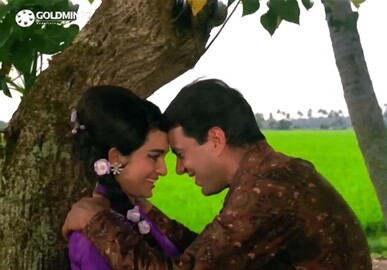
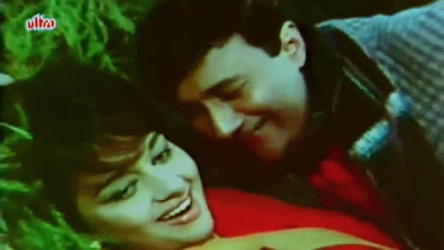
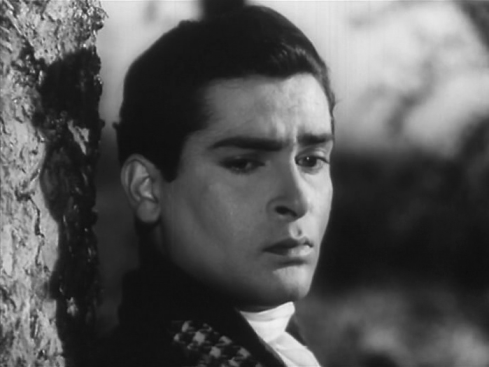
Aaye Din Bahaar Ke (1966)

(Coincidentally enough, I watched Aaye Din Bahaar Ke some weeks back, just after I’d posted my review of Phool aur Patthar. Back then I’d not known that we would be mourning the passing of Dharmendra so soon after. Consider this a tribute).

When I watched Phool aur Patthar some weeks back, I was reminded of the many fairly entertaining films Dharmendra worked in through the mid- and late-1960s. Not all of them were good (some, like Chandan ka Palna, were terrible), but quite a lot of them had at least good songs, a fair deal of entertainment value, and an undeniably handsome male lead to make them worth at least a one-time watch. Some of these (like Aankhen, arguably my favourite Dharmendra film) I’ve reviewed already; there are several others.

Here’s one. I last watched Aaye Din Bahaar Ke perhaps about 20-odd years ago, and actually remembered a fair bit of it. That I didn’t mind watching it again, even though the film is far from perfect, says a lot for it.

The story begins in Darjeeling, where Ravi (Dharmendra) lives with his widowed mother (Sulochana Latkar). Ravi is devoted to his mother: so much so that when Ma is doing her pooja, he tells her, “You may worship your gods, but I will worship only you.” She has devoted her life to looking after Ravi, educating him, etc, which is why this somewhat OTT sentiment.

Continue reading

Kati Patang (1970)

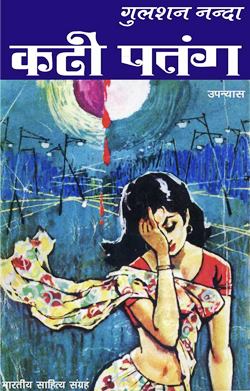
Our recent trip to Nainital prompted me (actually, even before we left on our trip) to read Gulshan Nanda’s novel Kati Patang. Gulshan Nanda, for those who may be unfamiliar with his work, wasn’t just a hugely successful writer of Hindi social-romantic popular fiction, but also a script writer for Hindi cinema: he wrote the scripts (many of them based on his own novels) of blockbusters like Saawan ki Ghata, Khilona, Kati Patang, and Jheel ke Us Paar. This insightful article about Nanda’s writing, as well as its adaptation to the big screen, is worth a read.

Continue reading

Mera Gaon Mera Desh (1971)

This blog focuses almost exclusively on films from before the 1970s. Very occasionally, though, I make exceptions. For films that are pretty much on the cusp, and which evoke more a sense of 60s cinema than 70s, which were made mostly during the 60s (or even earlier, as in the case of Pakeezah) but were released only later, but basically for films that, when I watch them, seem as if they were made in the 60s. Because of the people who star in them, because of the costumes, the songs, the feel of them.

When Vinod Khanna passed away last week, I wanted very much to review one of his films as a way of paying tribute. There are a couple of 60s’ films of Vinod Khanna’s that I’ve seen—the forgettable Man ka Meet, for instance—but I settled on a rewatch of Mera Gaon Mera Desh, not just because it features Vinod Khanna in one of his most memorable outings as a villain, but also because it is an interesting example of a film that may have only been moderately successful, but is the very obvious inspiration for one of the biggest hits ever in the history of Hindi cinema: Sholay.

Vinod Khanna, Asha Parekh and Dharmendra in Mera Gaon Mera Desh

Continue reading

Bahaaron ke Sapne (1967)

I can blame my not having watched Bahaaron ke Sapne all these years on my father: when I first expressed an interest in the film because it had been directed by Nasir Husain (back then, a teenaged me associated Nasir Husain only with frothy and entertaining films like Dil Deke Dekho, Tumsa Nahin Dekha, and Phir Wohi Dil Laaya Hoon), my father said, ‘It’s a serious film.’

And that was that. Because, back then, I didn’t care to ask how serious. Anything that smacked of reality rather than escapism was not to be touched with a barge pole.

Rajesh Khanna in Bahaaron ke Sapne

Continue reading

Jab Pyaar Kisise Hota Hai (1961)

Nasir Hussain, as someone (he himself?) once remarked, came to Bombay with one story in his briefcase, and made out of it one blockbuster after another. The story of a son, separated by circumstances from one parent and going through various ups and downs (including falling for the distant parent’s foster offspring, being impersonated by a crook, etc) before the happy ending, was one that was played out in Tumsa Nahin Dekha, Dil Deke Dekho, Phir Wohi Dil Laaya and Pyaar ka Mausam.

But, contrary to popular belief, Nasir Hussain was by no means a one-trick pony. He had other plot elements up his sleeve as well, and they appear now and then sporadically in various films. The ‘couple promised to each other as children’ trope is one [which always ends up with the couple—completely unaware of having been ‘betrothed’ in childhood, even sight unseen—falling in love with each other]. Another was the hero being [mistakenly, of course] believed to have killed a sister [or sister figure] of the heroine’s, after having played fast and loose with her—this, naturally, causing serious heartache and betrayal for the heroine until she realizes that her beloved couldn’t possibly do something so heinous.

Asha Parekh and Dev Anand in Jab Pyaar Kisise Hota Hai

Continue reading

Mahal (1969)

I had no particular film review or song list in mind for this week, but when Anu declared August Dev Anand month over at her blog, and Harini reviewed Duniya, I saw a bandwagon that I liked—and decided to jump on to it. With a film that reminds me of Duniya in some ways: Dev Anand, late 60s, suspense.

Asha Parekh and Dev Anand in Mahal

Continue reading

Saajan (1969)

The other day, a fellow blogger, mentioning her distaste for Manoj Kumar’s films said that while she has “nothing against the man himself”, she really hates his films. I know what she meant (at least I think I do): I hate that insufferably xenophobic “all that is Indian is good, all that is Western is bad” philosophy espoused by films like Upkaar or, even worse, Purab aur Pachhim.
But I tend to shove that lot of films to the boundaries of my recollection of Manoj Kumar’s films. For me, his best films are the outright entertainers, the romances and suspense thrillers he worked in. Especially the suspense thrillers: Woh Kaun Thi?, Anita, Gumnaam—and this one.

Manoj Kumar and Asha Parekh in Saajan Continue reading

Pyaar ka Mausam (1969)

Or, The Nasir Hussain Rule Book of Fool-proof Rehashing.

I’m beginning to think I’m an idiot for trying to think up new stories every time I write. Look at people like Betty Neels or Nasir Hussain; they managed to get by with basically the same story, over and over again, and very successfully too. [which makes me wonder: were Hussain and Neels long-lost brother and sister?]

Take the latter’s Pyaar ka Mausam, for example. I’d seen this film as a kid and remembered little of it except the very good music and the pretty lead pair. A rewatch last night revealed that it amounted to a cocktail of Nasir Hussain’s earlier films: Tumsa Nahin Dekha, Dil Deke Dekho, and Phir Wohi Dil Laaya Hoon. Same story, same plot elements, same rules from The Rule Book.
[Note: These rules will make more sense if you’ve seen one or more of the films I’ve mentioned above. If you haven’t, think of it this way: you’ll get to know about four films just from one review].

Continue reading

Dil Deke Dekho (1959)

Dil Deke Dekho isn’t quite the perfect film I’d like to make it out to be.
(a) The story isn’t exactly original (Nasir Hussain had already used it in Tumsa Nahin Dekha. He also went on to use it in Jab Pyaar Kisi se Hota Hai and Phir Wohi Dil Laaya Hoon, but that can’t be laid at the doorstep of Dil Deke Dekho).
(b) The plot is too complicated, relies too heavily on convenient coincidences, and has some unbelievable – and often unclear – motives.
(c) The lead actress, Asha Parekh (just 16 years old), though pretty as a picture, isn’t a terribly good actress at this stage of her career.

On the other hand: the film stars Shammi Kapoor.

Continue reading

Mere Sanam (1965)

Nasir Hussain may have made his Tumsa Nahin Dekha story into four separate – and equally successful – films, but did that induce others to be original? On the contrary. Narinder Bedi, at least, probably seemed to think that what worked for Nasir Hussain might well work for him. Therefore, Mere Sanam, which has a storyline similar in many ways to Tumsa Nahin Dekha. (Both films also have fantastic music by OP Nayyar, by the way).

Continue reading