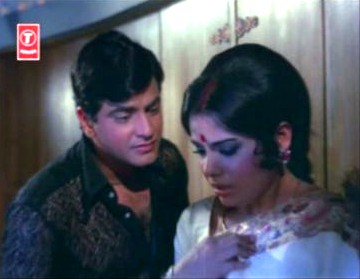
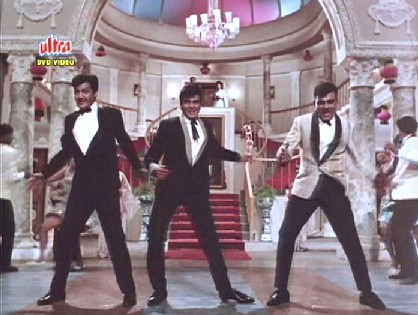
I’d planned to watch (and review) something quite different this week, but when Beth announced Shashi Fest, I couldn’t resist the temptation to participate. That resolve was strengthened when I realised that in a year and a half of blogging about cinema, I’ve never once reviewed a Shashi Kapoor starrer. For shame! This, therefore: a farcical and fun film that never lets itself slip into seriousness. It features some of Hindi comedy’s greatest stalwarts, has superb music, and—of course—stars Shashi Kapoor, showing how good he is at comedy.
Tag Archives: Bollywood
Waaris (1969)
Today’s Holi and much of Delhi has been busy slathering everybody else with colour. Out in the street (and in the neighbours’ yard) I saw people drenched in purple, green, yellow and red.
My husband and I don’t celebrate Holi—we’re both too fastidious and have better things to do in life than wasting hours getting colour off ourselves. So here’s my way of celebrating Holi: watching a Hindi film. And that too a colour film—yes, I’ve suddenly realised that the last Hindi colour film I reviewed was Leader, way back in June 2009. A situation pleading to be amended!
Ten of my favourite Talat Mahmood songs
It just so happened that the last film I reviewed on this blog was Sone ki Chidiya, which starred Talat Mahmood—better known as a singer, a man with one of those heartrendingly beautiful voices that can turn even a so-so tune into something sublime.
Today is the birth anniversary of Talat Mahmood: he was born on February 24th, 1924. Had he been alive, today would have been his 86th birthday. And so, to celebrate: a listing of ten of my favourite tunes sung by the Sultan of the Soulful Song (my appellation for Mr Mahmood). All from the 1950’s and 60’s, and all from films I’ve seen. These are in no particular order, though my absolute favourites are towards the top of the list.
Sone ki Chidiya (1958)
In Sone ki Chidiya, a poet tells a film actress why poor people go to the cinema: “For five annas’ worth of false dreams. And the glow of your beauty.”
On the surface, this may seem as cynical a comment on the Hindi film industry as Kaagaz ke Phool, but it isn’t, really. It’s a much more mainstream commercial film, with all the trappings of melodrama, dewy-eyed romance and oppressed heroine. I saw it because it stars one of my favourite actresses—Nutan—and one actor whom I’m very fond of: Balraj Sahni. And (this came as a surprise to me) the cast also includes someone whom I count among my favourite singers: Talat Mahmood.
Rail ka Dibba (1953)
I’m doing something I’ve never done on this blog before. I’m offering a free gift for anyone who cares for it: a VCD, once viewed, of Rail ka Dibba. I’ll ship it anywhere in India and you won’t need to pay a paisa for it.
Now, why I’m doing this. First, the preliminaries: it’s a Friends VCD, and we all know what that means. Their logo takes up much of the screen. The print is bad, the sound quality even worse. And their evil villain editor seems to have chewed up frames, scenes, dialogues—everything—in an attempt to fit the film onto two CDs. And though it’s not a really bad film, Rail ka Dibba left me feeling pretty certain that I won’t be watching it again. Anybody who wants it is welcome to it.
Ten of my favourite ‘inspired’ songs
I’d been toying with the idea of this list for a while, and memsaab’s recent post on Bhoot Bungla reminded me of it, what with Aao twist karein and its very obvious resemblance to Come on let’s twist again.
I am—and my family and friends know this by now—absolutely and completely enamoured of old Hindi film music. Especially of the 50’s and 60’s. What singers we had! What lyricists! What music directors! What inspiration! The songs were often derived, in small part or large, from a wide range of sources: folk music, classical ragas, Western music, even the rhythmic hoofbeats of a cantering horse. Sometimes the inspiration wasn’t too obvious, or the end result was such a change from the original, it was hard not to give credit to the music director. Other songs were shameless ‘lifts’ from originals.
So here goes: my favourite ‘inspired’ songs, all from 50’s and 60’s films that I’ve seen. And to make the scope more manageable for myself: tunes that were originally Western. These are in no particular order.
Bombai ka Babu (1960)
Much as I do not like like Dev Anand in his post-60’s avatar (the too-black hair, the bandanna and the cap don’t make him look any younger; they just bash home the fact that he’s aging most disgracefully)—I do like him in a lot of the films he did in the 50’s and early 60’s. There are some great suspense films here (CID, Baat ek Raat ki, Kaala Paani, Jewel Thief) and some great drama/thriller/romance/whatever (Jaal, Hum Dono, Paying Guest, Solvaan Saal, Guide, the very unusual Ferry)—and this, a simple story of a thief who finds himself impersonating the long-lost son of a village zamindar.
Bandish (1955)
A consumptive is told by his doctor that his days are numbered. An orphan who doesn’t even know what his parents looked like, finds himself unwanted. A man who loves a dancer/singer is forbidden by his stern father to marry the girl—and she acquiesces. The man sinks into despondency, alcoholism and debauchery, ending up being blackmailed by a gold-digger with an eye on his wealth.
Meena Kumari. Ashok Kumar. Nasir Hussain.
Tragedy? I’m glad to say no!
Chhoti Bahen (1959)
This blog’s been on a Hollywood roll long enough (two films in succession? Too long). So we’re back to good old Bollywood, and with a film that somewhat repeats the cast of the deplorable Bhabhi: Balraj Sahni (again as the long-suffering, self-sacrificing eldest brother), Nanda (again simpering and whimpering), even Shyama, again as the daughter-in-law who starts off being nice but changes into a screechy harridan. And, like Bhabhi, this too is about a loving family split asunder.
Saat Hindustani (1969)
Last week I watched Shichi-nin No Samurai. Earlier this week, The Magnificent Seven (which was based on Shichi-nin No Samurai). So, logical progression? Next in line ought to be a film based on The Magnificent Seven. Saat Hindustani. Going by the law of averages (or should that be the law of diminishing merit?), I guess I shouldn’t have held out much hope for this one. Shichi-nin No Samurai is far superior to The Magnificent Seven, and The Magnificent Seven is light years ahead of Saat Hindustani.