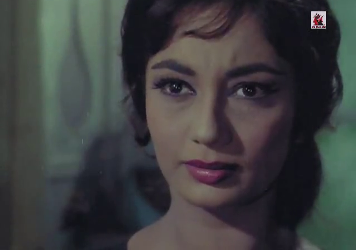
Noorjehan (1967)

Give me a period film, and I’m willing to give it a shot. If it happens to be set in Mughal India, so much the better. If the cast features people like Meena Kumari, Pradeep Kumar, Rehman, Veena, Lalita Pawar and Nighar Sultana: well, there’s hope that the acting will be passable. And when I realize that the music composer is Roshan: then I’m certainly on for it.

Noorjehan, of course (though Richard would probably question that ‘of course) is about the noblewoman who married the fourth of the Great Mughals, Jahangir. Born in May 1577 and named Mehrunissa, she was the daughter of a man who rose to great prominence in the Mughal court: Itmad-ud-Daulah (‘Pillar of the State’) was the title given to him, and the marriage of Mehrunissa to Jahangir made of Mehrunissa a powerful woman, too. Initially given the title Noormahal (‘Light of the Palace’) by her doting husband, she was subsequently given the title of Noorjehan (‘Light of the World’) and went on to become probably the most influential of imperial consorts in the Mughal dynasty, a wealthy woman in her own right, as well as a woman who exercised a good deal of power from beyond the purdah.


pic1

Continue reading

Hamlet (1954)

Today, April 23, 2016, marks the 400th death anniversary of one of English literature’s greatest writers, a man who had a huge hand in making English what it is today. Though William Shakespeare’s date of birth is unknown, he died on this day, nearly 52 years after he was baptized. In less than half a century, he created a corpus of work that has endured—and continues to spawn adaptations by the dozen in popular culture—ever since.

Shakespeare, died April 23, 1616

Continue reading

Abhilasha (1968)

A lot of my memories of 50s and 60s cinema date back to the 1980s, when almost all the films I watched were those shown on Doordarshan. In the early years, with Doordarshan being the sole channel, my sister and I (our parents were rather more discerning) watched every single Hindi film that was telecast, down to painful stuff like Jai Santoshi Ma and the thoroughly obscure Fauji, with Joginder Singh (who, if I remember correctly, also produced and directed it) in the lead role.

But, to get around to the topic of this post: Abhilasha, not a very well-known film but one which made an impression on me because of two songs I liked a lot. And because it depicted a mother-son relationship that was a little different from the usual.

Meena Kumari and Sanjay Khan in Abhilasha

Continue reading

Dil Hi Toh Hai (1963)

Some months back, I watched two relatively new Muslim socials: Daawat-e-Ishq and Bobby Jasoos. Both were an interesting reflection on the way the Muslim social has changed over the years (after close to disappearing during the 90s). The Muslim social of the 1950s was, more often than not, a film that, even when set amongst the wealthy upper class—the nawabs and their kin—came heavily burdened with all the stereotypical trappings of what was perceived as ‘Muslim’: the qawwalis and mushairas, the shararas and sherwanis. (I’ll write about all of those, and more, in a post to follow).

Bobby Jasoos and Daawat-e-Ishq had shed those to quite an extent. But that process had begun in earlier films, even as far back as the 60s. In Neend Hamaari Khwaab Tumhaare, for example, where Nanda’s character—the daughter of a nawab, no less—doesn’t merely have a Western education, but spends most of her time in skirts and dresses. And this film, where Nutan’s Jameela is a firebrand, giving as good as she gets, and by no means the simpering and demure Muslim girl exemplified by her contemporaries in films like Mere Mehboob, Mere Huzoor, and Chandni Chowk.

Nutan as Jameela in Dil Hi Toh Hai

Continue reading

Book Review: Jai Arjun Singh’s ‘The World of Hrishikesh Mukherjee’

In all the years I’ve been writing this blog, one film maker whose name keeps cropping up every now and then—whose films I’ve reviewed, whose work I’ve commented on—is the brilliant Hrishikesh Mukherjee. From his editing of classics like Do Bigha Zameen, Madhumati and Chemmeen, to his direction of both popular hits like Asli-Naqli and relatively little-known works like Majhli Didi and Biwi aur Makaan, Hrishikesh Mukherjee has had a hand (and a mind and a heart, and sometimes—as I discovered when I read Jai Arjun Singh’s ‘sort of biography’ of the man—a house) in some of my favourite films.

Jai Arjun Singh's 'The World of Hrishikesh Mukherjee'

Continue reading

Biwi aur Makaan (1966)

I’m reading Jai Arjun Singh’s The World of Hrishikesh Mukherjee: The Filmmaker Everyone Loves these days (yes; a review will be posted sometime this month). A few pages into the book, and I came across a mention—followed by more interesting stuff—about a film I’d run into once, about ten years back. Biwi aur Makaan, of which I’d happened to find a VCD and had happily bought, guessing (from the synopsis on the VCD cover) that this might be fun.

That VCD turned out a dud: the first disc was fine, the second refused to play. So I set Biwi aur Makaan aside (regretfully), and ended up forgetting about it. Until earlier this week, when, reading Jai’s book, I was reminded of it, and on a whim, decided to see if I could find it on YouTube. Sure enough, there it was. And here is my review.

Biswajeet, Keshto Mukherjee, Kalpana and Shabnam in Biwi aur Makaan

Continue reading

Mera Saaya (1966)

Permit me one last Sadhana-related post before I put aside my unexpected (even to me) sadness at her untimely death. I know I’ve already been through two tribute posts, but even as I was writing those posts, I couldn’t help but think of the Sadhana films I haven’t reviewed on this blog (and there are several of them, including all the ones she made with Rajendra Kumar). When I think of Sadhana, I always think of her in Raj Khosla’s suspense films. Three of them, two opposite Manoj Kumar (Woh Kaun Thi? and Anita), and this one, opposite Sunil Dutt, with whom Sadhana also starred in Gaban and Waqt.

Sadhana in Mera Saaya

Continue reading

Book Review: Balraj Sahni: An Autobiography

I have Richard, over at Dances on the Footpath, to thank for this. Several years back, Richard had linked a blog post to a URL from where one could download Balraj Sahni’s autobiography. Since I’m a fan of Mr Sahni’s, I did so, promptly (which was just as well, since sometime later, that link went dead). What with this and that, however, I didn’t get around to reading the book until a week or so back—and then I wished I’d taken the time to read it earlier.

Balraj Sahni in Anuradha

Continue reading

Ek Gaon ki Kahaani (1957)

What is it about Bengali directors—Bimal Roy, for instance, or Hrishikesh Mukherjee, or (if one steps out of the realm of just Hindi cinema, Satyajit Ray)—that they manage to bring so vividly to life the everyday happenings in the lives of everyday people? Not the escapist fare that most people tend to equate Hindi cinema with, but stories about real people, people one can relate to? Films like Majhli Didi, Parivaar, Parakh, Sujata, Anand: not larger than life, not without a shred of reality. Not art films, not angst-riddled, songless films about the search for the meaning of life, but everyday stories. Songs and all, still very much commercial cinema, but easy to relate to.

Add to that list Dulal Guha, who while he also went on to make films like Mere Humsafar, began his career as a director in Hindi cinema with this charming little film about a sleepy village named Chandangaon, that’s jolted by the arrival of a new doctor…

Talat Mahmood and Mala Sinha in Ek Gaon ki Kahaani

Continue reading

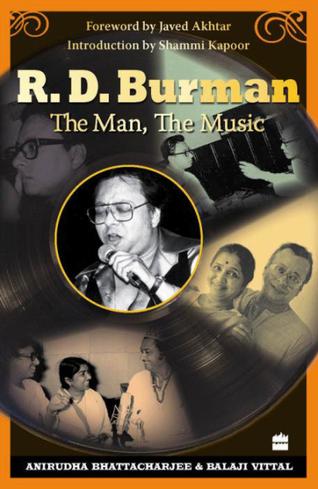
Book Review: Anirudha Bhattacharjee and Balaji Vittal’s ‘R.D. Burman: The Man, The Music’

People who know this blog focuses on pre-70s cinema would possibly be surprised to find a review here of a book about RD Burman—who, to most people, is more associated with Dum maaro dum and all those very peppy Rishi Kapoor songs of the 70s, than the music of the 60s. The fact, however, remains that RD Burman had actually made his debut as an independent composer (not merely as an assistant to his father, SD Burman) as far back as 1961, with the Mehmood production Chhote Nawab. And that he composed the chartbusting music for what is possibly my favourite Hindi suspense film (and one, too, which doesn’t have a single song I don’t like): Teesri Manzil.

This review, therefore, of a book about a man I knew little about except through his music—which has always appealed to me, not just because so much of it was there, all around me, playing on LPs in our house and blaring from radios wherever we went when I was growing up, but because it was so infectious, so full of life. (It was only later that an older, more informed me realized just how versatile RDB was, what softly melodious songs he could compose).

Anirudha Bhattacharjee and Balaji Vittal's 'RD Burman: The Man, The Music'

Continue reading