Aasmaan Mahal (1965)

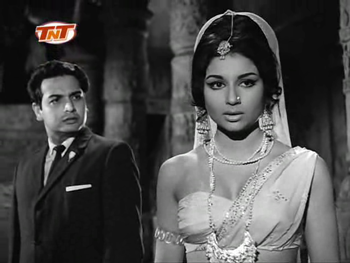
Blog reader Raunakjoy, commenting on Himalaya ki God Mein (which won the Filmfare Award for Best Film, outdoing films like Waqt and Haqeeqat), remarked that there were, besides these contenders for the award, also lesser-known but equally—if not more—meritorious films, like Aasmaan Mahal.

I had to admit I had never even heard of Aasmaan Mahal before, let alone watched it. Directed by Khwaja Ahmed Abbas, this film—as I discovered from a cursory look at Google search results—appears in the Limca Book of Records as one of the first Hindi films to not use sets for shooting. Also, the film won Prithviraj Kapoor an honourable mention at Karlovy Vary for his portrayal of an ageing and impoverished nawab trying desperately to hold on to the tatters of his family’s once-substantial prestige.

Continue reading

Zindagi (1964)

The main reason I watched this film was because of the songs, which include some very good ones. And Vyjyanthimala, whom I invariably enjoy watching. The two male leads, Rajendra Kumar and Raj Kumar, are not favourites of mine, but they aren’t absolutely unbearable either. And there was a star cast of several other people I like, such as Prithviraj Kapoor and Helen. Ramanand Sagar, who wrote and directed Zindagi, also has to his credit one film I really like (Aankhen) and some (Aarzoo, Ghoonghat, Charas) that I don’t mind too much. I figured there might be enough here for me to enjoy.

The story begins with Beena (Vyjyanthimala) coming home to her mother (Leela Chitnis) with the news that she has found a job, finally. Ma is happy, until Beena tells her what the job is: Beena is now a theatre actress. Ma is very upset and goes into a long harangue of how it’s better to be poor than to be in the theatre; their name will be mud, blah blah.

Continue reading

Raj Nartaki (1941)

Aka The Court Dancer.

When I was watching Amrapali some weeks back, I was reminded of another court dancer of Hindi cinema: Sadhona Bose’s character from this film, which claimed to be the first English language film to be made in India with an all-Indian cast and crew. I had made an attempt at watching Raj Nartaki a couple of years back, but I could not get into it, and abandoned it after a few minutes. I guess the concept of Indian actors speaking only English (and that back then) was sufficiently unusual to take time to get used to.

After Amrapali, though, I decided I had to give Raj Nartaki another try.

The film begins by laying the ground. This is the early 19th century, and the film is set in Manipur. Here, Prince Chandrakirti (Prithviraj Kapoor) is heir to the throne. He is also in love with the newly-appointed court dancer, the lovely Indrani (Sadhona Bose). When the story begins, Chandra (as Indrani affectionately addresses him) is at Indrani’s palace, where several of her fellow dancers are entertaining them.

Continue reading

Teen Bahuraaniyaan (1968)

I had read a review of this film on a blog years ago, but besides the fact that it starred Prithviraj Kapoor as the father-in-law of three women, I remembered nothing of what I’d read. Then, some weeks back, when Shashikala passed away, a couple of people remembered her role, as a popular film star, in this film. I was tempted to watch it.

The teen bahuraniyaan (the three daughters-in-law) live in one rambling house along with their husbands, their children, and their father-in-law Dinanath (Prithviraj Kapoor)a retired school teacher. The patriarch’s three sons, from eldest to youngest, are Shankar (Agha), Ram (Ramesh Deo) and Kanhaiya (Rajendranath). Appropriately enough, their wives, respectively, are Parvati (Sowkar Janki), Sita (Kanchana) and Radha (Jayanthi). Sita’s sister Mala (Vaishali), who’s come to town to do college, also lives with them.

Continue reading

Pyaar Kiya Toh Darna Kya (1963)

For those who’ve been following this blog since pretty much its inception, or who’ve explored some of the older posts and specials on Dustedoff, it should come as no surprise that I am a fan of Shammi Kapoor. I have seen most of the star’s films from after his watershed year of 1957 (which was the year Tumsa Nahin Dekha was released, catapulting him to sudden stardom), and I’ve seen several from the early 1950s as well.

Finding a 60s (or late 50s) Shammi Kapoor film that I’ve not seen before is therefore a matter of singular excitement [or was; I have begun to realize, after several less than enjoyable experiences, that there is a reason most of these films aren’t better-known]. This time, when I came across Pyaar Kiya Toh Darna Kya, I approached it with caution. Pandit Mukhram Sharma’s name among the credits bolstered my hopes somewhat; he wrote some good stories, so I began thinking this might not be too bad.

Continue reading

Nanak Naam Jahaaz Hai (1969)

Early in 2013, to mark hundred years of Indian cinema, I dedicated an entire month to regional Indian cinema. I reviewed several films of different languages, and realized, in the process, just how difficult it is to get hold of old regional films that have subtitles. Even when they’re blockbuster hits, National Award-winning films, films that must have been subtitled at some stage to enable a jury to judge them worthy of a prestigious award.

Among the films that I came across, but which wasn’t subbed, was this extremely popular Punjabi film, which won the National Award for Best Feature Film in Punjabi, as well as the National Film Award for Best Music Direction. My husband’s a Punjabi but speaks the language very rarely, and that too when he has no other option (as a result, his Punjabi is pretty shaky). As for me, the less said about my Punjabi, the better. But I had this film bookmarked from 2013, and when I discovered last year that Nanak Naam Jahaaz Hai had been digitally restored and re-released, I thought I may as well take the plunge.

Prithivraj Kapoor as Gurmukh Singh in Nanak Naam Jahaaz Hai

Continue reading

Sikandar (1941)

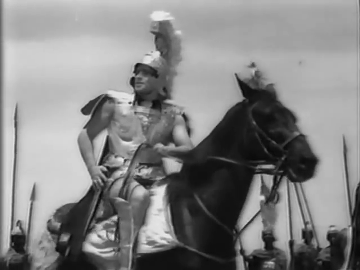
I remember my very first glimpse of a scene from Sikandar. It was years ago, probably sometime in the mid-80s, and in some Doordarshan programme or the other, a snippet appeared from Sikandar. All I recall is a closeup of Prithviraj Kapoor, dressed as an ancient Greek, plumes flowing from a gleaming helmet as he led his troops into battle. He looked startlingly like Shashi Kapoor, though with the build of Shammi. This film, I thought back then, I must see.

Prithviraj Kapoor in and as Sikandar

Continue reading

Rustom Sohrab (1963)

Who would’ve thought that the Ramsay Brothers’ first production was a historical worthy of a Sohrab Modi [granted, it does have two far-too-chubby leading men and its fair share of violence, but still; Rustom Sohrab is no horror film, not by a long shot]? But yes, Ramsay Productions—famous for its B grade horror films of the 80s and 90s—did make this rather surprising debut, a film based on the Persian epic poem Rostam and Sohrab (part of the famous Shahnameh).

Prithviraj Kapoor and Premnath in and as Rustom Sohrab. Continue reading

Ghazal (1964)

Those who frequent this blog have probably figured out by now that I have a soft spot (a very soft spot) for Muslim socials. So much so that I will watch just about any Muslim social out there, even if it features people who aren’t among my favourites. Even if it has a fairly regressive theme, and even if I end up not agreeing with half the things in the film. So, when I come across a Muslim social that stars some of my favourite actors (Sunil Dutt? Meena Kumari? Rehman? Prithviraj Kapoor? Rajendra Nath? Check, check, check), has lyrics by my favourite lyricist (Sahir Ludhianvi), and had its songs composed by one of my favourite music directors (Madan Mohan—and how appropriate, too, for a film called Ghazal to be scored by the Ghazalon ka Shahzaada): to not watch this would be a crime, I thought.

Meena Kumari and Sunil Dutt in Ghazal Continue reading

Yeh Raat Phir Na Aayegi (1966)

Poor Biswajeet must have gotten thoroughly sick of romancing spooky women in the ‘60s. True, in this one, the spookiness is rather more pronounced (Waheeda Rehman was pretty sunny and un-mysterious in Bees Saal Baad; everything else seemed steeped in mystery). But there is the inexplicability of everything around, dozens of very loud and pointed hints of someone haunting an area, and a song that’s sung again and again like a broken record.

Continue reading