Kundan (1955)

Some days ago, in this delightful post about chai in Hindi cinema, I came across a mention of Kundan. Aao hamaare hotal mein chai peeyoji garam-garam sounded so interesting that I bookmarked the film without even really checking to see what it was all about (though the cast, barring Nimmi—whom I often find very irritating—appealed to me). Then, just a couple of days later, Anu posted this wonderful tribute to Sohrab Modi, in which she listed Kundan as one of her favourite ten films directed by Modi. Adapted from Victor Hugo’s classic Les Miserables.

That sealed it. I had read Les Miserables a couple of years ago, and had been blown away by it: by the depth and width of it, the characterization, the sheer scope of it all. And now, it looked as if the universe was pushing me towards Kundan. I had to watch this one.

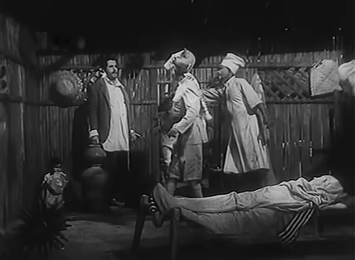
The story gets off to a flying start. Kundan (Sohrab Modi) is a very poor man who lives with his very ill sister and her little daughter Radha. Unable to earn [it’s not clear why, given that he looks able-bodied enough], a desperate Kundan finally steals a loaf of bread from a bakery and runs home to give it to Radha. Since he’s made no attempt to commit this theft in secrecy, the alarm has been raised and Kundan is arrested even as Radha is eating the loaf.
Continue reading

Yaadein (1964)

In its category for Fewest actors in a narrative film, the Guinness Book of World Records begins the list with this:

“Excluding monologues, the only narrative films with a single cast member have been Yaadein (India, 1964), written, directed and produced by Sunil Dutt (India), who was also its only actor….”

(Only two other films are listed in this category; one is the 2002 French-American production Lettre; the other is the 2004 Kannada film Shanthi).

I have known about Yaadein for a long time now; it was aired on Doordarshan when I was a child, and I remember my parents watching it. I wasn’t allowed, because this is one of those rare Hindi films from that era which had an A certificate. I do recall, though, my parents telling me that it was a unique film, with only Sunil Dutt in it.

Continue reading

Amrapali (1966)

Happy birthday, Vyjyanthimala! (it’s either her 90th birthday or her 87th today, it doesn’t seem very clear which, but anyway).

Among the recent books I’ve read is Advait Kottary’s Siddhartha: The Boy Who Became the Buddha, a fictionalized retelling of the story of the Buddha. While Siddhartha is the focal point of the narrative, several other important historical personages appear in the book, among them the nagarvadhu or courtesan of Vaishali, Amrapali. Amrapali is shown to have originally had a relationship with the ruler of Magadha, Bimbisara: so much so that she bears him a son, whom she is later compelled by circumstances to hand over to the Buddha to bring up. Bimbisara’s belligerent and headstrong son and heir, Ajatshatru, though he’s never seen ‘his father’s courtesan’ (as Kottary describes her), detests Amrapali.

… until he, injured in a way with Vaishali, impersonates a Lichhavi (native to Vaishali) soldier in order to escape with his life. Fate brings Ajatshatru and Amrapali together: she, thinking him to be Lichhavi, tends to his wounds and heals him, and they fall in love.

It’s been ages since I watched the Vyjyanthimala-Sunil Dutt Amrapali, and while I remembered some of the core elements, I’d forgotten much of it. As far as I remembered, the film had nothing whatsoever about Amrapali’s relationship with Bimbisara or her having a son with him. To be honest, I’d have been very surprised if that aspect of her life had been shown: it would have been far too bold for Hindi cinema, back then, to have a heroine who could have affairs with both father and son, and bear a child out of wedlock.

So I decided it was time to rewatch Amrapali, which begins in Magadha. Here, the king, Ajatshatru (Sunil Dutt), is in conference with his trusted advisor, friend, and Magadha’s commander-in-chief, Veer (Premnath). Ajatshatru is a hot-headed warmonger, and right now baying for the blood of the democratic Lichhavis, whose land, Vaishali, lies across the river to the north.

Continue reading

Sadhu aur Shaitan (1968)

Cinema looking at itself is not an uncommon feature; there have been several notable films, both in India (Kaagaz ke Phool, Sone ki Chidiya) as well as abroad (Cinema Paradiso, 8½, The Bad and the Beautiful, etc), which are about cinema and film-making. But this film, relatively obscure, really should be part of the annals, simply because of its sheer devotion to Hindi cinema. Not because it’s about film-making, not because there is even (as in Solvaan Saal), a single scene on the sets of a film. But because it celebrates Hindi cinema in so many ways, on so many levels.

Sadhu aur Shaitan begins by introducing us to the eponymous ‘sadhu’ of the story: Sadhuram (Om Prakash), a widower who lives with his two children Ganesh (Master Shahid) and Munni (Baby Fauzia), and the maid Ramdeyi (Dulari) who looks after home and the children. Sadhuram is a somewhat excessively ‘good and righteous’ man, the living image of piety (all a little over the top as far as I’m concerned, but at least he isn’t stuffy about his righteousness).

Continue reading

Aurat (1940)

In 1957, Mehboob Khan produced and directed a film that has achieved almost iconic status in the history of Indian cinema. Mother India was the first Indian film to receive a nomination for an Academy Award for Best Foreign Language Film, and won several Filmfare Awards, including Best Film and Best Actress.

Mother India is a fine example of the importance of perseverance. If you don’t get it right the first time, try again. Sometime along the way, somewhere and somehow, you will get to your goal. Also, if you did something well once, chances are you’ll do it better the next time round. Practice makes perfect.

I’m not talking about how Radha, the female lead character of Mother India (and of Aurat) manages to surmount all the obstacles in her path and emerge strong. I’m talking about Mehboob Khan himself, who was the director not just of Mother India, but of the film, Aurat, of which Mother India was a remake. Based on a story by Babubhai Mehta (and supposedly partly inspired too by Pearl S Buck’s The Good Earth) and with dialogue by Wajahat Mirza, Aurat was a film Mehboob Khan only directed. Seventeen years later, now a producer in his own right, he remade the film, both producing and directing it. And how well he proved that if you do something well the first time round, there’s a good chance you’ll do it well, and even better, the second time round.

Continue reading

Ek Phool Chaar Kaante (1960)

Sunil Dutt and Waheeda Rehman. The two names themselves conjure up a mix of everything from Pyaasa to Mother India, from Gumraah to Kaagaz ke Phool. Sunil Dutt, whom I tend to associate either with suspense films (Humraaz, Mera Saaya) or angst-ridden (or otherwise philosophical, socially relevant films like Railway Platform or Sujata. Okay, he did do Postbox No 999 and Padosan, but still… Waheeda, whose films with Guru Dutt did showcase her prowess as an actress, but which also tended to paint her as a ‘serious’ actress—although in her case, films like Solvaa Saal and 12 O’Clock showed that she could be as convincing in peppy and light-hearted roles as many of her contemporaries.

If that’s your impression of Dutt and Rehman—two actors who appeared in mostly grim films—this rom-com is worth seeing just for a different, fun, side to both of them.

Continue reading

Ek Hi Raasta (1956)

BR Chopra is one director for whom I have a lot of respect: he was one of the most versatile film makers of his time, a man whose films could not easily be dumped together into one broad category. Look at the difference between Waqt and Sadhna, for instance: one stylish and glamorous, the first big multi-starrer in Hindi cinema; the other a low-key yet impactful film with an unusual female lead. Or Humraaz, a sleek suspense thriller, and—on the other hand—Dharamputra, a commentary on secularism and bigotry and several related ills which still plague India.

Whether he was conveying a message, highlighting a social evil, or simply making an entertaining film, BR Chopra was in a class by himself. His films invariably had excellent production values; the music could always be counted upon to be topnotch (and the fact that he often commissioned Sahir Ludhianvi as lyricist meant that it wasn’t just the music that was superb, it was also the words of the songs—some of Sahir’s best songs are for BR Chopra’s films).

Which brings me to this film. Ek Hi Raasta was one of BR Chopra’s earlier films, and while it doesn’t have the impact of (say) Gumraah or Dhool ka Phool, it is still an interesting story.

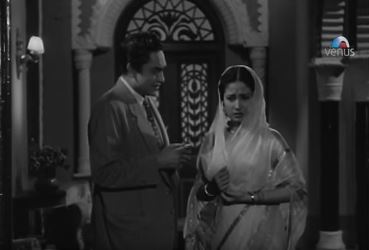
Meena Kumari and Ashok Kumar in Ek Hi Raasta

Continue reading

Nartakee (1963)

I remember watching Padosan as a child, and I remember my sister saying, “How could someone so handsome consent to be made up as someone like Bhola? And to act so silly?” I already liked Sunil Dutt a good deal, but that comment made me sit up and respect him a lot more than I already did. In a period when there was a very definite idea of what a ‘hero’ should be like (and the 60s was a decade where heroes tended to be more cookie-cutter than in the 50s), Sunil Dutt did roles that ranged from a man having an affair with another man’s wife (Gumraah), a dacoit (Mujhe Jeene Do), a buffoon (Padosan), a cuckold (Yeh Raaste Hain Pyaar Ke)… and in a slew of everything from suspense films (Mera Saaya, Humraaz) to family melodramas (Milan, Meherbaan, Khaandaan, etc).

Versatile, unafraid of experimenting—and a man, too, who seems to have worked in several films that focused on social reform. In Nartakee, for instance, where his character is that of a college lecturer, Nirmal, who comes in contact with a reluctant nautch girl who would much rather learn how to read and write than dance and sing for patrons.

Sunil Dutt and Nanda in Nartakee

Continue reading

Mera Saaya (1966)

Permit me one last Sadhana-related post before I put aside my unexpected (even to me) sadness at her untimely death. I know I’ve already been through two tribute posts, but even as I was writing those posts, I couldn’t help but think of the Sadhana films I haven’t reviewed on this blog (and there are several of them, including all the ones she made with Rajendra Kumar). When I think of Sadhana, I always think of her in Raj Khosla’s suspense films. Three of them, two opposite Manoj Kumar (Woh Kaun Thi? and Anita), and this one, opposite Sunil Dutt, with whom Sadhana also starred in Gaban and Waqt.

Sadhana in Mera Saaya

Continue reading

Ghazal (1964)

Those who frequent this blog have probably figured out by now that I have a soft spot (a very soft spot) for Muslim socials. So much so that I will watch just about any Muslim social out there, even if it features people who aren’t among my favourites. Even if it has a fairly regressive theme, and even if I end up not agreeing with half the things in the film. So, when I come across a Muslim social that stars some of my favourite actors (Sunil Dutt? Meena Kumari? Rehman? Prithviraj Kapoor? Rajendra Nath? Check, check, check), has lyrics by my favourite lyricist (Sahir Ludhianvi), and had its songs composed by one of my favourite music directors (Madan Mohan—and how appropriate, too, for a film called Ghazal to be scored by the Ghazalon ka Shahzaada): to not watch this would be a crime, I thought.

Meena Kumari and Sunil Dutt in Ghazal Continue reading